
BY:SpaceEyeNews.
Curiosity’s sulfur discovery began with an ordinary drive and an extraordinary glimpse inside a rock. On May 30, 2024, the rover rolled over a stone in Gediz Vallis channel. The rock fractured, exposing yellow crystals of elemental sulfur.
Scientists already knew that Mars contained sulfur within mineral compounds. Finding it in pure form introduced a different puzzle. Why had this material accumulated here?
The discovery now links a surprising surface deposit with questions about ancient subsurface chemistry. Its identity is clear. Its origin still requires explanation.
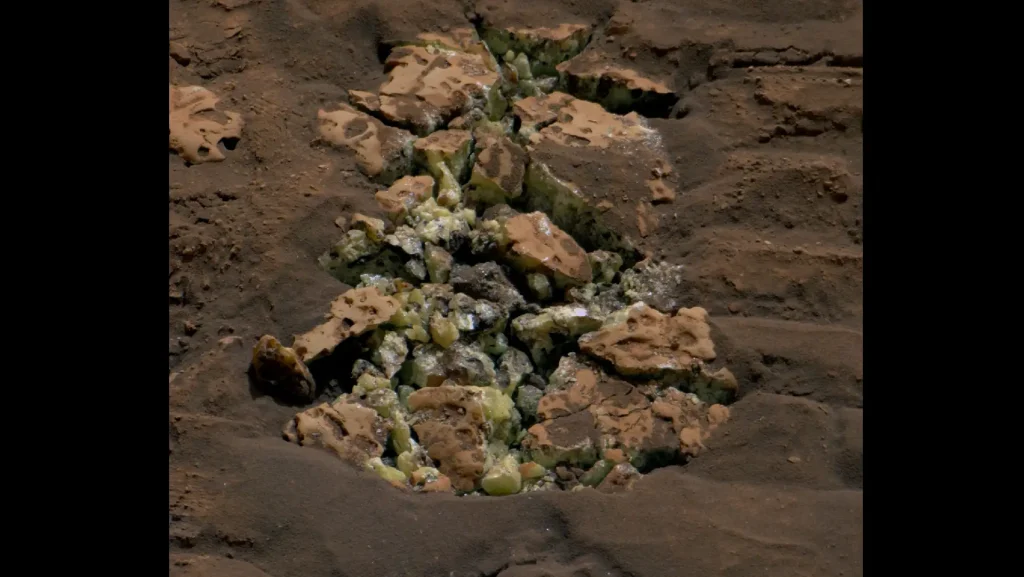
Yellow sulfur crystals exposed inside a Martian rock fractured by NASA’s Curiosity rover.Image credit: NASA/JPL-Caltech/MSSS.Source: NASA’s original discovery announcement.
A Broken Rock Reveals Unexpected Chemistry
Curiosity encountered the crystals while exploring terrain rich in sulfate minerals. These compounds contain sulfur chemically bound to other elements, including oxygen.
Elemental sulfur tells a different chemical story. The distinction matters because different minerals preserve evidence of different formation conditions.
NASA announced the discovery in July 2024. The rover’s instruments established the sulfur identification, rather than relying solely on the crystals’ yellow appearance.
That timing matters when reading newer coverage. A recent publication date does not make the original discovery a new event. Instead, subsequent research develops the explanation around observations that Curiosity collected earlier.
The central question therefore reaches beyond what the rover found. Scientists must determine which sequence of chemical and geological events could produce the material in this particular setting.
Curiosity’s Sulfur Discovery Extends Beyond One Stone
A field covering roughly 2,100 square meters
A mission review describes approximately 2,100 square meters of unusually bright fragments in Gediz Vallis. Measurements from APXS and ChemCam identified native sulfur within these stones.
This figure describes the deposit’s mapped extent. It does not mean a continuous sulfur slab covers every square meter.
The distinction helps explain the scientific challenge. Researchers must account for the distribution of individual fragments, their surroundings, and their relationship with older deposits.
Fragile stones provide a clue
The fragments’ brittle nature also matters. Together with their geological context, that fragility suggests local formation or only limited movement.
However, this remains an interpretation. Fragility alone cannot reconstruct the complete journey of every stone.
The useful question becomes more specific: did sulfur accumulate within this depression, or did nearby material move a short distance afterward? Either possibility demands a geological explanation that fits both composition and location.
Could Volcanic Gases Explain the Sulfur?
A proposed journey from depth to the surface
Research published in Science proposes a source beneath the visible landscape: sulfur supplied by magmatic vapor.
In this scenario, gases originating from magma rose and cooled within the shallow frozen subsurface. Later erosion of Gediz Vallis reduced pressure, allowing the stored material to escape.
The proposed sequence connects deep processes with changes at the surface. It also gives erosion a potentially active chemical role. Removing overlying material could help release substances previously confined underground.
That is more precise than saying a nearby volcano simply deposited sulfur across the channel.
A hypothesis still needs supporting evidence
The researchers present magmatic vapor as a proposed origin, not a directly observed event.
A convincing explanation must satisfy several requirements simultaneously. It must supply enough sulfur, explain its concentration, and fit the surrounding geology. It must also account for why the material survives in its observed form.
These requirements make the idea testable. A plausible story alone cannot establish which process actually occurred.
Crucially, a proposed deep gas source does not demonstrate a volcano or hot spring at the discovery site. The distinction keeps the interpretation aligned with the evidence.
The deposit also shows why location matters when interpreting planetary chemistry. Detecting sulfur somewhere on Mars would leave a broad range of possibilities. Finding a concentrated field within a particular channel narrows the problem. Researchers can compare the proposed mechanism with the channel’s shape, nearby debris, and the position of the stones. Each comparison can strengthen an explanation or expose a weakness. The goal is not simply to find a process that makes sulfur. It is to identify a process that makes sulfur under conditions consistent with this specific place.
Ancient Water Complicates the Sulfur Timeline
Gediz Vallis preserves more than one kind of landscape change. NASA describes evidence for rivers, wet debris flows, and dry avalanches.
Pinnacle Ridge, a prominent debris mound, forms part of that investigation. Scientists use such features to reconstruct the order of events across the channel.
The broader picture challenges a simple progression from wet conditions to permanent dryness. Water occasionally moved through this area during the region’s transition toward a drier climate.
Nevertheless, evidence for flowing water does not automatically explain the sulfur.
Shared surroundings do not prove a shared origin
Two features can occupy the same landscape while recording different episodes. A water flow might predate a chemical deposit, reshape it, or follow its formation.
Determining that order matters as much as identifying the materials themselves. Without a reliable sequence, scientists cannot confidently connect the channel’s water history with the sulfur’s origin.
The landscape therefore supplies essential context, rather than a ready answer.
What Curiosity Confirmed—and What Remains Unknown
Drilling limits did not prevent identification
The sulfur stones proved too small and brittle for Curiosity’s drill. Instead, the team selected a nearby rock named Mammoth Lakes for sampling in June 2024.
That limitation concerns sample collection. It does not undo the instrument measurements that identified elemental sulfur.
Laboratories on Earth could offer additional analytical capabilities if suitable samples ever reached them. However, scientists do not need an Earth laboratory to establish every mineral discovery on another planet.
The important distinction separates identifying a substance from reconstructing its complete formation history.
Sulfur is not evidence of life
Sulfur plays essential roles in terrestrial biology. Its presence nevertheless cannot demonstrate that organisms once lived at this location.
A biological interpretation would require additional evidence that distinguishes biological activity from nonbiological chemistry. The yellow crystals alone cannot provide that distinction.
Curiosity left the sulfur field in 2024 after collecting observations. Analysis can continue long after a rover moves onward, as researchers compare measurements and test explanations.
Curiosity’s Sulfur Discovery Leaves a Deeper Question
Curiosity’s sulfur discovery turned an accidental rock fracture into a focused investigation of Martian chemistry. The rover established the material’s identity and documented its surroundings. Researchers now face the harder task of explaining its formation.
The strongest scientific value lies in that challenge. Any successful explanation must connect the sulfur with its physical setting and geological history.
For now, the deposit offers a clear discovery alongside an open question. Mars contained the conditions needed to concentrate elemental sulfur here. Understanding those conditions could reveal processes that the surrounding landscape only partly records.
Main sources:
NASA — NASA’s Curiosity Rover Discovers a Surprise in a Martian Rock:
https://www.nasa.gov/missions/mars-science-laboratory/curiosity-rover/nasas-curiosity-rover-discovers-a-surprise-in-a-martian-rock/
NASA/JPL — NASA’s Curiosity Mars Rover Takes a Last Look at Mysterious Sulfur:
https://www.jpl.nasa.gov/news/nasas-curiosity-mars-rover-takes-a-last-look-at-mysterious-sulfur/
Space Science Reviews — Scientific Highlights and Status of the Mars Science Laboratory Mission, Years 9 Through 12:
https://link.springer.com/article/10.1007/s11214-026-01321-7
Science — A native sulfur deposit in Gale crater, Mars (publication record):
https://pure.psu.edu/en/publications/a-native-sulfur-deposit-in-gale-crater-mars/
You Might Also Like:
Long-lasting habitability on Mars: Curiosity rover’s most important discovery yet.
Mars Organic Molecules Discovery: Curiosity Finds Building Blocks of Life