
BY:SpaceEyeNews.
The Bao stellar merger began with a change so gradual that it took years to recognize. On the outskirts of the Andromeda galaxy, a point of light had started to brighten. By October 2025, astronomers were watching when it erupted. Its brightness climbed to a peak within a week. Yet the earlier, quieter years held a clue to something no telescope could see directly. A small star appeared to be orbiting inside a giant, and each circuit brought it closer to the core.
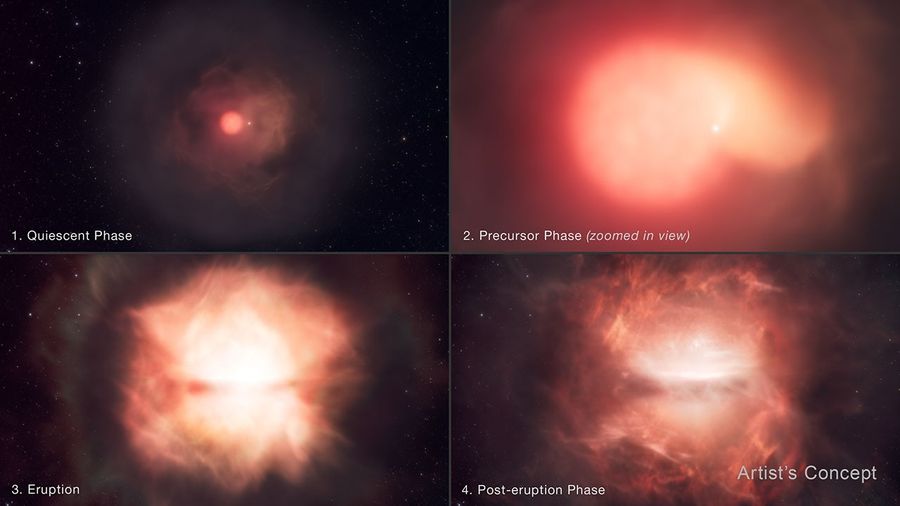
Top to bottom, left to right: In this artist’s concept, the stars are surrounded by a dust shell pre-merger; the stars brightened and the companion star’s orbit began to slow as the larger star engulfed it; the eruption occurred; dust freely expands at the poles after the merger.
Illustration: NASA, ESA, CSA, STScI, Leah Hustak (STScI); Science: Viraj Karambelkar (Columbia)
How astronomers spotted Bao before the eruption
In February 2023, astronomers noticed an unusual source in infrared records from NASA’s NEOWISE mission. Earlier observations gave them a baseline. Before 2018, the system had maintained a fairly steady luminosity. Somewhere around that year, its long rise began. The discovery gave observers a rare advantage. They had time to arrange follow-up observations while the two stars were still interacting.
By September 2024, the WINTER infrared telescope had picked up signs of dust as the system brightened. The following July, NASA’s SPHEREx mission caught a curious change. Bao grew fainter in visible light even as its infrared glow intensified. Dust offered a way to reconcile those signals. Grains surrounding a star can absorb its light and radiate that energy at longer wavelengths.
On October 17, 2025, the Zwicky Transient Facility detected the eruption. The system heated up rapidly. Observations from the Swift space observatory and the Gemini North telescope followed in November, giving researchers a record across several wavelengths. They could now compare the sudden outburst with years of much slower change in the same object, formally designated AT 2025abao.
Inside the Bao stellar merger
Before the eruption, the larger star had about seven times the Sun’s mass, according to the team’s reconstruction. Its radius was roughly 350 times the Sun’s, and it shone about 18,000 times as brightly. That glare concealed the companion so effectively that astronomers had to estimate its mass from models of the pair. Their best fit put the smaller star at about seven-tenths of the Sun’s mass.
The giant’s enormous radius helps explain how the two could interact while their cores were still far apart. As the companion encountered the giant’s outer gas, both stars came to share one atmosphere. Astronomers call this a common envelope. The companion still followed an orbit, but now it had to move through gas. Drag transferred some of its orbital energy to the surrounding material, and its orbit tightened.
That transfer offers an explanation for the early light from Bao. Friction supplied energy that the system could radiate while the smaller star spiraled inward. The team estimates that the descent took about seven orbits over seven years. Astronomers inferred that count from the system’s changing light and their models. At Andromeda’s distance, the two stars appeared as a single source throughout the event.
What Webb saw 47 days after peak brightness
On December 24, 2025, the James Webb Space Telescope observed Bao, just 47 days after peak brightness. Webb caught the system early enough to examine the infrared glow of the material surrounding it. Some of that dust traced gas the giant had shed over centuries. It preserved a record of the star’s earlier life alongside evidence of its recent upheaval.
Researchers compared Webb’s mid-infrared measurements with simulations of the system. A plausible model had to account for the giant that produced the older dust. It also had to explain the slow rise before the eruption and the much faster release of energy at the end. In the team’s favored reconstruction, the companion reached the giant’s core. The energy from that final encounter sent part of the outer envelope into space.
The earlier observations also helped resolve a question the models alone left open. Given the estimated masses, the companion might have released enough energy to clear a path out of the envelope. To distinguish between outcomes, the team needed to know what actually escaped. The material moving away from Bao provided a record of where some of that orbital energy went.
How much of the giant escaped?
The researchers estimate that the eruption expelled between 0.1 and 0.2 times the mass of the Sun. That amounts to about a tenth of the giant’s envelope. The distinction matters here. The envelope contains the extended gas around the core, and the estimate refers specifically to the share of that gas that escaped.
Knowing how much material got away allowed the team to tackle a longstanding question about close stellar pairs. When an orbit shrinks inside a shared envelope, how much of the released energy can help lift gas free of the giant’s gravity? Astronomers often study systems long after that exchange ends. With Bao, they had observations from the gradual descent as well as the eruption and its aftermath.
The researchers could compare the energy needed to free that material with the energy the companion gave up during its descent. They put the fraction of released orbital energy available to free gas at roughly 1% to 40%. That wide range still gives astronomers an observational test for a quantity their models often have to assume. It also bears on the fate of other pairs. If the stars shed their shared envelope in time, both can survive in a close orbit. If gas continues to slow the companion, its path can carry it all the way to the core.
What did the Bao stellar merger leave behind?
The evidence favors a single star where two once orbited. NASA describes Bao as potentially rejuvenated, though astronomers still need to see how the remnant settles. The journal Nature also notes that future observations could establish the final outcome more firmly. For now, the most revealing part of the Bao stellar merger lies in the years leading up to the flash. By recognizing the early brightening and continuing to watch, astronomers traced a hidden orbit through the light it helped produce.
Main sources:
NASA and the Space Telescope Science Institute — https://science.nasa.gov/missions/webb/nasa-data-clinches-first-of-its-kind-stellar-merger/
Nature, original research — https://www.nature.com/articles/s41586-026-11221-z
Nature Portfolio, research summary — https://www.natureasia.com/en/info/press-releases/detail/9486