
BY:SpaceEyeNews.
The cameras on Perseverance have stopped taking pictures, yet NASA can still hear from the rover. High above it, Mars Odyssey can still turn toward the Sun, though each adjustment now draws on a limited fuel supply. Perseverance and Mars Odyssey paused science for separate reasons, NASA explained on November 19. What connects their stories is the journey of a picture from Mars. The rover needs a working radio to send it. An orbiter needs precise control to receive data and pass them along to Earth.
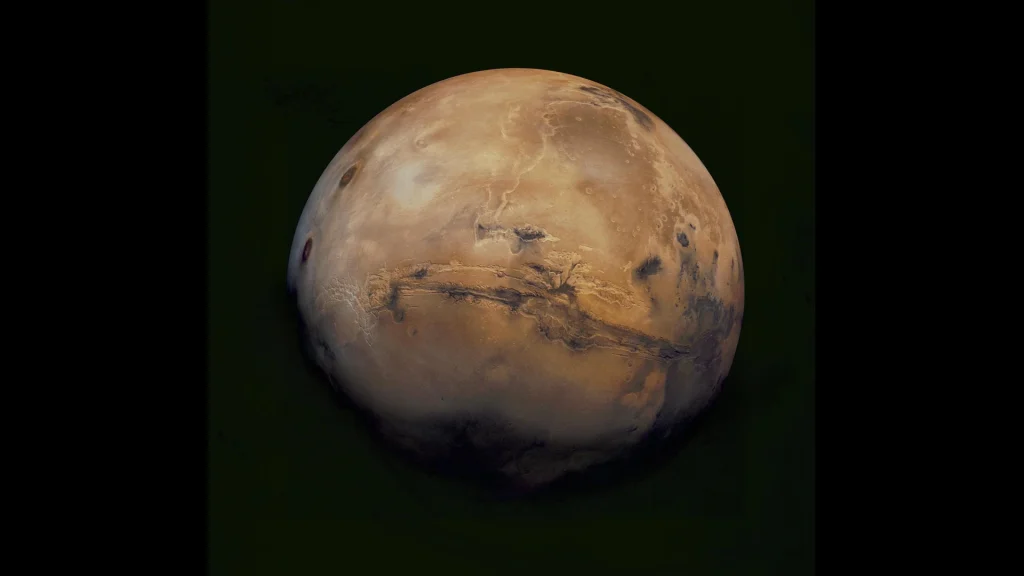
NASA featured this Viking 1 mosaic in its November 19 update on Perseverance and Mars Odyssey. Image. credit: NASA/JPL-Caltech.
The 100 seconds that interrupted Perseverance
On October 30, Perseverance switched on its primary relay radio for the day’s work. Its onboard computer expected a steady series of electronic signals from the radio. Each signal normally resets a counter, giving the computer a simple way to tell whether the radio is responding. This time, the counter kept climbing.
After 25 missed signals, roughly 100 seconds had passed. The rover shut off the primary radio, switched to its backup and entered safe mode. Those missing signals had only a short distance to travel. Both ends of the exchange sat inside Perseverance, and its computer could act without waiting for instructions from Earth.
Once engineers brought Perseverance out of safe mode, they found a different symptom in the backup. It could transmit, but its power output reached only about half the expected level. That measurement describes the strength of the transmission. It tells engineers little by itself about what interrupted the primary radio. The team set both radios aside while it investigated.
Why the rover’s cameras went quiet
Under normal conditions, a picture from Perseverance makes its first trip on a relatively short radio link. An orbiter passing overhead picks up the data, then uses its own communications equipment to send them much farther. That arrangement lets a rover with limited power return detailed views of the Martian surface.
Perseverance also has a high-gain antenna that can reach NASA’s Deep Space Network directly using X-band radio. Engineers can still ask how the rover is doing and receive an answer. However, this route carries much less information. Every engineering reading and every new image would compete for space on the same slow connection.
For people who follow the rover’s public gallery, that choice has a visible consequence. The cameras have stopped collecting new images during the pause. Meanwhile, engineers at NASA’s Jet Propulsion Laboratory are examining the backup radio first. They want to establish whether it can safely resume relay work before turning their attention back to the primary unit.
Mars Odyssey has two working wheels and needs three
Odyssey’s problem became apparent during a separate spell in safe mode from November 4 to 6. Engineers traced it to a reaction wheel that had stopped spinning. Odyssey uses these wheels to turn its body, whether it needs to aim an instrument at Mars or angle its solar arrays toward sunlight.
The orbiter carried four wheels when it left Earth in 2001. Normally, three handle pointing. That extra wheel has already earned its place in the mission’s history. In 2012, when one wheel began sticking, controllers brought the spare into service after 11 years in storage. Odyssey resumed observing Mars and relaying rover data. This time, only two wheels remain available for the job.
Why the fuel estimate matters
Hydrazine thrusters can take over pointing, but they draw from a supply Odyssey has carried for 25 years. Engineers estimate that the remaining fuel could support one to two months of pointing with thrusters alone. Recovering the stalled wheel would change how quickly Odyssey uses that reserve.
Even estimating the reserve takes ingenuity. Odyssey has no fuel gauge. In earlier assessments, engineers warmed its propellant tanks and measured how long the contents took to heat up. A tank holding more liquid warms more slowly. The team was still refining its fuel estimate when NASA issued the November update.
Perseverance and Mars Odyssey in the relay network
Odyssey has carried some memorable pictures home. When Curiosity landed in 2012, Odyssey relayed its first views from the surface. The orbiter also pursues science of its own. Its maps helped researchers identify buried ice and evaluate terrain that future missions might explore. The current pause affects both kinds of work.
Other spacecraft share the relay schedule. Between February and May 2026, Europe’s Trace Gas Orbiter relayed more than two billion bits per day on average. NASA’s Mars Reconnaissance Orbiter averaged about 851 million. Those figures cover traffic from surface missions across the network and show how much data an orbital connection can carry.
The timing of each pass matters as much as the choice of orbiter. Teams can predict when a spacecraft will rise above a rover’s horizon and arrange a radio session for that window. Once the data reach Earth, scientists use them to choose the next observations and plan the rover’s work.
The network has already absorbed one recent loss. NASA ended the MAVEN mission in June 2026 after losing contact the previous December. Other orbiters picked up its relay work. Perseverance faces a different constraint today. Even when a healthy orbiter passes directly overhead, the rover still needs a working relay radio to take advantage of that pass.
When could science resume?
One test gave Odyssey’s engineers reason to keep trying. When they sent a command to the stalled wheel, it moved. Further tests must establish whether it can keep doing useful work. On the surface, the next sign of progress would be a radio that engineers trust to carry Perseverance’s data again.
NASA set separate goals for Perseverance and Mars Odyssey. In its November 19 update, the agency hoped the rover could resume science by month’s end. Odyssey’s team aimed to restore observations and relay service during the last week of November. Those goals depended on what the hardware did next. For readers watching from Earth, a fresh photograph in Perseverance’s gallery would mark a particularly welcome step.
Main sources:
NASA Science — Mission status update, November 19, 2026
https://science.nasa.gov/blogs/mars/2026/11/19/nasas-perseverance-odyssey-teams-investigate-technical-issues/
NASA Science — Mars Relay Network
https://science.nasa.gov/mars/mars-relay-network/
NASA JPL — Odyssey’s earlier spare-wheel recovery
https://www.jpl.nasa.gov/news/longest-lived-mars-orbiter-is-back-in-service/
NASA JPL — How engineers estimate Odyssey’s fuel supply
https://www.jpl.nasa.gov/news/engineers-keep-an-eye-on-fuel-supply-of-nasas-oldest-mars-orbiter/
You Might Also Like:
MAVEN Mars Mission Ends After 11 Years of Transforming Our Understanding of Mars
Psyche Mars Flyby Prepares NASA for Historic Asteroid Mission
NASA lost contact with MAVEN: What the Silent Mars Orbiter Really Means-Video