
BY:SpaceEyeNews.
Could astronomers rebuild the M87 black hole image without telling their software to look for its famous ring? A team at CSIRO, Australia’s national science agency, tried exactly that. The researchers chose their method before inspecting the result. When they fed it radio signals from the Event Horizon Telescope, a bright ring emerged around a dark center. Its diameter held up across observations spanning four years. Differences emerged along the rim.
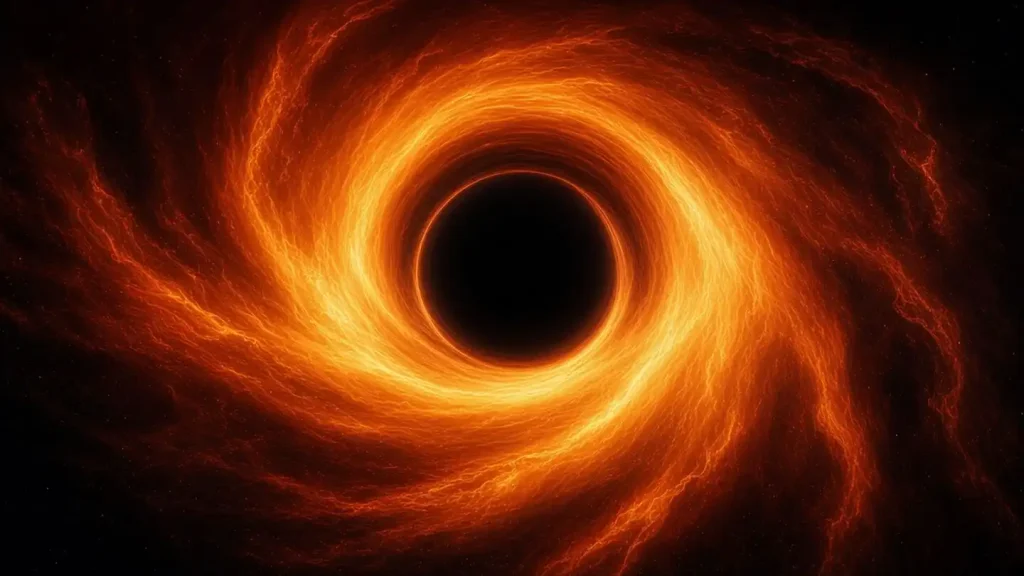
Why revisit the M87 black hole image?
In April 2019, the Event Horizon Telescope unveiled the first image of a black hole. The collaboration had collected the signals two years earlier from M87*, some 55 million light-years away. Four imaging teams worked independently within the collaboration. Each recovered a ring, although their pictures differed in how they distributed the light around its rim.
The difficulty lies in what reaches Earth. Each pair of radio telescopes picks up information about features of a particular size and orientation on the sky. Widely spaced stations can resolve remarkably fine detail. Yet even a network that spans continents leaves gaps. More than one picture can fit the signals that the telescopes actually record.
Those gaps mattered when another analysis challenged the ring itself. Astronomers now had a specific disagreement they could investigate. Would the same outline emerge if researchers combined the signals differently and gave the software freedom to recover other shapes? In November 2026, Samuel Lai and his colleagues published their answer in Nature.
Testing the black hole ring
The team began with a problem much closer to home. The atmosphere above each observatory can disturb an incoming radio signal. Instruments at individual stations can also introduce errors. Normally, astronomers estimate those effects and correct for them. An imperfect correction can influence the picture they eventually reconstruct.
Lai’s team combined measurements around closed loops of telescopes. In these combinations, certain errors from individual stations cancel out. Astronomers call the resulting quantities closure invariants. They preserve information about the source’s structure even when the precise correction for a particular telescope remains uncertain.
Training on cats and cars
The researchers built a machine-learning tool called GenDIReCT to find images compatible with those measurements. Its training included ordinary pictures of cats, dogs, and cars. That choice served a practical purpose. The researchers wanted a tool capable of recovering many shapes without imposing a black hole template on the data.
Before turning to M87*, the team checked whether the tool could recover sources with other outlines. One test used real observations of Centaurus A, another radio galaxy. Only after those checks did the researchers fix their procedure and apply it to M87*. That sequence matters when the expected result is already familiar to everyone running the experiment.
One ring across eight dates
The team examined four dates in April 2017, two in April 2018, and two in April 2021. Across those observations, the dark center and surrounding emission ring reappeared. The researchers measured a ring diameter of 42.2 microarcseconds, with an uncertainty of 1.5 microarcseconds. The original EHT analysis had put it at about 42 microarcseconds.
The later observations offered a particularly useful check. In 2018, the Greenland Telescope joined the array, adding new telescope pairings. The expanded network sampled details that the earlier configuration had missed. If gaps in the original coverage had created the ring, changing that coverage gave astronomers a chance to spot the problem.
The measured diameter describes the angle the ring spans in our sky. It gives the two teams something more precise to compare than a resemblance between pictures. The researchers also checked their result with a separate method based on traditional statistics. It recovered the ring from the same combinations of telescope signals.
A moving bright patch
Look closely at the reconstructions, however, and differences emerge. The methods agree more closely on the ring’s diameter than on its width or the brightness at individual points along its rim. Measuring the distance across the whole ring is easier than deciding exactly where a bright patch begins or ends.
Some changes also have a physical explanation. In an earlier comparison, the EHT collaboration tracked the brightest region from 2017 to 2018. It shifted about 30 degrees counterclockwise while the ring kept roughly the same diameter. Turbulence in the orbiting gas can account for that shift. A bright patch can move even as the shadow retains its familiar scale.
M87’s shadow and Einstein’s theory
General relativity connects the black hole’s mass to the apparent scale of its shadow. Near M87*, gravity bends the paths of light from the surrounding hot gas. Some paths lead into the black hole, leaving a darker region against the glow. That bending also helps explain why the shadow looks larger than the event horizon itself.
For astronomers testing Einstein’s theory, the useful comparison starts with the distance to M87* and the angle the ring spans. Using the standard relationship between ring size and mass, the new measurement corresponds to roughly 6.5 billion solar masses. That agrees with the EHT estimate. The independent analysis therefore strengthens the observational basis for testing gravity in this extreme environment.
There is also a prediction astronomers can revisit over time. At its current feeding rate, M87* gains too little mass in a few years to appreciably enlarge its shadow. A stable diameter is therefore what astronomers expect, even when images from successive years look different at first glance.
What changes around M87*?
The next time you see the M87 black hole image, look first at the distance across its dark center. Then follow the light around the rim. The first feature has held remarkably steady across different years and imaging methods. The second gives astronomers a way to study gas in motion, provided they account for uncertainty in those finer details. Seven years after the image appeared, researchers have a better idea of which parts they can measure reliably and where the most interesting changes may lie.
Main Sources
Nature — Independent interferometric observable confirms black hole shadow in M87*
https://doi.org/10.1038/s41586-026-11241-9
CSIRO — Is this iconic black hole image accurate? New study delivers an independent result
https://www.csiro.au/en/news/All/Articles/2026/November/Blackhole-Conversation
Event Horizon Telescope — Astronomers Capture First Image of a Black Hole
https://eventhorizontelescope.org/press-release-april-10-2019-astronomers-capture-first-image-black-hole
Event Horizon Telescope — M87* One Year Later: Proof of a Persistent Black Hole Shadow
https://eventhorizontelescope.org/M87-one-year-later-proof-of-a-persistent-black-hole-shadow
You Might Also Like:
M87 Black Hole Radiation Map Reveals Plasma Secrets
M87 Black Hole Jet Revealed in Sharpest X-Ray View
GRB 220706A: The Mystery of Its 27-Day Activity