
BY:SpaceEyeNews.
Ask how much time passed on a journey and you expect one answer. But what answer should a clock give when its own motion combines several quantum possibilities? A proposed test of quantum time dilation gives physicists somewhere to look. They would hold one atom in a trap and watch what happens to its ticks over one second. The telltale sign would be a slight fading of the pattern they use to read the clock.
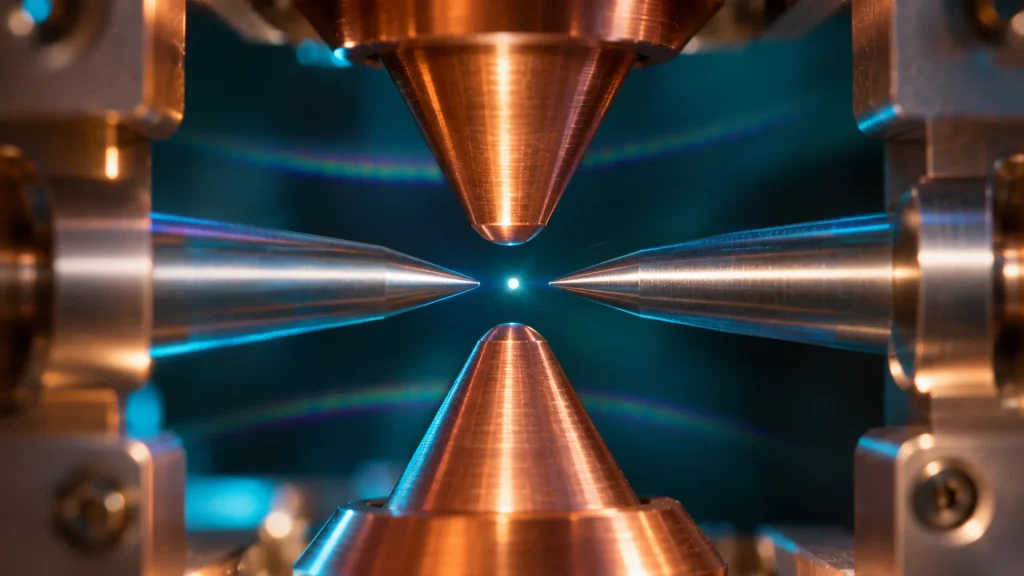
Quantum Time Dilation — Testing Time With a Single Trapped Ion
One clock, several elapsed times?
Give two clocks different journeys and they can disagree when they meet again. Each records its own proper time, the amount of time that passes along its path. Physicists can measure that difference even when it amounts to a tiny fraction of a tick. In an optical clock, they can detect it through a shift in the frequency of light that the atom absorbs.
Now consider a clock whose motion has no single, definite speed. Physicists can still use its average motion to predict a shift in its ticking rate. Yet an average can hide important differences. For a quantum clock, a similar puzzle arises. Does the average capture everything a physicist can learn by reading the atom?
How one ion could reveal quantum time dilation
The proposed experiment takes place inside a trap that holds a single electrically charged atom, or ion. The trap keeps the ion in one place on the laboratory bench while allowing it to oscillate. Inside the ion, two energy states provide the clock. A laser pulse prepares a combination of those states, and their relative phase advances like a clock hand.
The ion can occupy a combination of different motional energies while that clock hand turns. Each contribution to the motion corresponds to a slightly different amount of elapsed time. Consequently, the hand accumulates a slightly different angle for each contribution. The researchers can leave the apparatus on the same bench and change the question it answers simply by preparing the ion’s motion differently.
As the clock runs, its ticking and motion become entangled in the team’s model. Some information about elapsed time then resides in the relationship between the two. That prediction has a surprising consequence for someone who reads only the clock.
Reading the evidence
A single reading gives a simple result. After a second laser pulse, researchers check which internal energy state the ion occupies. They repeat the measurement many times, varying the phase of the final pulse. Plotting the results produces a pattern of peaks and troughs. At a peak, the ion frequently ends up in one state. At a trough, that outcome becomes less likely.
Two features of that pattern carry different information. Where a peak falls tells researchers how far the clock phase advanced. How far the peak stands above the trough tells them the contrast. When the different contributions to the clock signal line up closely, the pattern stands out clearly. As their phases spread apart, the peaks flatten and the troughs fill in.
Picture two plots with peaks in exactly the same places. In one, the probability of finding the ion in a given state swings widely. In the other, that probability changes little from peak to trough. Reading off the peak positions alone, however, would give the same estimate of elapsed time in both cases. Comparing their heights reveals something the average missed. The team calculated how large that difference should become as the ion’s possible motions accumulate different phases.
Why squeezing the ion’s motion helps
Ordinarily, the predicted fading would be difficult to pick out. To make it more pronounced, the researchers propose preparing the motion in a squeezed state. Squeezing redistributes quantum uncertainty between two aspects of an oscillation, such as position and momentum. Narrowing the spread in one widens it in the other. That preparation changes the range of motional energies that contribute to the clock signal.
Kyushu University estimates that controlling the motion this way could make the clock 100 to 1,000 times more sensitive to the effect. What would that gain look like to someone running the experiment? The team worked through an example using an ion familiar to researchers who build precision clocks.
What one second could reveal
Consider an single aluminum ion in a trap with an oscillation frequency of 20 megahertz. The authors allow the clock to evolve for about one second and assume a squeezing strength previously achieved in an ion trap. Under those conditions, their calculation gives a contrast of roughly 93 percent, down from full contrast. A seven percent drop gives experimentalists a specific target. Achieving it requires the clock and its motion to preserve their quantum states well enough throughout that second.
Ruling out noise
A laboratory clock can lose contrast for ordinary reasons, too. Fluctuations in the laser phase, for example, can blur a pattern built up across many readings. A convincing experiment would need to establish how much contrast the apparatus loses on its own. Researchers could then vary the squeezing or the waiting time and see whether the extra fading follows the predicted curve.
The authors also identify a more direct check. In principle, researchers could measure the internal clock and the motion together to look for entanglement. That would let them examine the relationship responsible for the fading. The original proposal appeared in Physical Review Letters on April 20, 2026. ScienceDaily revisited it on November 21, while experimental verification remained an open challenge.
A stranger side of time
The promise of quantum time dilation is that a question about time itself has become a measurement someone can attempt. Researchers know which atom they could use, how long to let it tick and where to look for the difference. If the predicted pattern appears, physicists could trace it back to the different motions available to a single atom. One second on the laboratory clock could then reveal a spread of elapsed times inside the trap.
Main sources
Physical Review Letters, original paper — https://doi.org/10.1103/qhj9-pc2b
National Institute of Standards and Technology, full study and calculations — https://tf.nist.gov/general/pdf/3350.pdf
Kyushu University, research announcement — https://www.kyushu-u.ac.jp/en/researches/view/391
ScienceDaily, November coverage — https://www.sciencedaily.com/releases/2026/11/261120075558.htm
You Might Also Like:
Leap Seconds Are Ending: Why Global Time Changes in 2027
Time Travel to the Future: What Tyson Really Means
Time Travel to the Past Faces a New Mathematical Barrier