
BY:SpaceEyeNews.
Alien life detection could gain a new tool small enough for future spacecraft: an electrical sensor that reads individual molecules. Researchers at the University of Osaka have combined nanoscale gold electrodes with artificial intelligence to distinguish mirror-image forms of amino acids.
The advance targets a difficult question in space exploration. Finding organic material is one thing. Understanding whether biology helped produce it requires stronger evidence.
Published in Nature Communications on October 5, 2026, the research demonstrates a promising laboratory technique. Its potential lies in measuring molecular patterns that could help scientists investigate life beyond Earth.
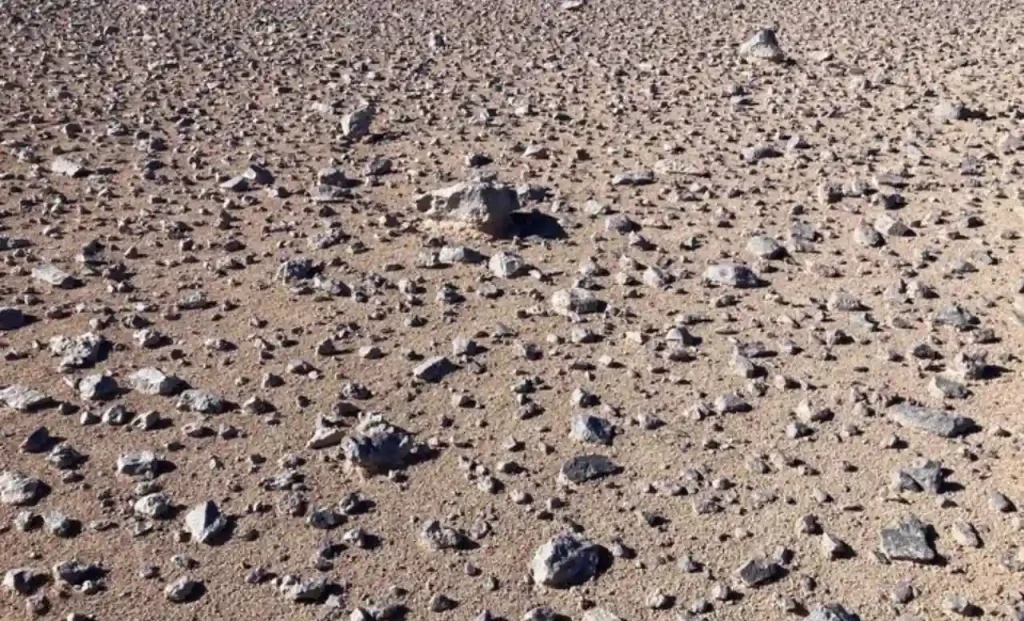
Alien Life Detection: Testing the Search in Desert Soil.
Why Molecular Handedness Matters for Alien Life Detection
Many amino acids occur in two mirror-image forms, known as L and D. Earth’s proteins overwhelmingly favor the L-form. That preference gives researchers a reason to examine the balance between these forms in extraterrestrial samples.
Nonbiological chemistry often produces roughly equal amounts of both. Therefore, a strong imbalance can raise interesting questions about a sample’s history.
However, molecular handedness is a potential biosignature, not a verdict. Some nonbiological processes can also generate an imbalance. Scientists must consider contamination and other chemical evidence before connecting any unusual ratio to life.
The challenge is measuring those ratios when a sample contains very little organic material. Minerals, salts, and unrelated compounds can further complicate the analysis.
How the Gold Nanogap Sensor Works
The Osaka team uses an extremely narrow gap between two gold electrodes. Individual molecules interact with this gap and influence the electrical current flowing through it.
Turning Molecular Encounters Into Signals
At this scale, electrons can cross the gap through quantum tunneling. A molecule’s interaction with the electrodes changes that current, producing a brief waveform.
Researchers record these electrical events instead of relying on a large collection of molecules to produce one combined measurement. Each event provides information that software can examine.
The goal goes beyond detecting that something passed through the sensor. Scientists want to identify the molecule and determine which mirror-image form it represents.
Where Artificial Intelligence Helps
L- and D-amino acids contain the same atoms and share the same connections. Their different spatial arrangements make them difficult to distinguish.
AI helps recognize subtle differences across the recorded waveforms. By classifying many molecular events, the system can estimate the relative amounts of the two forms.
This pairing of electrical measurements and pattern recognition forms the core of the new approach.
Counting many events is important because individual classifications can be imperfect. The useful result is a carefully assessed pattern across the sample. Researchers must understand measurement errors before interpreting that pattern as a meaningful chemical imbalance.
What the Experiments Actually Showed
The researchers reported more than 80% accuracy when distinguishing between mirror-image amino-acid forms. That result concerns molecular classification under experimental conditions.
It does not mean the sensor has an 80% chance of finding extraterrestrial life. Nor does it establish the same performance for every possible sample.
Moving Beyond Purified Chemicals
To explore more realistic conditions, the team analyzed extracts from the Murchison meteorite and Chile’s Atacama Desert soil.
These materials offer a harder test than purified amino acids. Natural samples contain mixtures that can produce overlapping signals or interfere with measurements.
The technique captured major features of amino-acid composition that conventional laboratory analysis also detected. This supports its potential usefulness with material relevant to astrobiology.
Still, the study identifies challenges involving background signals and molecules present in small quantities. Recovering broad compositional patterns does not mean every compound or ratio matches conventional results.
That distinction matters because future instruments must handle unfamiliar samples, not simply recognize chemicals already known to researchers.
Why Future Spacecraft Could Benefit
Space missions face strict limits on instrument mass, size, and power. Every additional component also creates engineering demands.
An electrical sensing approach could simplify parts of the detection system. It avoids the need for optical measurements at the sensing stage and could support smaller instruments.
A Route Toward Compact Sample Analysis
The technique also avoids chiral recognition molecules for distinguishing the two forms. Reducing specialized detection chemistry could make future instrument designs less complicated.
However, a tiny sensing gap is only one component of a complete instrument. A spacecraft would still need equipment to collect material, prepare samples, control measurements, and process results.
The experiments analyzed extracts. They did not demonstrate a spacecraft directly testing untouched planetary soil.
Possible future applications include samples from Mars, asteroids, or icy moons. These remain development possibilities rather than confirmed destinations for this sensor.
What Must Improve Before a Space Mission
The next steps involve both analytical reliability and spacecraft engineering. Researchers must show that the method can handle complex samples consistently.
Managing Unknown Compounds and Contamination
A future sample could contain molecules outside the system’s training data. Scientists need reliable ways to separate confident classifications from uncertain signals.
Contamination poses another challenge. Amino acids from Earth could distort an extraterrestrial sample’s apparent molecular balance.
Consequently, careful controls would remain essential throughout collection, preparation, and measurement. Greater sensitivity only helps when researchers can establish where a signal originated.
Proving Performance Beyond the Laboratory
Further work must improve quantitative accuracy and test the instrument under space conditions. Researchers also need stronger validation across different sample backgrounds.
Even a reliable measurement would represent one piece of evidence. Scientists would assess molecular handedness alongside other chemical findings and the sample’s environmental context.
A Measured Step Forward for Alien Life Detection
Alien life detection depends on tools that can reveal more than the presence of organic compounds. This research offers a way to investigate molecular asymmetry through individual electrical measurements.
The achievement is promising because it connects sensitive chemistry with the prospect of smaller instruments. Turning that promise into a dependable spacecraft payload will require further testing.
For now, scientists have demonstrated a new method for examining a potential clue to life. The larger question awaits future samples and stronger evidence.
Main sources:
University of Osaka — Official research announcement:
https://www.sanken.osaka-u.ac.jp/en/achievement/release/20261005.html
Nature Communications — Original research paper:
https://www.nature.com/articles/s41467-026-77947-6
University of Osaka — Detailed research release:
https://www.sanken.osaka-u.ac.jp/achievement/release/20261005.html