BY:SpaceEyeNrews.
The Andromeda star formation decline has continued for roughly 500 million years, according to a detailed reconstruction made with the Hubble Space Telescope. Around half a billion years ago, the neighboring galaxy was producing stars at about five times its present rate.
The slowdown did not happen at a constant pace. Instead, astronomers found a much sharper decrease during the past 40 million years. Andromeda still creates new stars, but its productive regions are steadily becoming quieter.
This discovery offers more than a simple measurement. It reveals how a major spiral galaxy can move from an active period toward a calmer phase without running out of raw material.
Hubble Maps the Andromeda Star Formation Decline
Researchers used optical observations from two major Hubble programs. These were the Panchromatic Hubble Andromeda Treasury, or PHAT, and its southern counterpart, PHAST.
Together, the surveys cover about two-thirds of Andromeda’s star-forming disk. This wide coverage allowed astronomers to study changes across the galaxy instead of focusing on only one bright region.
The PHAST team divided the southern disk into more than 6,500 small areas. Each region covered about 0.01 square kiloparsecs. Scientists then reconstructed the recent star formation history inside every area.
Hubble can resolve individual stars in Andromeda because the galaxy lies about 2.5 million light-years away. That distance is enormous, yet close enough for Hubble to separate many stars that would blend together in more distant galaxies.
Researchers examined the brightness and color of those stars. Young, massive stars shine brightly in blue wavelengths and live for relatively short periods. Older and less massive stars tend to appear redder and survive much longer.
By comparing these populations, the team determined when different parts of Andromeda produced new stars. The stars therefore act like a historical record of the galaxy’s changing activity.
Star Production Has Fallen Across Andromeda
The resulting maps reveal a clear galaxy-wide decline over the past 500 million years. At the beginning of that period, Andromeda formed stars at roughly five times its current rate.
Measurements from the combined PHAT and PHAST region show an average production rate of about 0.445 solar masses per year during the past 100 million years. When applied to the full disk, that becomes roughly 0.67 solar masses per year.
However, the rate falls when researchers examine a shorter period. During the most recent 20 million years, the estimated total dropped to about 0.43 solar masses per year.
These figures show that the Andromeda star formation decline is still progressing. The change has also become more pronounced during the galaxy’s recent history.
Still, Andromeda should not be described as a dead galaxy. New stars continue to appear within its disk. The process is simply much weaker than it was in the past.
NASA’s Hubble visualizations show the same trend. Bright areas associated with recent stellar production become less extensive as the timeline approaches the present.
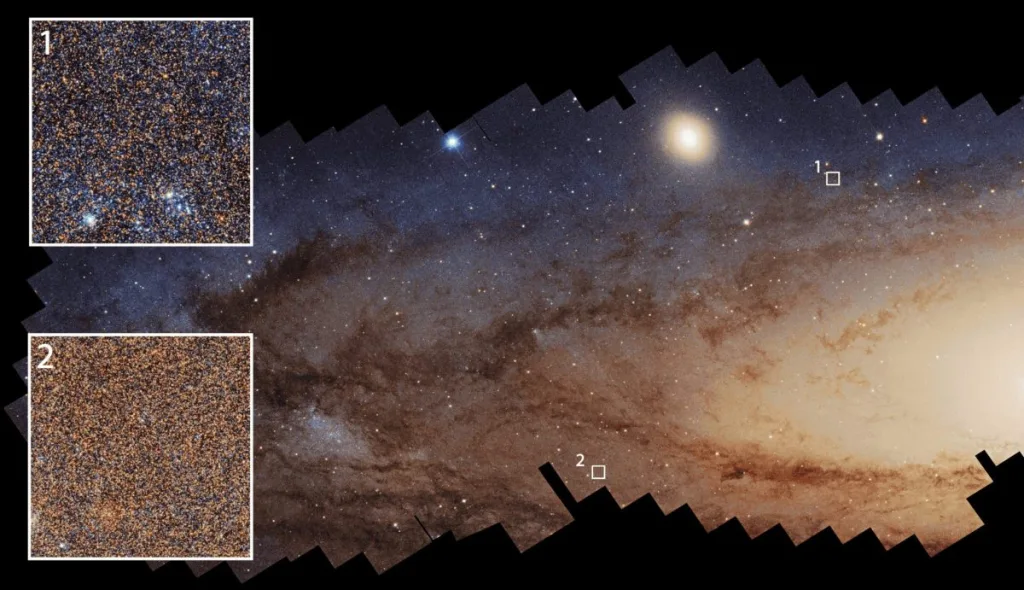
Star formation in Andromeda has been declining for half a billion years.
Andromeda’s Star-Forming Rings Are Growing Quieter
The decline does not occur evenly throughout the galaxy. Much of Andromeda’s recent stellar activity takes place inside large ring-shaped structures.
The most prominent ring lies about 10 kiloparsecs, or nearly 32,600 light-years, from the galactic center. Earlier Hubble observations showed that this ring has supported star formation for at least 400 million years.
Previous research also estimated that about 60% of recent star formation within the PHAT survey area occurred in this structure. Its long life suggests that the ring is a stable feature, rather than a brief concentration of young stars.
The latest maps show that weakening activity inside these rings drives much of the broader Andromeda star formation decline. As the rings produce fewer stars, the total rate across the disk falls.
Some regions have slowed faster than others. That uneven pattern indicates that local conditions still influence how efficiently gas forms stars.
Andromeda Has Not Simply Run Out of Gas
A shortage of gas and dust might seem like the easiest explanation. However, the researchers do not consider a lack of material to be the main cause.
Instead, Andromeda may be settling after a much more active period. Evidence from its stellar populations suggests that the galaxy experienced a major rise in star formation around two billion years ago.
That earlier episode may have followed a substantial interaction or merger with another galaxy. Such an event could have compressed large gas clouds and temporarily increased stellar production.
One proposed model suggests that Andromeda merged with a sizeable galaxy about two billion years ago. The encounter may also explain parts of Andromeda’s stellar halo, its giant stream and the unusual history of its compact companion M32.
Under this interpretation, the current slowdown represents the fading end of a long cycle. Andromeda is not suddenly switching off. It may simply be returning to a quieter state after an unusually productive era.
However, astronomers continue to debate the exact details of Andromeda’s merger history. No single model explains every feature of the galaxy with complete certainty.
Could M32 Be Influencing the Recent Decline?
M32 appears close to Andromeda from Earth. Yet its precise three-dimensional position remains uncertain. Astronomers therefore cannot reconstruct its past orbit with complete confidence.
The new Hubble analysis found that the sharp decline during the past 40 million years appears strongest in the region closest to M32. This pattern raises an intriguing possibility.
A close passage by M32 could have disturbed gas within Andromeda’s disk. The interaction might have changed gas density, disrupted star-forming clouds or shifted material away from productive regions.
Still, the evidence remains circumstantial. The study does not confirm that M32 caused the decline. Researchers only identify the compact galaxy as a plausible influence because of its location near the most strongly affected area.
Future orbital measurements will be needed before astronomers can connect M32 directly to Andromeda’s recent changes.
Why the Andromeda Star Formation Decline Matters
Most galaxies are too distant for astronomers to examine their stars individually. Researchers often have to estimate their histories from combined ultraviolet, infrared or visible light.
Andromeda offers a rare alternative. Its proximity allows scientists to connect individual stellar populations with changes across a complete spiral galaxy.
The study also highlights a limitation in common measurement methods. A standard ultraviolet and infrared technique underestimated Andromeda’s average 100-million-year star formation rate by a factor of about 2.1.
That mismatch occurs because some indicators assume a relatively stable rate. They become less reliable when star formation changes quickly.
Detailed stellar maps provide a clearer timeline. They reveal where activity rose, where it faded and how different areas evolved at different speeds.
A Major Galaxy Entering a Quieter Phase
The Andromeda star formation decline reveals a galaxy in transition. Its star-producing rings remain active, but they now create far fewer stars than they did 500 million years ago.
The cause appears more complex than a simple shortage of gas. Ancient interactions may have driven an earlier productive era, while M32 could have influenced the latest regional changes.
Hubble has now mapped this slowdown across much of Andromeda’s disk. Those observations show that even a familiar spiral galaxy can experience major changes over relatively recent cosmic time.
Andromeda is not inactive. It is gradually settling into a quieter chapter of its history.
Main Sources:
NASA — Hubble Shows Star Formation in Andromeda Galaxy Winding Down:
https://science.nasa.gov/missions/hubble/nasas-hubble-shows-star-formation-in-andromeda-galaxy-winding-down/
Original PHAST research paper:
https://arxiv.org/abs/2605.12721
Earlier PHAT star formation study:
https://arxiv.org/abs/1504.03338
Andromeda merger history study:
https://arxiv.org/abs/1807.08819