
BY:SpaceEyeNews.
The Apollo 12 lightning strike remains one of the most dramatic moments in spaceflight history. Less than a minute after launch, the spacecraft suffered two lightning strikes that scrambled onboard systems and shocked Mission Control. Warning lights flooded the cockpit. Telemetry screens turned unreadable. For a brief moment, NASA feared the Moon mission might end before even reaching orbit.
Yet Apollo 12 survived.
The mission continued because one young flight controller recognized a strange telemetry pattern almost nobody else understood. His four-word instruction — “Try SCE to AUX” — became one of the most famous calls in NASA history. More importantly, it showed how preparation, teamwork, and technical curiosity helped save a mission during one of the most dangerous moments of the Apollo era.
Why the Apollo 12 Lightning Strike Happened
A Risky Launch Morning
Apollo 12 launched on November 14, 1969, aboard the massive Saturn V rocket from Kennedy Space Center. The weather that morning was far from ideal. Thick clouds covered the launch area. The atmosphere carried strong electrical energy.
NASA allowed the launch to proceed because weather rules at the time did not fully understand the danger posed by rocket-triggered lightning.
That gap in knowledge became critical only seconds after liftoff.
The First Lightning Strike
At about 36 seconds after launch, the Apollo 12 lightning strike occurred. The rocket climbed through the charged atmosphere while its exhaust plume created a conductive path through the sky.
The result was immediate chaos.
Inside the spacecraft, alarms activated everywhere. Three fuel cells disconnected. Instrument panels lit up with warning lights. Telemetry data flowing into Mission Control suddenly became unreadable.
Astronaut Pete Conrad reported that nearly everything seemed to drop offline at once.
Mission controllers stared at screens filled with nonsense data. Many believed the mission might require an immediate abort.
The Second Strike Increased the Danger
Only seconds later, another lightning strike hit the vehicle again.
This second discharge caused even more confusion. The spacecraft’s guidance platform temporarily lost orientation reference. Engineers on the ground struggled to understand which systems were truly damaged and which were simply sending corrupted data.
At that point, the Apollo 12 lightning strike looked capable of ending the entire mission.
The Young NASA Engineer Who Recognized the Problem
Who Was John Aaron?
John Aaron was serving as the mission’s EECOM flight controller during Apollo 12. His role focused on electrical, environmental, and communication systems inside the spacecraft.
He was not one of the senior leaders in Mission Control. He was relatively young and still early in his NASA career.
However, Aaron possessed something more important during that crisis: experience with a strange failure pattern that almost nobody else recognized.
A Forgotten Ground Test Became Critical
About a year before Apollo 12 launched, Aaron had investigated an unusual telemetry issue during a ground test at Kennedy Space Center.
Most engineers ignored the odd readings. Aaron decided to study them further.
He traced the issue back to a system called the Signal Conditioning Equipment, or SCE. This hardware converted raw spacecraft sensor data into readable telemetry signals for Mission Control.
Aaron discovered that under low-voltage conditions, the SCE produced a very specific pattern of corrupted telemetry data.
That strange signature stayed in his memory.
The Moment Aaron Recognized the Pattern
During the Apollo 12 lightning strike, Mission Control suddenly saw the exact same telemetry behavior.
Other engineers believed the spacecraft itself might be failing completely. Aaron realized the situation looked different.
He believed the spacecraft’s systems were still functioning. Instead, he suspected the telemetry conversion equipment was malfunctioning because of the voltage drop caused by the lightning.
That realization changed everything.
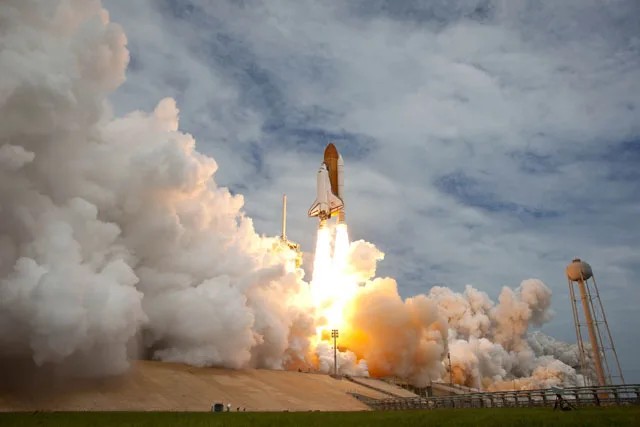
“SCE to AUX”: The Four Words That Saved Apollo 12
The Command Nobody Understood
Aaron quickly advised Flight Director Gerry Griffin to tell the crew:
“Try SCE to AUX.”
The instruction referred to switching the Signal Conditioning Equipment into auxiliary mode. That setting allowed the unit to continue functioning during unstable voltage conditions.
The problem was that almost nobody in the room knew what the command meant.
Even the capsule communicator reportedly responded with confusion before relaying the instruction to the astronauts.
The Apollo 12 lightning strike had created a situation so unusual that only a handful of people fully understood the solution.
Alan Bean Knew the Switch
Fortunately, astronaut Alan Bean recognized the switch location inside the spacecraft.
That detail became one of the most important moments of the mission.
Bean quickly flipped the switch.
Telemetry data immediately returned to normal.
Mission Control could finally see accurate spacecraft readings again. Engineers regained the ability to evaluate the vehicle properly instead of relying on corrupted data streams.
The famous command did not instantly repair the spacecraft, but it restored visibility into the real situation.
Why Telemetry Recovery Mattered
The return of telemetry allowed NASA to recover multiple systems step by step.
Controllers restarted fuel cells. Engineers checked electrical systems. The crew later realigned the spacecraft’s guidance platform after reaching orbit.
Without restored telemetry, none of those recovery steps would have been possible.
The Apollo 12 lightning strike became survivable because engineers regained accurate information at exactly the right time.
Apollo 12 Still Faced Serious Problems After Launch
The Mission Was Not Safe Yet
Many simplified retellings make it sound like one switch instantly saved Apollo 12.
The real situation was more complicated.
Even after telemetry returned, NASA still needed to verify the spacecraft’s health carefully. Controllers had to confirm whether critical systems remained operational.
The crew continued troubleshooting while the Saturn V carried them toward orbit.
Only later did Mission Control finally determine that the mission could continue safely.
The “Go for TLI” Decision
After Apollo 12 reached Earth orbit, engineers conducted extensive checks before approving the mission’s next phase.
Eventually, NASA issued the famous “Go for TLI” call, allowing the spacecraft to perform Trans Lunar Injection and continue toward the Moon.
That decision confirmed the Apollo 12 lightning strike had not destroyed the mission after all.
Days later, the crew successfully landed on the lunar surface.
Teamwork Saved the Mission
The Apollo 12 lightning strike became a powerful example of teamwork inside both the spacecraft and Mission Control.
John Aaron recognized the telemetry pattern.
Alan Bean knew the switch location.
Flight controllers trusted Aaron’s recommendation under pressure.
Each person played a critical role.
The recovery depended on shared knowledge, preparation, and fast decision-making.
How Apollo 12 Changed NASA Forever
NASA Rewrote Launch Weather Rules
The Apollo 12 lightning strike triggered major changes inside NASA.
Investigators later concluded that the rocket itself likely initiated the lightning by creating a conductive path through the atmosphere.
Before Apollo 12, NASA did not fully understand that danger.
After the mission, the agency introduced far stricter launch weather rules. New restrictions prevented launches near electrically dangerous cloud formations and thunderstorms.
Those policies still influence launch safety procedures today.
The Birth of the “Steely-Eyed Missile Man”
John Aaron’s calm response during the crisis earned him legendary status within NASA.
He later became known as a “steely-eyed missile man,” one of the agency’s highest informal compliments for exceptional problem-solving under pressure.
The phrase became part of NASA culture and remains famous decades later.
Why the Apollo 12 Lightning Strike Still Matters
The Apollo 12 lightning strike continues to resonate because it highlights the human side of space exploration.
Modern spacecraft rely heavily on automation and advanced computers. Yet Apollo 12 showed how human memory, technical curiosity, and fast thinking can still become the deciding factors during emergencies.
It also reminds us how exploration often depends on tiny details.
A forgotten ground test.
An obscure switch.
A flight controller willing to trust his instincts.
Those small moments helped keep one of NASA’s most important Moon missions alive.
Conclusion
The Apollo 12 lightning strike nearly ended NASA’s second crewed Moon landing mission less than a minute after launch. Two lightning strikes disabled systems, corrupted telemetry, and pushed Mission Control toward a possible abort decision.
Instead, one engineer recognized a strange failure pattern from an earlier test and delivered a four-word instruction that changed the course of the mission.
Apollo 12 ultimately reached the Moon because knowledge, teamwork, and preparation worked together under extreme pressure. More than fifty years later, the story remains one of the clearest examples of how human expertise can shape the future of space exploration.
Main Sources:
NASA Apollo 12 Mission Overview
https://www.nasa.gov/history/55-years-ago-apollo-12-makes-a-pinpoint-landing-on-the-moon/
NASA Science — Apollo 12 Lightning Strikes
https://science.nasa.gov/resource/lightning-strikes-twice/
Apollo Flight Journal Archive
https://history.nasa.gov/afj/ap12fj/
Wikipedia — John Aaron
https://en.wikipedia.org/wiki/John_Aaron