BY:SpaceEyeNews.
Florida rarely feels “arctic,” but this week it did—and it forced a schedule move on one of NASA’s biggest near-term milestones. The Artemis 2 fueling test delay pushed the mission’s critical “wet dress rehearsal” (WDR) back to Monday, Feb. 2, and it also erased the first two days of NASA’s early-February launch opportunities. NASA now says the first possible Artemis 2 launch opportunity is no earlier than Sunday, Feb. 8, assuming the rehearsal goes well and teams clear the vehicle afterward.
This isn’t a “paperwork delay.” The wet dress rehearsal is the last major end-to-end pad test before NASA commits to a launch attempt for its first crewed lunar mission in more than half a century.
Artemis 2 fueling test delay: what changed right now
NASA’s official update is blunt: weather drove the change. Engineers watched a rare cold outbreak and strong winds move through Florida, then managers compared the forecast to hardware and pad limits. That review triggered a timeline shift for the wet dress rehearsal.
New dates at a glance
NASA’s updated targets now look like this:
- WDR tanking day: Monday, Feb. 2
- Earliest launch opportunity: Sunday, Feb. 8
- Feb. 6–7: no longer viable opportunities
- Extra delays: likely shift the schedule “day for day”
That last line matters. NASA is signaling that the plan has little slack. If weather or technical issues push the rehearsal again, the launch timeline likely slides with it.
Why NASA postponed the wet dress rehearsal
Cold weather sounds simple. Launch hardware makes it complicated.
NASA said the expected conditions would “violate launch conditions,” so the agency adjusted the timeline to “position NASA for success” during the rehearsal. That language usually means NASA saw multiple risks stacking up at once, not one single temperature number.
Cold limits aren’t only about the rocket
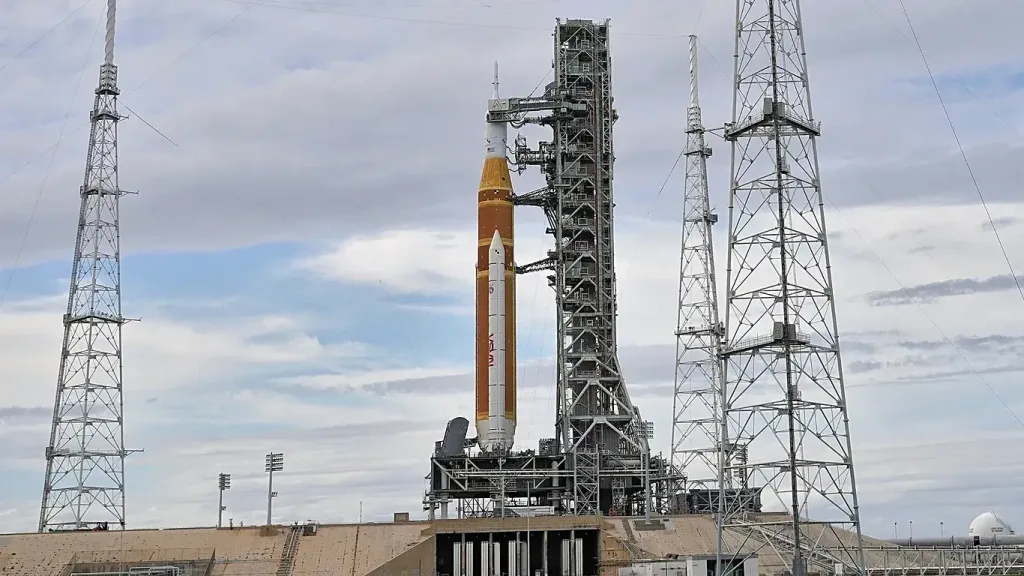
The Space Launch System stack sits on a launch pad that behaves like a small industrial plant. The wet dress rehearsal uses complex ground systems, including propellant lines, valves, seals, umbilicals, purge systems, and sensors that must all perform cleanly for many hours.
AP reporting (also carried by Euronews) adds two important operational details: NASA used heaters to keep the Orion spacecraft warm, and teams were adapting rocket purge systems for the cold. Those steps help, but they don’t erase the core issue: WDR is a long, tightly sequenced operation, and NASA prefers margin over rushing a test that gates launch approval.
NASA won’t set a firm launch date until WDR results are in
NASA also made another point explicit: the agency will wait to set a launch date until teams review the wet dress rehearsal outcome. In other words, the “Feb. 8” message is an earliest possible opportunity, not a promise.
What the wet dress rehearsal tests
The wet dress rehearsal is exactly what it sounds like: teams run a realistic countdown “for real,” including loading propellant, but they stop short of lighting the engines.
NASA describes this WDR as a prelaunch test where teams fuel the rocket and rehearse procedures on the pad before launch. Space.com also frames it as the last major test the Space Launch System must pass before NASA clears it for Artemis 2.
Countdown choreography, step by step
During WDR, teams simulate the flow of launch day:
- Operators power up the vehicle and key pad systems.
- The countdown runs for many hours.
- Teams practice decision points and troubleshooting.
Space.com’s reporting highlights that the rehearsal includes a 49-hour simulated countdown in the lead-up to the main milestones. The Verge echoes that timeline framing and notes the test must be completed before the mission gets launch approval.
Cryogenic fueling is the center of gravity
Fueling SLS means handling cryogenic propellants and keeping them stable. That’s a big reason NASA treats WDR as a go/no-go checkpoint for readiness. Even small leaks, sensor glitches, or timing conflicts can force teams to stop, recycle, or scrub.
Space.com’s earlier Artemis 2 WDR coverage notes the test includes fueling the rocket and running the countdown down to seconds before liftoff during simulation. (NASA’s Jan. 30 update then shows how quickly weather can rearrange that carefully planned flow.)
Holds and “recycles” prove the team, not just the machine
A modern launch is a systems test of people, procedures, and hardware together. During terminal count, teams often insert planned holds and practice recycling the clock. Those rehearsals build confidence that the ground and flight teams can recover from small surprises without losing control of the timeline.
That’s why NASA won’t “save time” by skipping WDR rigor. The agency wants to learn on the rehearsal day, not on launch day.
What could still go wrong, and why WDR matters so much
The simplest way to understand NASA’s caution is to look backward—at the program’s own recent experience.
Artemis 1 proved the value of finding problems early
Artemis 1 launched successfully in November 2022, but the road to that launch ran through WDR and pad troubleshooting. The Artemis 2 story now leans on those lessons. Space.com points out that Artemis 1’s wet dress rehearsal phase in 2022 faced issues such as hydrogen leaks and umbilical challenges that contributed to delays and rollbacks before the mission finally flew later that year.
NASA doesn’t need perfection during WDR. NASA needs clarity. Teams must understand what worked, what didn’t, and what fixes stick.
The “day-for-day” warning is a real signal
NASA’s Jan. 30 update says any additional delays would result in a day-for-day change. That tells readers two things:
- NASA already squeezed the near-term plan as tight as it can.
- Weather or technical friction now pushes the schedule quickly.
AP reporting also captures the same concept, warning that the delay compresses the February options and can push the mission into March if delays stack.
Crew status during the Artemis 2 fueling test delay
While hardware teams adjust timelines, the crew stays on a steady track.
NASA confirms the Artemis II crew remains in quarantine in Houston, and managers are assessing the timeline for the crew’s arrival at Kennedy Space Center. That’s a practical detail with real consequences: travel schedules, training cadence, and on-site simulations all depend on when managers feel the pad timeline is stable enough.
Media coverage consistently lists the four astronauts assigned to the mission:
- Reid Wiseman (commander)
- Victor Glover
- Christina Koch
- Jeremy Hansen (Canadian Space Agency)
This human layer often gets overlooked in “weather delay” headlines. NASA can shift a pad test by 48 hours. Managing crew logistics during repeated slips is harder.
February launch window pressure is real
A key takeaway from this story is not the cold itself. It’s the calendar.
Why only a few days work
NASA has only a handful of launch opportunities each month due to orbital mechanics, lighting constraints, tracking assets, range availability, and mission requirements. That’s why losing Feb. 6–7 matters so much: it reduces flexibility immediately. NASA now says Feb. 6 and Feb. 7 are no longer viable, and Feb. 8 becomes the earliest possible shot.
AP reporting goes further, noting that the shift leaves only a few feasible February launch days before the calendar slips into March.
NASA still needs a clean runway after WDR
Even if WDR runs on Feb. 2, teams still must review data, confirm performance, and verify any required adjustments. NASA says it will wait to set a launch date until after teams review the WDR outcome.
That’s why the Artemis 2 fueling test delay has a multiplier effect: it doesn’t just move one event. It compresses the work that comes after the event.
What to watch next
If you want to track this story like an insider, focus on outcomes—not optimism.
1) Does WDR tanking complete cleanly?
NASA’s updated plan targets Feb. 2 as tanking day. Watch for language that confirms teams loaded propellant as planned and reached the key countdown milestones without major interruptions.
2) Do managers talk about repeat attempts?
If teams end WDR early or stop for a technical reason, NASA may schedule additional attempts. That doesn’t automatically mean a long delay, but it does put pressure on the remaining launch window days.
3) Do NASA updates keep repeating “day for day”?
That phrase is a warning light. NASA used it to set expectations: schedule margin is thin.
4) Do we get a firm launch target?
NASA has not locked a launch date yet. The agency says it will set one after reviewing WDR results. When you see a specific date paired with confident operational language, you’ll know managers like what they saw.
Why this delay still counts as progress
In the short term, the headline reads like a setback. In reality, cautious schedule calls often protect missions from bigger problems.
NASA made a straightforward trade: it accepted a two-day slip rather than run a high-stakes rehearsal under conditions that strained launch and ground limits. That choice aligns with how NASA typically approaches first-of-a-kind crewed milestones: prove the system on the pad, confirm the data, then commit to launch.
The bigger story is still intact. Artemis 2 remains the next major step toward routine crewed lunar operations. Yet the path runs through disciplined testing. The Artemis 2 fueling test delay is a reminder that spaceflight schedules don’t bend to headlines. They bend to physics, engineering margins, and weather.
If NASA gets a solid WDR on Feb. 2, Feb. 8 becomes a real possibility. If issues stack up, the same “day-for-day” logic likely pushes the mission into March. Either way, this week’s decision shows NASA protecting the test that protects the launch.
Main sources:
NASA — “NASA Updates Artemis II Wet Dress Rehearsal, Launch Opportunities”
https://www.nasa.gov/blogs/missions/2026/01/30/nasa-updates-artemis-ii-wet-dress-rehearsal-launch-opportunities/
NASA — “Final Steps Underway for NASA’s First Crewed Artemis Moon Mission”
https://www.nasa.gov/missions/artemis/artemis-2/final-steps-underway-for-nasas-first-crewed-artemis-moon-mission/
Space.com — “NASA delays critical Artemis 2 rocket fueling test… launch no earlier than Feb. 8”
https://www.space.com/space-exploration/artemis/nasa-delays-critical-artemis-2-rocket-fueling-test-due-to-below-freezing-temperatures-launch-no-earlier-than-feb-8