BY:SpaceEyeNews.
Introduction: A Historic Return to Deep Space
The Artemis II lunar mission has done something humanity has not achieved in over five decades. Humans have officially left Earth orbit again. Following a precise engine burn, the crew aboard NASA’s Orion spacecraft began their journey toward the Moon, marking a defining moment in modern space exploration.
This mission is not simply about revisiting the past. It is about rebuilding deep-space capability. Unlike missions that remain close to Earth, Artemis II pushes outward, testing systems that will support long-term operations beyond our planet. In that sense, the Artemis II lunar mission signals the beginning of a new era.
Artemis II Lunar Mission Breaks Free from Earth Orbit
A Precise Engine Burn Changes Everything
About 25 hours after launch, the mission reached its turning point. The Artemis II lunar mission executed a translunar injection burn, accelerating the spacecraft to over 24,000 miles per hour. Within minutes, Orion broke free from Earth orbit and began its path toward the Moon.
Timing was critical. The maneuver required near-perfect execution to align with the Moon’s position. The burn performed exactly as planned, placing the spacecraft on a stable trajectory into deep space.
Why the One-Day Orbit Phase Mattered
Before committing to the Moon, the crew remained in Earth orbit for a full day. This step allowed engineers to confirm that all life-support and onboard systems worked as expected.
During this period, teams monitored oxygen flow, temperature stability, and communication links. Only after verifying system performance did mission control approve the departure. This cautious approach ensures reliability for longer missions ahead.
A Perspective Reserved for Few
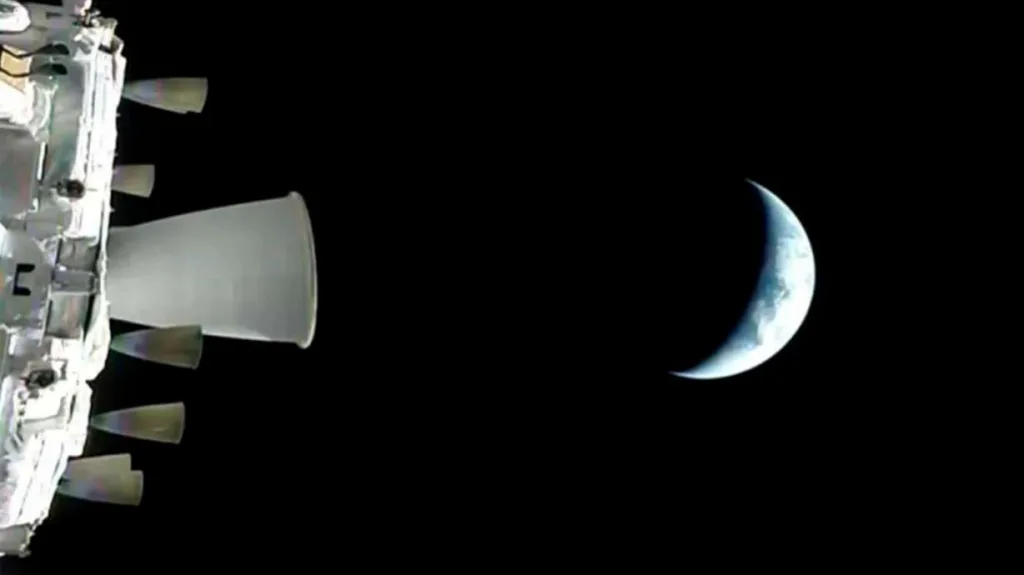
As the Artemis II lunar mission moved farther away, Earth began to shrink into the distance. From tens of thousands of miles away, astronauts could see entire continents at once. Even polar regions appeared clearly.
This view is rare. It highlights both the scale of the journey and the reality of leaving Earth behind.
A Lunar Flyby Designed to Test Every System
Understanding the Mission Path
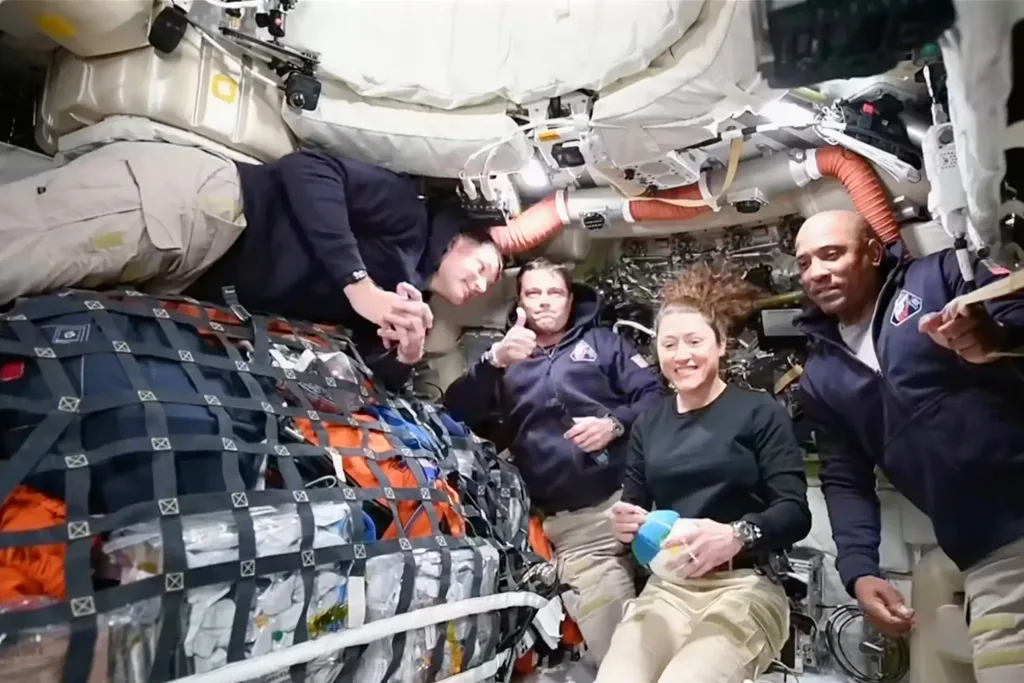
The Artemis II lunar mission is designed as a flyby, not a landing. The spacecraft will travel around the Moon, extend roughly 4,000 miles beyond it, and then return to Earth.
This path follows a free-return trajectory. It uses the natural gravitational interaction between Earth and the Moon to guide the spacecraft safely back. The design reduces risk while still allowing deep-space testing.
Pushing Human Limits in Space
During the mission, the crew will travel nearly 250,000 miles from Earth. This places them among the farthest humans ever to venture into space. The journey may even exceed the distance record set during Apollo 13.
Reentry will present another challenge. The spacecraft will return at extremely high speeds, testing its heat shield and structural performance under intense conditions.
Rare Views Beyond Earth
The Artemis II lunar mission offers more than engineering data. The crew is expected to witness a solar eclipse from space, with the Moon temporarily blocking the Sun from their viewpoint.
In addition, they will observe the far side of the Moon with direct human vision. These moments combine scientific value with a powerful human experience.
Artemis II Lunar Mission Crew Marks a New Era
A More Inclusive Step Forward
The Artemis II lunar mission reflects a broader shift in space exploration. The crew includes the first woman, the first Black astronaut, and the first non-U.S. astronaut to travel on a lunar mission.
Earlier missions such as Apollo 17 featured a far more limited representation. Artemis signals a more inclusive direction.
Global Collaboration in Action
International participation now plays a larger role in space missions. The presence of a non-U.S. astronaut highlights growing global cooperation.
This collaboration strengthens knowledge sharing and aligns multiple nations toward a common goal in space exploration.
Inspiring the Next Generation
Representation carries long-term impact. It shapes how future generations view their place in science and technology. A more inclusive crew opens doors and expands possibilities.
As a result, the Artemis II lunar mission influences not only current exploration but also future participation.
Challenges in Orbit: Small Issues, Big Lessons
Early Technical Problems on Orion
Shortly after reaching orbit, the Artemis II lunar mission encountered minor technical issues. The spacecraft’s toilet system experienced a malfunction. A valve issue also affected the water dispenser.
While these issues were not critical, they required immediate attention.
How the Crew Responded
The astronauts adapted quickly. They used backup procedures and contingency storage methods to manage both systems.
Mission control provided guidance throughout the process. Together, they resolved the situation without disrupting the mission timeline.
Why These Moments Matter
Small issues in space often reveal the most important insights. They test system resilience and crew readiness under real conditions.
Each challenge provides data that will improve future missions. These lessons are essential for longer journeys, where reliability becomes even more critical.
Why Artemis II Lunar Mission Matters for the Future
A Gateway to Future Lunar Missions
The Artemis II lunar mission serves as a critical test flight. Its success will directly support upcoming missions, including planned lunar landings.
Led by NASA, the Artemis program aims to establish a sustained human presence on the Moon. This includes building infrastructure and enabling repeated missions.
From Exploration to Long-Term Presence
Unlike earlier efforts, Artemis focuses on continuity. The objective is not a single visit, but an ongoing presence.
This shift requires stable systems, efficient logistics, and consistent mission execution. Artemis II plays a central role in validating these elements.
Preparing for Missions Beyond the Moon
Looking further ahead, the technologies tested in the Artemis II lunar mission will support future missions to Mars.
Deep-space travel demands reliable life-support systems, navigation precision, and crew endurance. Each milestone in Artemis brings those capabilities closer to reality.
Conclusion: A New Chapter Begins
The Artemis II lunar mission represents a true return to deep space. For the first time in more than 50 years, humans have moved beyond Earth orbit again. This moment reflects both progress and renewed ambition.
More importantly, it marks the start of something larger. The Moon is no longer the final destination. It is the next step in a broader journey that will carry humanity deeper into space than ever before.
Sources:
- https://www.politico.com/news/2026/04/02/artemis-ii-astronauts-rocket-toward-the-moon-after-spending-a-day-around-earth-00857021
- https://www.nasa.gov/artemis
- https://www.space.com/artemis-2-mission