BY:SpaceEyeNews.
NASA has moved one of Artemis II’s most important milestones into sharper focus. The agency now says teams at Kennedy Space Center are preparing to run the Artemis II wet dress rehearsal as early as Saturday, Jan. 31, 2026.
For Artemis watchers, this matters because the wet dress rehearsal is the closest thing to launch day without leaving the pad. NASA will load the Space Launch System (SLS) with super-cold propellants, run a full countdown, and then drain the vehicle. In other words, the Artemis II wet dress rehearsal is the final “prove it” moment for the pad team, the rocket, and the ground systems before NASA commits to a launch date.
NASA’s official Artemis II mission listing still shows a launch date of No Earlier Than Feb. 6, 2026, and that date remains the next big marker on the calendar. But the agency has also been clear about the logic: first, pass the wet dress rehearsal; then, hold a formal readiness review; then, choose the exact liftoff day and time.
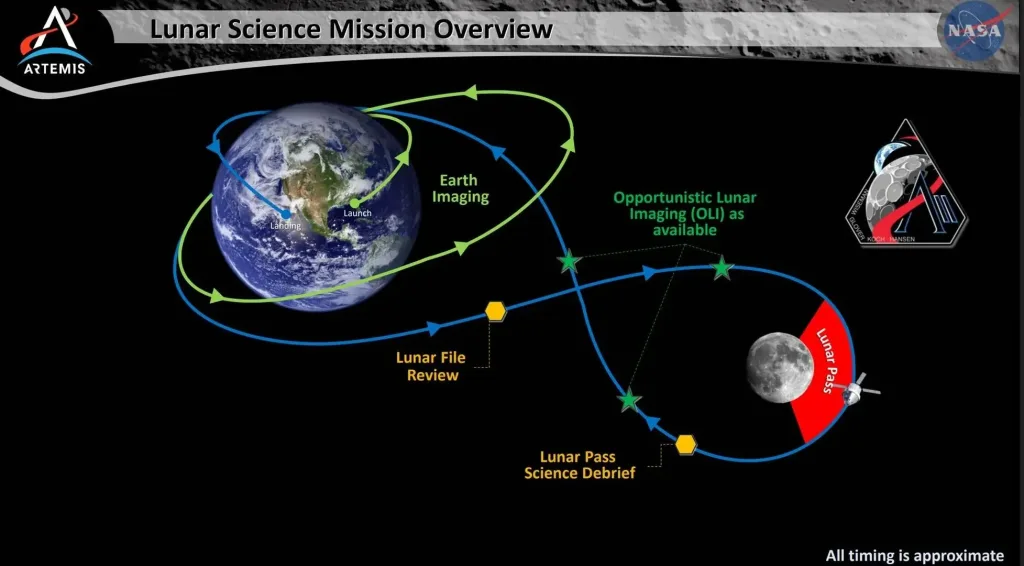
An overview of the Artemis 2 mission. (Image credit: NASA)
What changed this week
NASA says pad work is on track
The key update is simple: NASA reports its engineers remain “on track or ahead of schedule” at Launch Complex 39B. That progress is why the agency says the countdown simulation can come as early as Jan. 31.
The stack arrived at Pad 39B on Jan. 17
The SLS rocket and Orion spacecraft reached the pad on Jan. 17, 2026. That rollout opened the door to final pad integration, checkouts, and the last major rehearsal sequence.
What the Artemis II wet dress rehearsal will do
It’s a full fueling test, not a “mini rehearsal”
NASA describes the wet dress rehearsal as a prelaunch test designed to prove the team can fuel the rocket, manage the countdown, and then remove propellant safely after the run ends—without astronauts inside Orion.
That “drain the rocket” step is not a footnote. Cryogenic operations sit at the center of launch-day risk, schedule pressure, and procedure discipline. The wet dress rehearsal forces every step into the open: valves, timelines, comm loops, controllers, and the ground hardware that supports them.
NASA plans to load more than 700,000 gallons of cryogenic propellant
During the test, NASA plans to load more than 700,000 gallons of cryogenic propellants into SLS. Space.com also reports the equivalent of 2,650,000 liters, and notes the fully fueled stack would weigh about 5.75 million pounds (about 2.6 million kilograms).
Those numbers help explain why this rehearsal matters. A fully fueled SLS becomes a different machine. The rocket chills. Lines contract. Sensors respond to extreme temperatures. Tanks pressurize. Teams learn how the integrated system behaves under real conditions.
The countdown targets a simulated liftoff at 9 p.m. ET
NASA says the rehearsal will count down to a simulated launch at 9 p.m. ET, and could run as late as about 1 a.m. ET if needed. Space.com adds that operations may begin as early as Thursday evening, Jan. 29, heading toward that Saturday night target.
The most interesting part is the “terminal count” stress test
NASA will practice holds, resumes, and recycling in the final 10 minutes
The final 10 minutes of a launch countdown tend to reveal whether procedures work in real time. NASA calls this period “terminal count,” and the agency plans multiple “runs” that test the team’s ability to hold, resume, and recycle the countdown clock.
This is where an orderly test becomes a true rehearsal. Controllers must make clean calls under time pressure. Engineers must confirm hardware limits quickly. The launch director must keep the timeline intact without forcing bad decisions.
The timeline drills down to T-33 seconds, then repeats
NASA outlines a detailed flow:
- The first run begins about 49 hours before the simulated launch moment, when teams report to stations.
- The count proceeds to T-1 minute 30 seconds, then pauses for a planned hold, and continues to T-33 seconds. At that point, SLS’s automatic sequencer would control the final seconds on an actual launch day.
- Then the team resets back to T-10 minutes and performs a second run down to T-30 seconds.
That repeat attempt is important. NASA wants to know the team can not only count down once, but also recycle the clock and do it again with discipline.
Recent pad and vehicle work NASA highlighted
Booster servicing, engine checkouts, and Orion closeouts
NASA’s update offers a snapshot of work that supports a crewed mission tempo. Teams serviced the SLS boosters, including loading hydrazine into booster aft skirts. Technicians also checked out the core stage’s four RS-25 engines and continued Orion closeouts, including stowing items inside the spacecraft and performing planned pyrotechnic work on the launch abort system.
NASA also noted work on a propulsion-system tank used for fueling—described as a composite overwrapped pressure vessel. That kind of detail matters because WDR success depends on small systems behaving perfectly at the right moment.
Cold weather is a real factor this week
Florida does not often face deep cold, but NASA says it is taking steps to ensure environmental control systems keep Orion and SLS elements at proper conditions as lower-than-normal temperatures arrive.
Space.com notes temperatures near Kennedy Space Center could dip below freezing, which is unusual for the region and enough for NASA to take precautions.
Two “small” issues that show how tight launch prep can be
Emergency egress baskets needed an adjustment
NASA recently evaluated the emergency egress system used to move crew and pad personnel away from the mobile launcher during an emergency. The agency says the baskets stopped short of the terminus area during an evaluation. NASA then adjusted the system’s brakes to ensure the baskets fully descend.
This kind of fix is exactly why NASA runs deep prelaunch testing. The hardware may look ready from a distance. A full operational trial can still reveal a mechanical edge case.
Orion’s potable water samples triggered extra checks
NASA also says technicians will take additional samples of Orion’s potable water system after initial samples showed higher total organic carbon than expected. The agency frames the goal clearly: ensure the crew’s water is drinkable.
It’s not flashy. It’s essential. And it reflects how launch prep is not only about engines and propellant. It is also about everyday life support details that must meet strict standards.
Could NASA roll the rocket back to the VAB?
Yes, and NASA says so directly. If needed after the wet dress rehearsal, NASA may rollback SLS and Orion to the Vehicle Assembly Building for additional work ahead of launch.
Rollback does not automatically mean trouble. It often means engineers want a controlled environment for follow-up work. Still, the option signals realism: large, integrated rockets can reveal surprises during cryogenic operations.
Space.com also points out a lesson from Artemis I: wet dress rehearsals in that campaign faced leaks and issues that led to multiple rollbacks. The Artemis II hardware and procedures have evolved since then, but the reminder stands—WDRs are meant to uncover problems before launch day.
What this means for the Feb. 6 “NET” date
NASA’s Artemis II mission page lists No Earlier Than Feb. 6, 2026. That is the earliest opening of the launch window, not a promise of liftoff.
NASA also says it will assess readiness after a successful wet dress rehearsal and then convene a formal review before selecting a specific date. That approach explains the current rhythm:
- Run the Artemis II wet dress rehearsal.
- Review the data across rocket, spacecraft, infrastructure, and teams.
- Pick the best launch opportunity that meets mission constraints.
So, the short version is this: a clean WDR can keep the schedule moving, but the launch date still depends on what the data says.
Where the crew fits in right now
NASA’s Jan. 26 update notes the Artemis II crew entered quarantine in Houston on Jan. 23, 2026.
Space.com also lists the crew: Reid Wiseman (commander), Victor Glover (pilot), Christina Koch (mission specialist), and Canadian Space Agency astronaut Jeremy Hansen (mission specialist). The outlet describes Artemis II as a roughly 10-day mission that uses a “free-return” trajectory around the Moon.
Quarantine does not mean the launch is locked. It does show NASA is treating the near-term timeline seriously. Agencies do not place crews into a launch-prep posture unless they expect the next steps to move quickly.
Bottom line
NASA’s latest update brings Artemis II’s next big hurdle into clear view: the Artemis II wet dress rehearsal now targets Jan. 31 for a full fueling and countdown simulation. NASA will load more than 700,000 gallons of cryogenic propellant, run repeated terminal-count drills, and then drain the vehicle.
If the rehearsal performs cleanly, NASA can move into its readiness review flow and keep the “No Earlier Than Feb. 6, 2026” launch window in play. If the test reveals issues, NASA may choose rollback and additional work. Either way, the Artemis II wet dress rehearsal is the moment when launch preparation shifts from planning to proof.
Main sources:
https://www.nasa.gov/mission/artemis-ii/