
BY:SpaceEyeNews.
NASA has dramatically changed the direction of Artemis III. What was once planned as humanity’s long-awaited return to the lunar surface is now becoming a large-scale orbital test mission instead.
The decision marks one of the biggest strategic shifts in NASA’s modern Moon program. Artemis III was originally expected to deliver the first crewed lunar landing since Apollo 17 in 1972. Now, NASA plans to keep astronauts in Earth orbit while testing the systems needed for future Moon expeditions.
At first glance, the adjustment may seem like a simple scheduling change. In reality, it reveals something much bigger. The technologies behind the Artemis campaign are proving far more difficult to complete than expected.
Lunar landers are still under development. Next-generation spacesuits require additional testing. Docking procedures between multiple spacecraft remain unproven. Instead of pushing toward a risky lunar landing, NASA appears to be slowing the program down to avoid larger failures later.
That decision could reshape the future of Artemis.
Artemis III No Longer Leads NASA Back to the Moon
For years, Artemis III represented the centerpiece of NASA’s lunar ambitions. The mission aimed to send astronauts to the Moon’s South Pole and begin a new era of human exploration beyond low Earth orbit.
That plan has now changed completely.
NASA confirmed earlier this year that Artemis III will remain in Earth orbit instead of traveling to lunar distance. The actual Moon landing objective has effectively shifted to Artemis IV.
Under the revised mission profile, four astronauts will launch aboard the Orion spacecraft using NASA’s Space Launch System rocket. Once in orbit, Orion will dock with one or more lunar landing systems currently being developed by commercial partners.
Two vehicles are central to that effort:
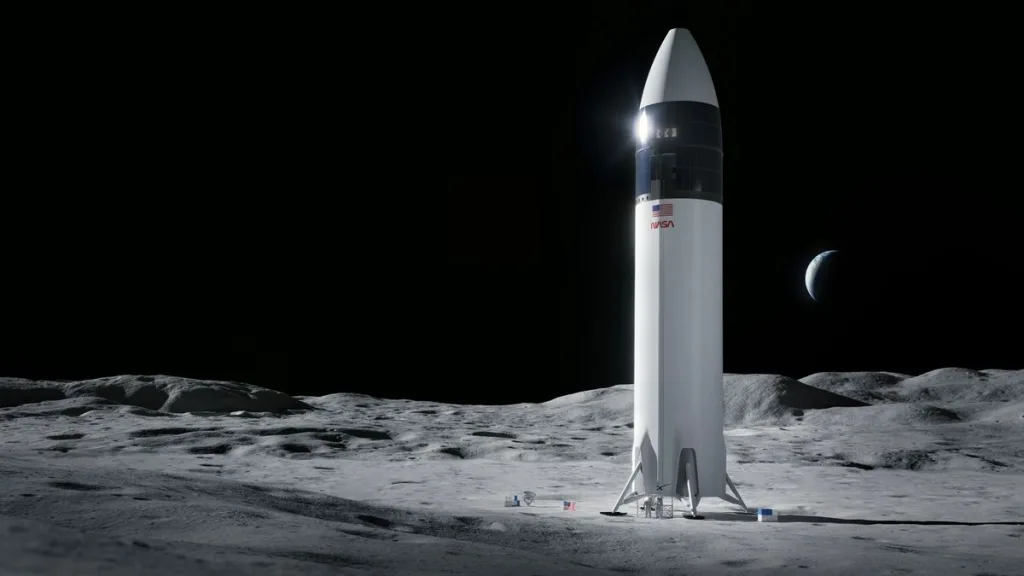
- SpaceX’s Starship Human Landing System
- Blue Origin’s Blue Moon Mark 2 lander
NASA has not yet decided which system will participate in the mission. Both remain under active development.
The new focus centers on docking operations, crew transfers, spacecraft coordination, and long-duration testing inside Orion. These procedures are essential for any future lunar landing attempt. Before astronauts descend to the Moon, NASA must prove that every system can work together safely in orbit.
That process now appears to be the agency’s highest priority.
Why NASA Changed the Artemis Plan
Several major technologies tied to Artemis are still unfinished. Because of that, NASA is moving toward a more cautious strategy.
The biggest challenge involves the lunar landing systems themselves. SpaceX continues testing Starship, but the vehicle still requires successful orbital refueling demonstrations and additional operational validation before NASA can rely on it for Moon missions.
Blue Origin’s Blue Moon program also remains in development. While progress continues, the lander is not yet ready for operational lunar deployment.
Meanwhile, NASA’s next-generation lunar spacesuits from Axiom Space still need extensive testing before astronauts can use them during surface exploration near the Moon’s South Pole.
Taken together, these delays create a difficult situation. Artemis depends heavily on commercial systems that are ambitious, technically complex, and still evolving.
NASA now appears focused on reducing risk rather than forcing an aggressive landing timeline. Instead of attempting a high-profile lunar mission before all systems are fully validated, the agency is prioritizing gradual integration and operational testing.
In many ways, the new Artemis strategy mirrors the Apollo era. During the 1960s, NASA conducted multiple test missions before attempting the Apollo 11 landing. Artemis III is now evolving into a similar stepping stone mission rather than the final destination itself.
Orion’s Earth-Orbit Mission Changes Everything
One of the most important details revealed by NASA involves Orion’s mission profile. The spacecraft will officially remain in low Earth orbit throughout Artemis III.
For months, analysts suspected this possibility. NASA has now confirmed it publicly.
The revised mission allows astronauts to stay inside Orion longer than during Artemis II. Engineers want additional data on life-support systems, spacecraft endurance, crew operations, and onboard maintenance procedures.
NASA is also introducing a major cost-saving measure. Since Orion will not travel toward the Moon, the mission no longer requires a fully operational Interim Cryogenic Propulsion Stage, commonly known as ICPS.
Instead, NASA will install a geometric mock-up version with identical external dimensions. The substitute maintains structural compatibility while avoiding the cost and complexity of building a full operational stage for a mission that remains in Earth orbit.
That decision highlights how dramatically Artemis III has changed from its original design.
NASA is also studying alternative communication systems because the Deep Space Network will not support the mission. In addition, the agency is considering launching CubeSats into orbit as secondary payloads during the flight.
Many operational details remain unresolved. NASA has not finalized the mission duration, crew assignments, scientific objectives, or the exact procedures for testing the new Artemis spacesuits. Those decisions will likely emerge closer to launch.
The Bigger Problems Facing Artemis
The redesign of Artemis III says something larger about NASA’s Moon program. Returning humans to the lunar surface is proving far more difficult than many early timelines suggested.
Modern lunar exploration involves far greater complexity than Apollo-era missions. Artemis is not simply trying to repeat history. NASA wants to establish sustainable operations, support future lunar infrastructure, and prepare for eventual missions deeper into space.
That requires multiple advanced systems working together flawlessly:
- heavy-lift launch vehicles,
- deep-space spacecraft,
- lunar landers,
- orbital docking systems,
- communications networks,
- and new surface exploration hardware.
Each element introduces additional risk.
At the same time, NASA continues facing political pressure, budget concerns, and growing international competition. China is actively developing its own crewed lunar program and aims to land astronauts on the Moon during the 2030s. That race increases pressure on Artemis timelines while also raising expectations for success.
Still, NASA’s decision to slow down may ultimately strengthen the program. A failed lunar landing attempt would create major political and technical consequences. By shifting Artemis III into a large-scale orbital rehearsal, NASA gains time to validate systems before committing astronauts to a far more dangerous mission profile.
The agency appears to be choosing realism over symbolic deadlines.
Artemis III Has Become a Bridge Mission
Artemis III is no longer the mission people expected. It will not place astronauts on the Moon. Instead, it has become a critical preparation step for the missions that follow.
That shift reflects the enormous complexity of modern human space exploration. Building a long-term presence near the Moon requires far more than launching astronauts into deep space. Every spacecraft, docking system, spacesuit, and operational procedure must work together with near-perfect reliability.
NASA now seems determined to avoid rushing that process.
While some observers may view the delay as a setback, the revised approach could improve the long-term chances of success. Artemis III is evolving into the mission that prepares humanity for a sustainable return to the Moon rather than a short symbolic visit.
And in the long run, that may prove far more important.
Main Sources:
NASA official Artemis program:
https://www.nasa.gov/artemis/
Universe Magazine article:
https://universemagazine.com/en/nasa-reveals-details-of-one-of-the-most-challenging-artemis-missions/
NASA Orion spacecraft information:
https://www.nasa.gov/exploration/systems/orion/
SpaceX Starship Human Landing System:
https://www.spacex.com/humanspaceflight/moon/
Blue Origin Blue Moon lander:
https://www.blueorigin.com/blue-moon
Axiom Space Artemis spacesuits:
https://www.axiomspace.com/axiom-space-suits