BY:SpaceEyeNews.
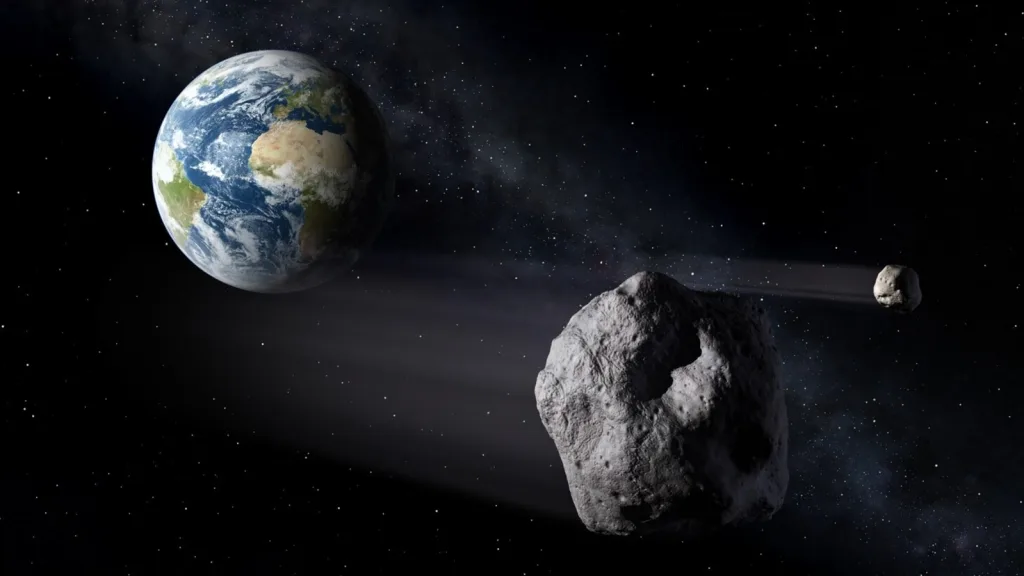
For decades, scientists viewed asteroids as agents of destruction. Large impacts reshaped planets, altered climates, and left enormous scars across planetary surfaces. However, new research suggests a very different role for these ancient visitors. According to a recent study, asteroid impacts and the origin of life may be more closely connected than previously believed.
The research proposes that repeated asteroid bombardment during Earth’s earliest history transformed the planet’s crust. Instead of merely damaging the surface, these impacts created vast networks of fractures and porous rock. Water and gases could then circulate through these underground pathways, forming hydrothermal environments that may have supported the chemical reactions that preceded life.
This finding offers a new perspective on one of science’s biggest questions: where and how did life begin on Earth?
Asteroid Impacts and the Origin of Life During Earth’s Earliest Era
Earth formed approximately 4.5 billion years ago. During its first billion years, the young planet experienced frequent collisions with asteroids and planetesimals. Scientists refer to much of this period as the Hadean Eon, a time when Earth’s surface remained highly dynamic.
Traditionally, researchers focused on the destructive consequences of these impacts. Large collisions melted rock, formed craters, and altered the planet’s surface. Yet the new study suggests that these same impacts may have created favorable conditions beneath the surface.
The key factor is permeability. Permeability measures how easily fluids move through rock. When asteroid impacts fractured Earth’s crust, they increased the number of pathways available for water and gases.
As a result, underground fluids could circulate more efficiently through large portions of the crust.
Why Permeability Matters
Life requires more than organic molecules. Chemical reactions also need suitable environments.
Water acts as a solvent. Minerals provide ingredients. Temperature gradients supply energy. When these factors interact over long periods, complex chemistry can emerge.
Highly permeable rock allows these ingredients to move and mix. That creates conditions where prebiotic chemistry can occur.
Researchers believe these environments may have played an important role in the transition from simple chemistry to the earliest biological systems.
A Planet Constantly Reshaped
Early Earth did not experience only a few impacts. It endured countless collisions over hundreds of millions of years.
Each impact fractured rock. Each fracture increased local permeability. Over time, the cumulative effect may have transformed large regions of the planet’s crust.
Instead of isolated hydrothermal systems, Earth may have contained extensive underground networks where water, minerals, and heat interacted continuously.
That possibility changes how scientists think about asteroid impacts and the origin of life.
How Scientists Investigated Asteroid Impacts and the Origin of Life
To test this idea, researchers used advanced computer simulations.
The team employed the iSALE impact modeling code, which scientists widely use to study planetary collisions. The simulations recreated conditions on the early Earth and examined how impacts altered the crust.
Several variables entered the models.
These included:
- Crust thickness
- Geothermal gradients
- Rock composition
- Impact energy
- Ocean presence or absence
By changing these factors, researchers could evaluate how different environments responded to repeated bombardment.
Simulating Billions of Years of Impacts
The study did not focus on a single impact event.
Instead, scientists integrated individual simulations into a broader model of Earth’s bombardment history. This approach allowed them to estimate the cumulative effects of impacts across vast periods of time.
That long-term perspective proved critical.
A single impact might affect a limited area. Thousands of impacts over hundreds of millions of years could reshape an entire planetary crust.
The simulations revealed that impact-generated fractures remained important long after individual collisions ended.
What the Models Revealed
The results showed that asteroid impacts significantly increased permeability in the upper crust.
According to the simulations, these effects extended to depths approaching eight kilometers.
Impact energy influenced the size of the fractured regions. Larger impacts generally produced larger porous zones.
Meanwhile, crustal temperatures and rock composition affected how fractures developed and persisted.
Together, these factors created extensive underground regions where fluids could circulate.
Those regions may have served as natural chemical laboratories throughout Earth’s early history.
Hydrothermal Systems and Asteroid Impacts and the Origin of Life
Hydrothermal systems occupy a central place in many origin-of-life theories.
These systems form when water interacts with heat sources beneath the surface. Modern examples exist in volcanic regions and geothermal fields around the world.
Researchers have long suggested that hydrothermal environments provide ideal settings for complex chemistry.
The new study expands that idea.
Instead of focusing only on volcanic activity, it highlights the role of asteroid impacts in creating the pathways needed for hydrothermal circulation.
Building Underground Chemical Laboratories
When impacts fractured the crust, water could penetrate deeper underground.
As water encountered hotter rock, it absorbed heat and dissolved minerals. The fluid then moved through interconnected fractures.
This circulation created chemical gradients.
Chemical gradients are important because they drive reactions. They help concentrate molecules and provide energy sources for increasingly complex chemistry.
Over time, these environments could support the formation of compounds associated with prebiotic processes.
The study does not claim that life originated directly because of impacts.
Instead, it argues that impacts may have created environments where life-supporting chemistry became more likely.
Expanding the Number of Potential Habitats
One of the most important conclusions involves scale.
Many origin-of-life models focus on specific locations. Researchers often examine individual hydrothermal vents or isolated environments.
This study suggests something much larger.
If impacts increased permeability across broad regions of the crust, then suitable environments may have existed almost everywhere.
Rather than relying on one special location, early Earth may have contained countless underground habitats capable of supporting prebiotic chemistry.
That dramatically increases the opportunities for life’s building blocks to emerge.
Why Asteroid Impacts and the Origin of Life Matter Beyond Earth
The implications extend far beyond our planet.
Scientists search for life throughout the Solar System and beyond. Understanding how habitable environments form helps guide that search.
If asteroid impacts can create favorable underground environments, then similar processes may occur elsewhere.
Lessons for Mars
Early Mars experienced intense bombardment similar to Earth.
The Red Planet also possessed liquid water during its ancient history. If impacts increased crustal permeability there, hydrothermal systems may have formed beneath the Martian surface.
Such environments could have supported complex chemistry for extended periods.
That possibility strengthens the case for searching ancient Martian rocks for signs of past habitability.
Implications for Rocky Exoplanets
Many rocky exoplanets likely experience heavy bombardment during their formation.
The same physical processes identified in this study could operate on those worlds.
Impacts fracture crusts. Water moves through porous rock. Hydrothermal circulation develops.
As a result, conditions favorable for prebiotic chemistry may emerge naturally on young planets across the galaxy.
That idea broadens the range of environments scientists consider potentially habitable.
A New Perspective on Planetary Evolution
The study encourages researchers to rethink the role of impacts in planetary history.
Asteroids remain powerful geological forces. They can reshape landscapes and alter environments.
Yet they may also contribute to habitability.
Rather than viewing impacts solely as destructive events, scientists increasingly recognize their ability to create new opportunities for geological and chemical evolution.
Conclusion: Asteroid Impacts and the Origin of Life May Be Closely Connected
The new research offers a compelling explanation for how Earth’s earliest environments may have formed.
Repeated asteroid impacts fractured the young planet’s crust and increased its permeability. Those changes allowed water and gases to circulate through underground networks. In turn, extensive hydrothermal systems could develop across large regions of the planet.
These environments may have provided ideal settings for prebiotic chemistry. While the study does not solve the mystery of life’s origin, it identifies a mechanism capable of creating countless potential habitats during Earth’s formative years.
Most importantly, asteroid impacts and the origin of life may represent two parts of the same story. Events once viewed mainly as destructive may have helped transform a young planet into a world capable of supporting life.
Main Sources:
- Universe Magazine
https://universemagazine.com/en/life-on-earth-may-have-originated-thanks-to-asteroids/ - Southwest Research Institute (SwRI)
https://www.swri.org/newsroom/press-releases/impact-history-of-early-earth-created-conditions-conducive-life - AGU Advances (Research Paper)
https://agupubs.onlinelibrary.wiley.com/doi/10.1029/2025AV002097 - Yellowstone National Park Hydrothermal Systems Background
https://www.nps.gov/yell/learn/nature/geothermal-activity.htm