
BY:SpaceEyeNews.
Bennu samples may hold a surprisingly clear record of the ingredients that helped build Earth. New research suggests the asteroid’s parent body formed near the young solar system’s water-ice boundary. There, material from warmer and colder regions could gather and mix.
That possibility changes how scientists interpret this small asteroid’s beginnings. Instead of forming deep in the outer solar system, its parent may have emerged closer to the growing Jupiter. The finding also raises a larger question: how faithfully does Bennu preserve the original recipe for rocky planets?
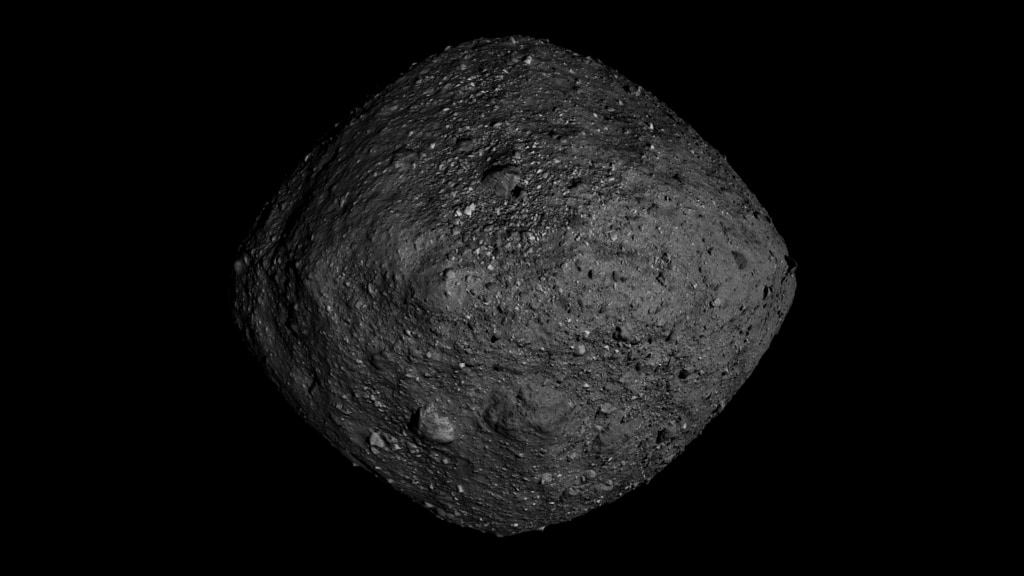
A mosaic image of the asteroid Bennu created by observations made by NASA’s OSIRIS-REx spacecraft. (Image credit: NASA/Goddard/University of Arizona)
What researchers found in Bennu samples
Maria Schönbächler’s team at ETH Zurich received half a gram of material from NASA’s OSIRIS-REx mission. Researchers examined isotopes of iron, titanium, and chromium to investigate its origins. These measurements reveal chemical fingerprints that scientists can compare across different solar system materials.
The team found closely matching signatures in Bennu, asteroid Ryugu, and rare meteorites known as CI chondrites. Their similarities suggest that these objects drew material from a common dust reservoir.
Iron and titanium isotope measurements also indicated a particularly consistent mixture within the analyzed material. That consistency matters because any formation scenario must explain how the ingredients became so thoroughly mixed.
The study, published in Science Advances, uses these clues to examine both the source material and its possible gathering place. ethz.ch
A birthplace between warmer dust and ice
Earlier proposals placed the parent bodies of Bennu and Ryugu far from the sun, potentially near comet-forming regions. Such scenarios also suggested relatively late formation.
The new interpretation points instead toward the water snow line. This boundary separated regions where water remained vapor from colder areas where ice could persist.
Why the snow line matters
Near that transition, drifting solids and moving vapor could redistribute material. Dust arriving from different regions could accumulate together, while ice helped fine particles stick.
This gives the headline’s “fire and ice” phrase its meaning. It describes contrasting temperature environments, rather than literal flames or volcanic activity.
The proposed location concerns Bennu’s ancient parent body. Today’s asteroid assembled later from material belonging to that larger object. Its present orbit therefore does not identify the place where its original ingredients first gathered.
Jupiter’s possible role in sorting the dust
A growing Jupiter could help explain why fine material dominated this mixture. As the planet gained mass, it changed how particles moved through the surrounding disk.
In the researchers’ scenario, Jupiter restricted the passage of much coarser material. Smaller dust particles could continue moving with the gas and contribute to the reservoir near the snow line.
A filter for planetary ingredients
Think of this as selective transport. Different particle sizes did not necessarily follow the same routes or reach the same destinations.
Consequently, the material that accumulated near the boundary could differ from nearby collections of larger grains. Fine dust from multiple sources could mix before joining the growing parent bodies.
This explanation connects the isotope evidence with Jupiter’s early development. However, scientists still need to establish how strongly that filtering shaped the final mixture.
Water-bearing minerals add another clue
The returned material also contains abundant water-bearing minerals. These provide another constraint on any explanation of Bennu’s history.
Near the snow line, ice could turn into vapor as material entered warmer surroundings. Some vapor could then move toward colder conditions and condense again.
That recycling could enrich the proposed formation region with water ice. Together with the dust supply, it offers a plausible route toward assembling water-rich parent bodies.
However, water-bearing minerals do not mean liquid water currently flows across Bennu. They preserve evidence of its material’s history. Likewise, their presence alone cannot pinpoint a birthplace; researchers must interpret them alongside the isotope measurements.
What Bennu samples reveal about Earth’s ingredients
The broader significance reaches beyond one asteroid. Bennu’s composition may preserve a useful approximation of the early solar system’s mixture of planet-forming elements.
That makes its material valuable for reconstructing the starting conditions of planetary growth. Researchers can compare primitive samples with other objects to investigate how those initial ingredients became separated, concentrated, or redistributed.
A starting recipe, not an Earth duplicate
This does not mean Bennu has exactly the same composition as Earth. Nor does the study establish that Bennu itself supplied our planet’s material.
Instead, the asteroid may help reveal the reservoir from which later planetary ingredients developed. That distinction allows scientists to investigate Earth’s origins without treating every primitive object as a direct ancestor.
Sample return makes these comparisons possible. NASA delivered 121.6 grams from Bennu on September 24, 2023. Laboratory work can extract detailed chemical information from portions far smaller than that total.
NASA also plans to preserve at least 70 percent of the collection for future research. That reserve matters because new instruments and methods could reveal details beyond today’s measurements. Scientists can revisit the same material as their questions become more precise. science.nasa.gov
What scientists still need to test
The isotope similarities are measurements. The proposed birthplace and Jupiter’s filtering role are interpretations that explain those measurements.
Further comparisons could strengthen the scenario or reveal where it needs revision. Do other asteroids share the same signature? How widespread was the reservoir that supplied Bennu and Ryugu?
Two sampled asteroids cannot answer those questions for the entire near-Earth population. Researchers need additional material and comparisons to assess how common this formation pathway might have been.
For now, the study provides a testable explanation linking dust transport, ice, and early planetary growth.
Bennu samples bring planetary beginnings into focus
Bennu samples offer a connection between asteroid chemistry and the processes that shaped the young solar system. Their fingerprints suggest a shared origin with Ryugu and CI meteorites, while the snow-line scenario explains how those ingredients might have gathered.
The next challenge is testing that picture against more objects. Each comparison could sharpen our understanding of the material from which Earth and its neighboring planets eventually grew.
Main sources:
- ETH Zurich — Mystery surrounding the formation of asteroid Bennu solved
- NASA — OSIRIS-REx bulk sample mass and return date
- Science Advances — Nucleosynthetic constraints on the origin of Bennu and CI-like asteroids
- Space.com — Asteroid samples from NASA’s epic OSIRIS-REx mission show Bennu was born from fire and ice.