
BY:SpaceEyeNews.
After almost eight years in interplanetary space, BepiColombo has entered the final phase of its journey to Mercury. Yet arrival does not mean the mission can relax. Its most complicated operations are only beginning.
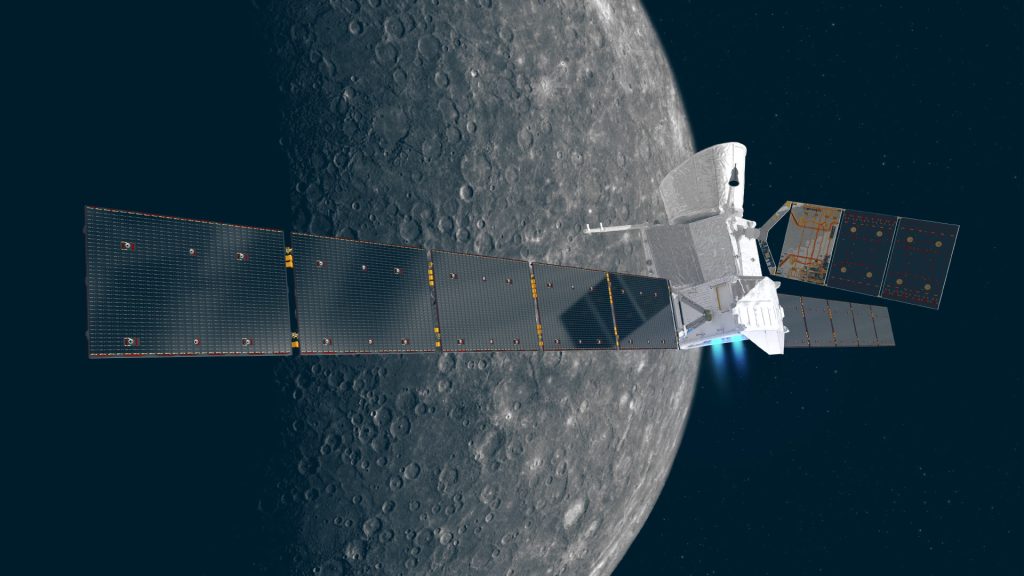
The BepiColombo Mercury arrival started with a decisive event on September 3, 2026. The spacecraft released the propulsion module that had carried it across billions of kilometers. Now, two connected science orbiters must reach Mercury, enter orbit, separate, and move into different paths around the planet. If the sequence succeeds, they could transform our understanding of the Solar System’s smallest planet.
BepiColombo Mercury Arrival Passes Its First Major Test
BepiColombo did not travel as a single spacecraft. During its cruise, it operated as a stacked system with several connected elements.
The Mercury Transfer Module supplied power and propulsion for most of the journey. Above it sat ESA’s Mercury Planetary Orbiter, known as MPO. JAXA’s Mercury Magnetospheric Orbiter, or Mio, traveled with MPO. A protective sunshield kept Mio safe during the trip.
A Spacecraft Changes Roles Near Mercury
On September 3, the transfer module successfully separated from the remaining stack. ESA ground stations in Spain and Argentina confirmed the event through spacecraft signals.
The module had completed its purpose. Its four ion thrusters used electricity to ionize xenon gas. That process produced gentle but efficient thrust over long periods. It helped reshape BepiColombo’s path around the Sun between planetary flybys.
Keeping the module attached would have added unnecessary mass during orbital arrival. However, releasing it forced the rest of the spacecraft to change roles immediately. MPO took control of power, pointing, temperature management, and propulsion. Its solar arrays also began recharging batteries used during separation.
The operation occurred about 63 million kilometers from the Sun. At that distance, intense sunlight and heat place unusual demands on every system.
Successful separation marked an important victory. Still, it only prepared BepiColombo for Mercury’s gravitational capture.
Why Reaching Mercury Took Nearly Eight Years
Mercury lies relatively close to Earth, but distance is not the main problem. A spacecraft moving inward falls deeper into the Sun’s gravity and gains speed. To enter Mercury orbit, it must remove enough energy to avoid rushing past the planet.
That requirement makes Mercury surprisingly difficult to reach. In terms of the needed velocity change, entering Mercury orbit can demand more than sending a spacecraft past Pluto.
Nine Flybys Reshaped the Mission’s Path
BepiColombo could not carry enough conventional fuel for a direct braking maneuver. Instead, controllers combined ion propulsion with nine gravity assists. The route included one Earth flyby, two at Venus, and six at Mercury. JAXA confirms that the mission completed nine planetary swing-by maneuvers during its extended journey.
Each encounter adjusted the spacecraft’s speed and direction around the Sun. The mission covered about 10 billion kilometers after its October 2018 launch, despite targeting a planet in our cosmic neighborhood.
The journey also faced an unexpected setback. In 2024, engineers found that the transfer module’s thrusters could not operate at full power. ESA’s flight dynamics team created a new trajectory that worked with the reduced thrust. The change moved arrival from 2025 to 2026 but protected the main science plan.
The mission therefore relied on precision and flexibility, not one dramatic slowdown near its destination.
The Final Route Into Mercury Orbit
The next critical date is November 21, 2026. On that day, MPO and Mio should enter an initial polar orbit while they remain connected.
This will not complete the BepiColombo Mercury arrival. ESA plans 16 maneuvers between November and March 2027. Those steps will place both orbiters in paths designed for their separate scientific roles.
Mio should separate from MPO on December 9 or 10. On December 16, MPO will release the sunshield that protected the Japanese spacecraft. MPO will then lower its orbit and should reach its final path around March 10. Routine scientific observations are scheduled to start in April 2027.
Two Orbiters Will Examine One Mysterious Planet
MPO will travel closer to Mercury. Its instruments will map the surface, study its composition, and examine its interior. Researchers will investigate volcanic features, craters, the thin exosphere, and deposits inside permanently shadowed polar regions.
Some of those deposits may contain water ice, despite Mercury’s closeness to the Sun. The orbiter will also study the planet in wavelengths beyond visible light. This could reveal materials and geological boundaries that ordinary cameras cannot detect.
Mio will follow a higher, elliptical orbit. It will measure Mercury’s magnetic field, plasma, energetic particles, and surrounding dust. The spacecraft will also track how the solar wind interacts with Mercury’s small magnetosphere.
Why Simultaneous Measurements Matter
Earlier missions changed our view of Mercury. Mariner 10 completed three flybys in the 1970s. NASA’s MESSENGER later became the first spacecraft to orbit the planet. It also produced the first global map of Mercury.
However, one orbiter cannot observe two regions at the same moment. MPO and Mio can compare conditions close to Mercury with activity farther away. Their combined measurements could show whether a change began near the planet or arrived with the solar wind.
That wider perspective may help scientists explain several puzzles. Mercury has an unusually large metallic core. It also retains a global magnetic field. Its surface contains volatile materials that researchers once considered unlikely so near the Sun. Meanwhile, hidden polar craters may preserve ancient ice.
Together, those clues challenge simple accounts of how Mercury formed. They may also reveal how heat, impacts, and early planetary movement shaped the inner Solar System.
BepiColombo Mercury Arrival Opens a New Chapter
BepiColombo has completed its long electric-powered cruise, but its scientific mission has not truly started. The coming months will decide whether two connected spacecraft can become two coordinated observatories around Mercury.
If the remaining maneuvers succeed, the BepiColombo Mercury arrival will deliver new maps, environmental measurements, and views of the planet’s hidden history. Those findings could explain why Mercury differs so sharply from its neighbors. More importantly, they may preserve evidence from the earliest stages of planet formation—evidence that Earth and Venus no longer display so clearly.
Main Sources:
ESA – Latest updates: BepiColombo’s arrival at Mercury
https://www.esa.int/Science_Exploration/Space_Science/BepiColombo/Latest_updates_BepiColombo_s_arrival_at_Mercury
ESA – BepiColombo factsheet
https://www.esa.int/Science_Exploration/Space_Science/BepiColombo/BepiColombo_factsheet
ESA – Training while flying: Inside BepiColombo’s arrival simulations
https://www.esa.int/Enabling_Support/Operations/Training_while_flying_Inside_BepiColombo_s_arrival_simulations
ESA – End of the blue glow: BepiColombo turns off solar electric propulsion
https://www.esa.int/Enabling_Support/Operations/End_of_the_blue_glow_BepiColombo_turns_off_solar_electric_propulsion_for_Mercury_arrival
JAXA – Mercury Exploration Mission BepiColombo
https://global.jaxa.jp/projects/sas/bepi/
JAXA/ISAS – Mercury Magnetospheric Orbiter Mio
https://www.isas.jaxa.jp/en/missions/spacecraft/current/mmo.html
Ars Technica – After 8 years, Europe’s BepiColombo mission is on final approach to Mercury
https://arstechnica.com/space/2026/09/after-8-years-europes-bepicolombo-mission-is-on-final-approach-to-mercury/