BY:SpaceEyeNews.
Astronomers may finally be closing in on one of Betelgeuse’s longest-running mysteries. New telescope images show the clearest view yet of a faint star beside the famous red supergiant. The source appears almost exactly where scientists predicted a hidden Betelgeuse companion should be.
Researchers captured the object with the SPHERE instrument on the European Southern Observatory’s Very Large Telescope in Chile. They provisionally call it Betelgeuse B.
The image provides the strongest visual evidence so far that Betelgeuse forms part of a binary system. However, astronomers still want to track the object farther around its expected orbit before declaring the case fully settled.
Betelgeuse Companion Could Explain a Six-Year Mystery
Betelgeuse does not shine at a constant level. Its main pulsation cycle lasts about 400 days. During that period, the star expands, contracts, brightens and fades.
Yet astronomers have also tracked a slower pattern that repeats about every six years. This long secondary period could not be explained easily by the star’s normal pulsations.
Scientists considered several possibilities. Large convection cells might alter the visible surface. Dust could temporarily block part of the star’s light. Changes in the surrounding atmosphere might also contribute.
However, independent studies reached a similar conclusion. A small companion orbiting close to Betelgeuse could produce the long-term changes seen in its brightness and radial velocity.
The suspected orbit would place the companion extremely close to the red supergiant from Earth’s perspective. Betelgeuse’s intense light, vast atmosphere and dusty surroundings would then conceal it from most instruments.
That explains why astronomers could study Betelgeuse for generations without clearly separating the second star.
Astronomers Predicted Where to Find Betelgeuse B
The new detection was not a lucky snapshot. Researchers used decades of observations to estimate the companion’s orbit.
Their calculations predicted that the object would reach one of its widest apparent separations from Betelgeuse in December 2024. That did not mean the stars were physically far apart. Instead, their positions would appear more widely separated when viewed from Earth.
A team led by Paris Observatory astronomer Miguel Montargès observed Betelgeuse with the Very Large Telescope on December 3 and December 6, 2024.
SPHERE specializes in high-contrast imaging. It can suppress light from a bright central object and reveal much fainter sources nearby. Astronomers often use similar techniques to search for planets and stellar companions.
After months of data processing, the team found a bright point beside Betelgeuse. Its position matched the predicted location of the companion.
Earlier observations had already offered an important clue. In 2025, a team using the Gemini North telescope reported a probable direct image of a companion near Betelgeuse. The source remained tentative, but it appeared in the expected region.
The VLT observations independently recovered a source at a closely matching position. That agreement greatly strengthens the companion interpretation.
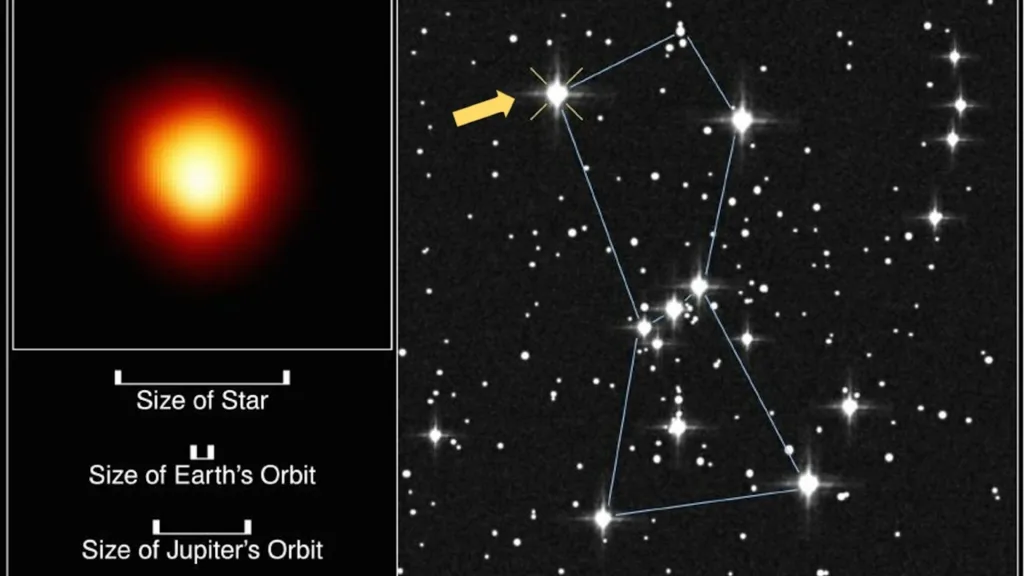
Betelgeuse, Betelgeuse? One of the brightest stars in the sky may actually be 2 stars, study hints.
What the Clearest Image Actually Shows
The SPHERE data reveal a compact source about 52 milliarcseconds from Betelgeuse. A milliarcsecond is an extremely small angular measurement. Resolving two objects at that separation requires exceptional image quality.
Researchers analyzed the observations with two separate processing methods. Both revealed the candidate companion.
In the strongest analysis, the source reached a statistical significance of 6.1 sigma. That means random image noise provides a highly unlikely explanation for the detection.
The team also examined whether the source could be an unrelated star located behind or in front of Betelgeuse. Their calculations found that such an alignment would be extremely improbable.
This matters because the telescope appears to have recorded light from the companion itself. Astronomers are no longer relying only on indirect clues from Betelgeuse’s motion or brightness.
Still, the research paper uses the cautious term “candidate companion.” One clear observing period cannot map an entire orbit.
Astronomers need to detect the object again after it moves to another predicted location. Confirming that motion would show that the source travels around Betelgeuse rather than remaining fixed in the background.
Betelgeuse Companion Appears Larger Than Expected
One of the biggest surprises concerns the possible companion’s mass.
Previous models often suggested that Betelgeuse B could have a mass similar to, or lower than, the Sun. The new brightness measurements point toward a heavier star.
Assuming both stars formed at roughly the same time, researchers estimate that the companion may contain between 2.6 and 3.1 solar masses.
Their models describe it as a young, hot main-sequence star. It may belong to a late B-type spectral class, with a temperature between about 11,200 and 12,000 kelvins.
The estimated luminosity ranges from roughly 47 to 92 times that of the Sun. That would make Betelgeuse B a bright star by ordinary standards.
Yet Betelgeuse outshines it so dramatically that the companion disappears inside the red supergiant’s glare.
These estimates still carry uncertainty. Dust surrounding Betelgeuse may absorb some of the companion’s light. The system’s distance, age and local environment also affect the calculations.
Therefore, astronomers have not directly measured the companion’s mass. They inferred it from its brightness, temperature and expected evolutionary stage.
A Star Moving Through Betelgeuse’s Outer Atmosphere
Betelgeuse B may orbit so close that it passes through the extended outer atmosphere of the red supergiant.
That journey could allow the smaller star to disturb nearby gas. NASA’s Hubble Space Telescope has detected changes consistent with a dense wake trailing behind the companion.
Researchers studied ultraviolet and visible-light signatures from ionized iron. Those signals changed as the proposed companion moved through different parts of its orbit.
The results support the idea that Betelgeuse B influences the gas surrounding the larger star. It may also affect nearby dust and help shape the six-year observational cycle.
However, the companion may not explain every brightness change by itself. Betelgeuse remains a complex star with huge convective structures, pulsations and irregular mass loss.
What the Discovery Means for Betelgeuse’s Future
The possible companion could influence Betelgeuse’s long-term evolution. Its gravity may affect the red supergiant’s rotation, atmosphere and pattern of material loss.
Over time, interactions between the two stars could also alter their orbit. Yet astronomers do not know how important those effects will become.
The discovery does not mean Betelgeuse will undergo a supernova soon. It also does not provide a new date for that future event.
Moreover, researchers should not automatically link the companion to Betelgeuse’s Great Dimming in 2019 and 2020. Evidence indicates that expelled material cooled into dust and temporarily blocked part of the star’s light.
The binary hypothesis mainly addresses the repeating six-year signal, not every irregular change seen on Betelgeuse.
Betelgeuse Companion Needs One Final Orbital Test
The new VLT image connects several pieces of evidence. It matches previous orbital predictions, supports the earlier Gemini detection and agrees with Hubble observations of disturbed gas.
Most importantly, the source appears where the Betelgeuse companion should have been during the December 2024 observing window.
Even so, its movement will provide the decisive test. Astronomers must find the object again at another predicted point in the orbit.
NASA has identified November 2027 as another favorable period, when the companion should again reach a wide apparent separation.
If the source moves as expected, Betelgeuse will no longer look like a solitary red supergiant. Instead, one of the sky’s most familiar stars will become a remarkable nearby binary system whose hidden member remained buried in its glare for generations.
Main Sources:
European Southern Observatory — “Astronomers find strongest evidence yet that Betelgeuse has a companion”
https://www.eso.org/public/news/eso2611/
Astronomy & Astrophysics — “VLT/SPHERE imaging of the candidate companion of Betelgeuse”
https://www.aanda.org/articles/aa/full_html/2026/07/aa61023-26/aa61023-26.html
NASA — “Hubble Helps Detect ‘Wake’ of Betelgeuse’s Elusive Companion Star”
https://science.nasa.gov/missions/hubble/nasa-hubble-helps-detect-wake-of-betelgeuses-elusive-companion-star/
NASA — “NASA Scientist Finds Predicted Companion Star to Betelgeuse”
https://www.nasa.gov/science-research/astrophysics/nasa-scientist-finds-predicted-companion-star-to-betelgeuse/