
BY:SpaceEyeNews.
Some stars may not die alone. A new study suggests that binary stars and supernovas may be connected through one of the most dramatic final acts in stellar evolution.
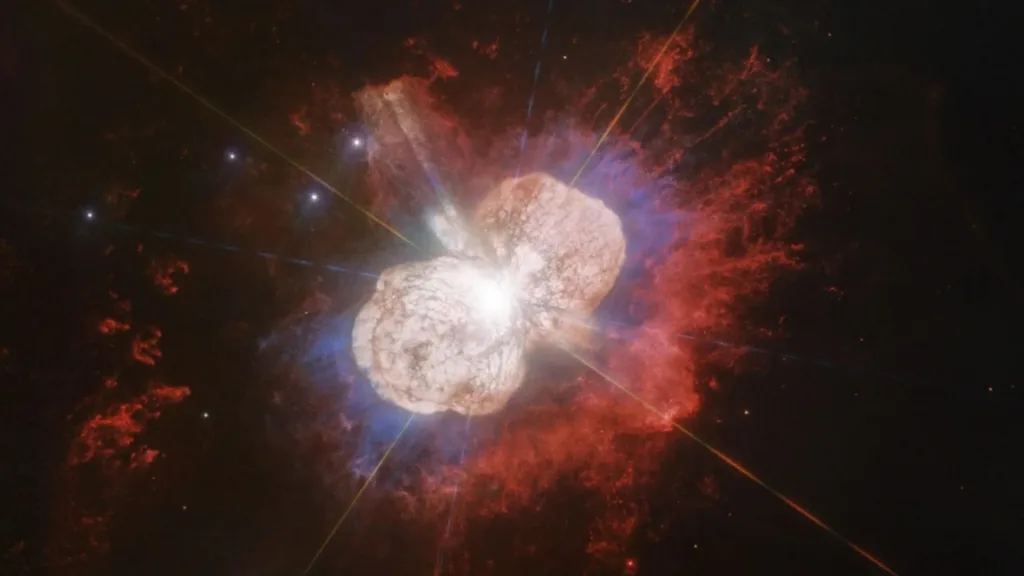
The focus is a strange class of event known as an interacting supernova. These supernovas do not behave like simple stellar endings. Their light can remain strong for months, and sometimes even years. The reason is not only the dying star itself. It may also be the dense gas sitting around it before the final event begins.
For decades, astronomers have asked one major question. Where does that gas come from?
New research led by scientists at the Academia Sinica Institute of Astronomy and Astrophysics, or ASIAA, points to a clear answer. In some binary systems, one star swells near the end of its life. It begins transferring material toward its companion. Not all of that material stays in the system. Some escapes and forms a cocoon around both stars.
Then the dying star reaches its final stage. Its fast-moving material expands outward and hits that cocoon. The impact turns energy into light and creates an unusually bright cosmic display.
This is why binary stars and supernovas matter. A star’s final appearance may depend not only on its own mass, but also on the partner that lived beside it.
Binary Stars and Supernovas Reveal a Cosmic Puzzle
Interacting supernovas have puzzled astronomers for many years. They need a nearby supply of dense gas to create their unusual glow. Without that gas, the event would look far more ordinary.
In a regular core-collapse supernova, a massive star reaches the end of its life. Its core can no longer support itself. The outer layers then move outward at extreme speed. The event becomes visible across vast cosmic distances.
But an interacting supernova has another layer to the story. The outward-moving material does not travel into empty space. It runs into a thick shell of gas and dust that already surrounds the star.
That meeting changes the event.
The moving material carries huge energy. When it hits the surrounding gas, part of that energy becomes heat and light. This can make the supernova brighter. It can also keep it visible for much longer than expected.
The mystery was never the glow itself. Scientists could explain how the light forms once material hits the cocoon. The harder question was the origin of that cocoon.
A single massive star can lose material through strong stellar winds. It can also pass through unstable stages before the end. Yet those ideas do not always place enough gas in the right location at the right time.
This is where the binary-star model becomes important. It gives astronomers a natural way to create dense material close to a dying star shortly before the final event.
Instead of treating the gas cocoon as a random leftover, the new study links it to the late life of a stellar pair.
That makes the explanation more powerful. It also gives scientists a model they can test with future observations.
How a Companion Star Builds the Gas Cocoon
Many massive stars do not live alone. They exist in binary systems, where two stars orbit a shared center of gravity. Over millions of years, that partnership can reshape both stars.
In the new model, one star evolves faster than the other. It grows larger as it moves toward the final stage of its life. During this phase, the star can expand to hundreds or even thousands of times its earlier size.
As the star swells, its outer layers can reach an important boundary. This boundary is called the Roche lobe. It marks the region where material remains mainly tied to one star by gravity.
When the swollen star fills that region, material can spill toward the companion. This process is known as Roche-lobe overflow.
The companion captures some of the flowing gas. But it does not capture everything. Part of the material escapes into the space around both stars.
That escaping material forms the cocoon.
This detail is important. The companion does not need to directly cause the supernova. Its role is more subtle. It helps shape the environment before the final event begins.
In that sense, the companion acts like a silent architect. It helps prepare the stage. Later, the dying star creates the final display.
This gives binary stars and supernovas a much closer connection. The supernova is not only the ending of one star. It may also be the result of a long relationship between two stars.
That relationship decides whether enough gas sits close enough to create a bright interacting event.
Why Timing Is the Key Discovery
The most important part of the study is timing. A binary companion can help create gas around a dying star. But that alone is not enough.
The gas must stay nearby.
If mass transfer happens too early, the material has time to spread far away. By the time the star reaches its final stage, the gas may be too distant or too thin. The supernova material may not meet it in the right way.
That would create a weaker interaction. It may not produce the unusual glow seen in interacting supernovas.
The simulations show a more precise path. In some systems, mass transfer happens only a few thousand years before core collapse. For a massive star, that is almost the final moment.
This late transfer keeps the gas close. It creates the right environment for the expanding material to hit the cocoon soon after the supernova begins.
That timing helps solve a major problem.
Binary stars are common. Massive stars often have companions. So if companions alone caused interacting supernovas, these events should appear more often.
They do not.
The missing ingredient is timing. The companion must transfer material during the correct late stage. Too early, and the cocoon fades into space. Too weak, and the cocoon may not become dense enough.
This makes the discovery more than a binary-star story. It is a story about the final schedule of stellar life.
In astronomy, timing can decide what we see.
A star may live for millions of years. Yet its final few thousand years can control how its ending appears across the universe.
What the New Simulations Found
The research team used hundreds of computer simulations to study how massive binary stars evolve. These models followed mass transfer between stars with different masses and separations.
The study focused on a late-stage process known as Case C mass transfer. This occurs after the star has already burned helium in its core.
That stage matters because the star is already close to core collapse. It has little time left before the final event.
According to the research, donor stars with about 10 to 20 times the mass of the sun can undergo late Roche-lobe overflow in the right binary systems.
The models suggest that this process can happen roughly 1,000 years before core collapse. That is extremely late in stellar terms.
The simulations also show that these systems can release about 0.01 to 0.2 solar masses of material. That gas can form a circumstellar medium, or CSM, around the binary system.
The CSM can extend across large distances. Still, it remains close enough to affect the final supernova.
This is the key result. The model creates the right kind of material without requiring a separate mystery event. It does not depend on a sudden unexplained burst from one star. Instead, it uses binary evolution itself.
That makes the explanation elegant. It also connects interacting supernovas to a broader pattern in the lives of massive stars.
Why These Events May Not Be Rare
One surprising result is the estimated frequency. The study suggests this pathway could account for about 13 percent of core-collapse supernova progenitors.
That means the process may not be a rare exception. It may represent an important channel in the final evolution of massive stars.
This matters because astronomy often works backward. Scientists observe a strange event. Then they try to reconstruct the life of the star that produced it.
If many massive stars live with companions, then a single-star view can miss part of the story.
A supernova’s brightness, color, and long-term behavior may carry hidden clues about a companion star. That companion may be hard to detect after the event. Still, its influence can remain visible in the surrounding gas.
This changes how scientists may interpret future observations.
When a supernova stays bright longer than expected, astronomers may search for signs of nearby gas. When they find that gas, they may ask whether late binary interaction created it.
That shift is important. It turns the surrounding material from a mystery into evidence.
The gas becomes a record of the star’s final relationship.
The Link to SN 2014C
The study also connects the model to real observations. One important example is SN 2014C.
This supernova first appeared more ordinary. Later, it showed signs that its material had reached a surrounding shell of gas. That change made it a valuable case for understanding interacting supernovas.
The new simulations may help explain events like this. Some binary systems in the model produce surrounding gas similar to what astronomers inferred around SN 2014C.
That does not mean every interacting supernova has the same origin. Space rarely gives one answer for every event. But it does show that late binary interaction can create realistic conditions.
That is why the model has value. It does not only sound possible. It matches the kind of environment astronomers already observe.
Future sky surveys could test this idea further. Telescopes that monitor the sky night after night may catch more supernovas as they change over time.
Those changes can reveal when the expanding material reaches gas around the star. They can also show how far away that gas was before the final event.
With enough examples, astronomers may be able to map the final years of massive binary systems.
Binary Stars and Supernovas Could Change Future Research
The connection between binary stars and supernovas gives scientists a better way to read cosmic endings. It suggests that the final look of a supernova may depend on the full life story of a stellar pair.
This has several important effects.
First, it makes binary evolution central to supernova research. Massive stars often form with companions. Their interactions can remove material, transfer gas, and reshape their surroundings.
Second, it helps explain why some supernovas shine longer than expected. The extra light may not come from the star alone. It may come from the meeting between expanding material and a cocoon built earlier.
Third, it gives astronomers clearer targets. If they can identify signs of late mass transfer, they can better understand which systems may create interacting events.
This is also important for chemical enrichment. Supernovas spread heavy elements into space. Those elements later become part of new stars, planets, and possibly life-friendly worlds.
So understanding supernovas is not only about stellar endings. It is also about the cycle that shapes galaxies.
The new study adds one more message. A star’s final act may not be private. It can carry the signature of a companion that shaped its surroundings until the end.
Conclusion: A Cosmic Partnership Until the End
The story of binary stars and supernovas is not just about an unusual cosmic event. It is about connection. A massive star may reach its final stage, but its companion can shape what the universe sees next.
The new research suggests that late mass transfer in binary systems can create the dense gas cocoons behind interacting supernovas. The timing must be precise. If the gas forms too early, it drifts away. If it forms near the end, it can power a bright and unusual display.
Main Sources:
ASIAA official release: https://press.asiaa.sinica.edu.tw/ASIAA_TAIWAN_News/260701
Research paper on arXiv: https://arxiv.org/abs/2605.11635
Space.com report: https://www.space.com/astronomy/stars/dance-of-death-between-binary-stars-leads-to-an-unusual-supernova