BY:SpaceEyeNews.
Black hole disk winds may remove nearly as much material as a black hole consumes. That is the striking conclusion from detailed observations of Swift J1727.8−1613, a stellar-mass black hole system that brightened dramatically in 2023.
Astronomers followed the system through several stages of its outburst. They found that a dense flow of gas remained active even after the source had become much dimmer in X-rays. The wind’s estimated mass-loss rate was comparable to the amount of material moving inward toward the black hole.
The finding changes the simple picture of black holes steadily swallowing everything supplied by a companion star. Instead, much of that material may leave the surrounding disk before it can cross the event horizon.
A Rare View of Swift J1727.8−1613
Swift J1727.8−1613 is a low-mass X-ray binary. It contains a stellar-mass black hole and a lower-mass companion star.
The companion supplies gas to the black hole. However, that gas does not fall straight inward. It forms a rapidly rotating accretion disk, where friction and compression heat the material and produce strong radiation.
The system suddenly brightened on August 24, 2023. NASA’s Swift Burst Alert Telescope first detected the event. Other observatories soon confirmed a rapidly rising source.
Within a short period, Swift J1727.8−1613 became exceptionally bright at X-ray wavelengths. It also brightened significantly in visible light. That unusual intensity triggered observations across several parts of the electromagnetic spectrum.
The new study describes the central object as a stellar-mass black hole with an estimated mass near 10 Suns. However, its exact mass remains uncertain because astronomers are still refining the system’s orbital angle and other properties.
Tracking the Outburst With the Very Large Telescope
Researchers used the X-Shooter instrument on the European Southern Observatory’s Very Large Telescope in Chile.
Unlike a single photograph, spectroscopy separates light into individual wavelengths. This allows astronomers to identify chemical elements and measure how gas moves around an object.
The team collected 13 spectra across 11 observing periods. The observations began in August 2023 and continued into March 2024.
This coverage allowed the researchers to follow the black hole system as it changed from a bright, hard X-ray state to a softer state. They later observed its return to a dimmer hard state.
Several hydrogen and ionized-helium signatures changed during that process. These spectral lines helped reveal where the gas was located and whether it was rotating, falling inward or moving away.
The observations created one of the most detailed optical records of a black hole binary changing throughout an outburst.
The Disk Changed as the Jet Became Active
During the brightest radio flare, the researchers detected changes in ionized-helium emission from the disk.
The line became stronger, while its width and the separation between its two peaks decreased. The team interpreted this as evidence that stronger radiation illuminated larger regions of the outer disk.
Gas farther from the black hole rotates more slowly. Therefore, emission coming from larger disk radii produces narrower spectral features.
However, the observations did not show a similarly clear change in the line base associated with the inner disk. This suggests that the outer disk responded to the jet-launching event, while any inner change remained too small to detect.
The result supports a close connection between the disk, radiation and jet activity. Yet it also shows that this relationship is not controlled by one simple change across the entire disk.
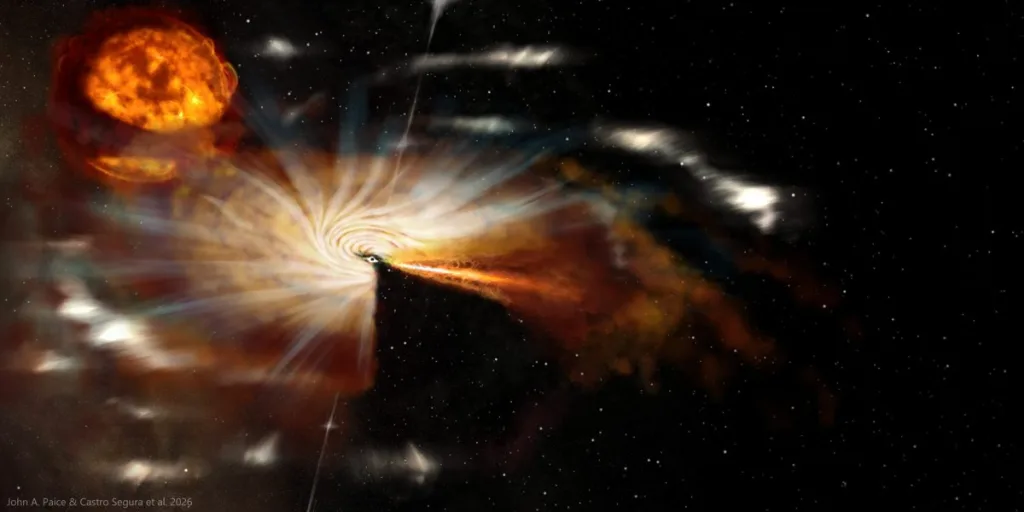
Black holes expel a substantial portion of matter into space.
Black Hole Disk Winds Appeared During the Decline
The greatest surprise came near the end of the outburst.
By then, the system’s X-ray luminosity had fallen to around one-hundredth of its earlier observed level. Despite that decline, the spectra revealed broad hydrogen absorption and a strongly uneven helium-emission profile.
The researchers concluded that both features likely came from a massive, cool wind rising from the accretion disk.
This outflow travelled at approximately 750 kilometres per second. Its temperature was likely below 10,000 kelvin.
That temperature makes the wind relatively cool compared with highly ionized disk winds usually detected through X-ray observations. Its density allowed it to leave clear signatures in visible-light spectra.
Computer simulations also supported the interpretation. A rotating wind that accelerated outward naturally produced emission shapes similar to those recorded by X-Shooter.
The Black Hole May Reject Much of Its Supply
The researchers estimated that the wind removed at least one-billionth of the Sun’s mass each year.
That may appear small, but it becomes important when compared with the black hole’s feeding rate at that stage. The estimated mass leaving through the wind was similar to the amount flowing inward through the inner disk.
In other words, the system may have expelled roughly as much material as it was accreting during the dim hard state.
This does not mean matter escaped from inside the black hole. Nothing in the study challenges the event horizon.
Instead, black hole disk winds remove gas while it is still outside the black hole. The material leaves the disk before reaching the point beyond which it cannot return.
The estimate also represents a lower limit. The actual mass-loss rate could be higher, depending on the wind’s shape, density and viewing angle.
Therefore, astronomers should not assume that all material transferred from a companion star eventually increases a black hole’s mass.
Why Black Hole Disk Winds Matter
Disk winds carry more than gas. They also remove energy and angular momentum from the binary system.
Over long periods, that process can influence how quickly the companion transfers material. It may also affect the orbit and the system’s future evolution.
The study suggests that the wind’s mass-loss rate was about 10 percent of the system’s estimated long-term transfer rate from the companion star.
However, the researchers present an important condition. Astronomers do not yet know whether a wind this strong continues during full quiescence.
Should similar outflows persist at very low X-ray brightness, black hole binaries may lose a meaningful share of their transferred material continuously. Their growth would then be less efficient than models based only on inward flow might suggest.
The result also highlights the value of watching an outburst after its dramatic peak. A fading X-ray source may still contain powerful and scientifically important activity.
Black Hole Feeding Is a Two-Way Process
Swift J1727.8−1613 shows that black hole feeding involves both inward and outward motion.
Gas enters the accretion disk, but jets and winds can redirect a significant share back into space. In this system, a dense wind became most visible when the main X-ray display was already fading.
The discovery strengthens the idea that black hole disk winds play a major role in controlling how much matter black holes truly consume.
Future observations must determine whether these winds survive during quieter periods. Until then, Swift J1727.8−1613 offers a clear lesson: measuring what approaches a black hole is not the same as measuring what finally enters it.
Main Sources:
Monthly Notices of the Royal Astronomical Society:
https://academic.oup.com/mnras/article/doi/10.1093/mnras/stag1175/8743827
DOI link:
https://doi.org/10.1093/mnras/stag1175
European Southern Observatory — Very Large Telescope and X-Shooter:
https://www.eso.org/public/teles-instr/paranal-observatory/vlt/vlt-instr/xshooter/