BY:SpaceEyeNews.
For decades, scientists believed galaxies came first. Stars formed inside those galaxies, collapsed, and eventually created black holes. That idea shaped modern cosmology for years.
Now, the James Webb Space Telescope may have found evidence that the opposite happened in at least one case.
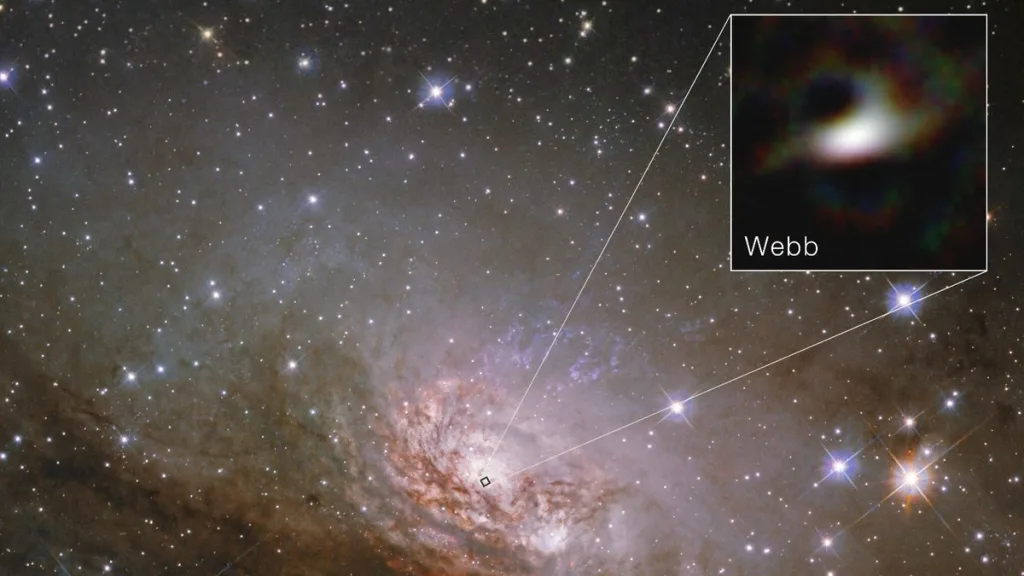
Researchers studying a strange object called Abell2744-QSO1 discovered a giant black hole inside an extremely tiny young galaxy. The discovery shocked astronomers because the black hole appears far too massive for its surroundings.
The finding suggests a possibility scientists once considered highly speculative: a black hole formed before galaxy growth truly began.
If confirmed by future Webb observations, this discovery could change how scientists understand the early universe.
The Strange “Little Red Dot” That Changed Everything
What Is Abell2744-QSO1?
The object sits more than 13 billion light-years away from Earth. Webb observed it as it existed only 700 million years after the Big Bang.
Astronomers classify it as one of Webb’s mysterious “Little Red Dots.” These are compact red objects discovered in the early universe. Many appear brighter and heavier than expected.
Abell2744-QSO1 became especially important because it was magnified by gravitational lensing. A massive galaxy cluster called Abell 2744, also known as Pandora’s Cluster, bent and amplified its light.
That magnification allowed Webb to study the object in extraordinary detail.
A Tiny Galaxy With a Giant Black Hole
Scientists quickly noticed something unusual.
The entire object measures only about 1,300 light-years across. That is extremely small compared to modern galaxies like the Milky Way.
Yet Webb data revealed a black hole with roughly 50 million times the Sun’s mass.
That result immediately created a problem.
In nearby galaxies, supermassive black holes usually represent only a tiny fraction of total galactic mass. In QSO1, however, the black hole may account for nearly two-thirds of the entire system.
That ratio is enormous.
Researchers realized this object did not fit the traditional picture of galaxy evolution.
Webb Directly Measured the Black Hole
A Major Scientific First
Previous studies of early black holes relied mostly on indirect estimates. Scientists had to assume distant black holes behaved like nearby ones.
This time was different.
Researchers used Webb’s Near Infrared Spectrograph, called NIRSpec, to directly track gas motions around the black hole.
That achievement matters because it produced one of the first direct black hole mass measurements from the universe’s earliest era.
The Importance of Keplerian Motion
Scientists mapped hydrogen gas swirling around the object’s center.
The gas moved in a very specific pattern called Keplerian motion. This is the same gravitational behavior seen in planets orbiting the Sun.
The discovery carried huge implications.
If stars dominated the object’s mass, the gas would move differently. Instead, Webb showed that most of the mass concentrates inside one central point.
That point is the black hole.
The direct measurements confirmed the black hole truly is enormous.
One of the Most Pristine Environments Ever Seen
Webb also studied the chemical composition of the surrounding gas.
The results surprised researchers again.
QSO1 contains mostly hydrogen and helium. Scientists found extremely low amounts of oxygen and other heavier elements.
That matters because stars create those heavier elements over time.
In other words, this galaxy had not formed many stars yet.
Its metallicity measures less than 0.5% of the Sun’s.
That makes QSO1 one of the most chemically primitive galactic environments ever observed.
The evidence points toward a startling possibility: the black hole may have appeared before large-scale star formation truly began.
Did the Black Hole Form First?
The Traditional Model Faces Problems
For years, scientists thought supermassive black holes grew slowly.
The standard process looked like this:
- Stars form inside galaxies
- Massive stars collapse into black holes
- Black holes merge and consume matter
- Over billions of years they become supermassive
But QSO1 creates a timing problem.
The universe was still incredibly young when this object existed. Researchers struggle to explain how a black hole could grow this massive so quickly through ordinary processes alone.
That is why many astronomers now think Webb may be revealing a completely different formation pathway.
The “Heavy Seed” Theory Gains Momentum
Direct Collapse Black Holes
One leading explanation involves something called a direct collapse black hole.
Instead of forming from a star, a giant cloud of gas could collapse directly into a massive black hole.
That process would skip the normal stellar stage entirely.
Scientists have theorized this possibility for years. However, observational evidence remained limited.
QSO1 may now provide some of the strongest evidence yet.
The object appears dominated by a massive black hole despite having very little stellar development around it.
That scenario fits surprisingly well with direct collapse models.
Could Primordial Black Holes Exist?
Some scientists are exploring an even more radical possibility.
They wonder whether certain black holes formed shortly after the Big Bang itself.
These hypothetical objects are called primordial black holes.
Researchers still debate whether they exist. However, discoveries like QSO1 are renewing scientific interest in the idea.
Some theories even connect primordial black holes to dark matter.
Webb’s observations do not prove primordial black holes exist. Still, the telescope is clearly finding objects that challenge current models.
Webb Keeps Discovering “Impossible” Objects
A Growing Pattern in the Early Universe
This is not the first time Webb has surprised astronomers.
Since operations began, the telescope has repeatedly found objects that seem too large, too bright, or too evolved for the young universe.
Examples include:
- Massive early galaxies
- Overgrown black holes
- Compact “Little Red Dots”
- Unexpectedly mature cosmic structures
Each discovery increases pressure on existing cosmological models.
Scientists now debate whether galaxy evolution happened much faster than expected or whether important physics remains missing.
Why This Discovery Matters So Much
The idea that a black hole formed before galaxy growth changes the entire story of cosmic evolution.
For decades, astronomers viewed black holes as products of galaxies.
Now, Webb suggests black holes may have helped create galaxies instead.
That reversal carries enormous implications.
If giant black holes appeared first, they could have shaped the formation of stars, galaxies, and large cosmic structures across the universe.
The discovery could influence future research involving:
- Galaxy formation
- Dark matter
- Early universe physics
- Black hole growth
- Cosmological simulations
Scientists Are Now Searching for More Objects Like QSO1
Researchers believe QSO1 may not be unique.
Webb has already detected multiple “Little Red Dots” across the early universe.
Scientists are now analyzing similar objects to determine whether giant black holes commonly formed before their host galaxies matured.
Future observations may reveal whether this discovery represents:
- A rare cosmic anomaly
- Or a major missing chapter in cosmic history
Either answer would reshape astronomy.
Conclusion
The James Webb Space Telescope may have uncovered one of the biggest cosmological surprises in decades.
The evidence surrounding Abell2744-QSO1 suggests a black hole formed before galaxy development fully began. That possibility directly challenges traditional theories about how cosmic structures evolve.
Webb is no longer just confirming existing ideas. It is exposing gaps in humanity’s understanding of the universe itself.
If future discoveries support these findings, astronomers may need to rewrite the story of how galaxies and supermassive black holes first emerged after the Big Bang.
Main Sources:
https://science.nasa.gov/missions/webb/nasas-webb-reveals-black-hole-that-formed-before-its-galaxy/
https://academic.oup.com/mnras