BY:SpaceEyeNews.
Black hole hair could leave a recognizable signature in the fading waves that follow a black hole merger. Scientists now have a clearer idea of what that signature might look like. Their calculations suggest that hidden structure could change both a signal’s rhythm and its fading speed.
A team led by Nagoya University researchers developed the approach. Their study explores how those changes might reveal matter around black holes. However, nobody has detected hidden hair through this work. The advance is a theoretical framework that gives future observations specific patterns to investigate.
What Scientists Mean by Black Hole Hair
The word “hair” describes extra structure beyond the simplest black hole description. It does not mean strands extending from a surface. Here, researchers explore how something surrounding a black hole could influence its gravitational signature.
The familiar description involves mass, spin, and electric charge. The new calculations focus on standard, uncharged black hole models, then introduce small departures from them.
That distinction matters. A black hole with additional surrounding structure need not behave exactly like an isolated one. Scientists want to understand those differences before interpreting an unusual measurement.
Hidden hair also does not automatically mean dark matter. Black hole hair covers possible structures with different physical explanations. Identifying one would require evidence beyond an intriguing label.
Two Signals Could Expose Hidden Structure
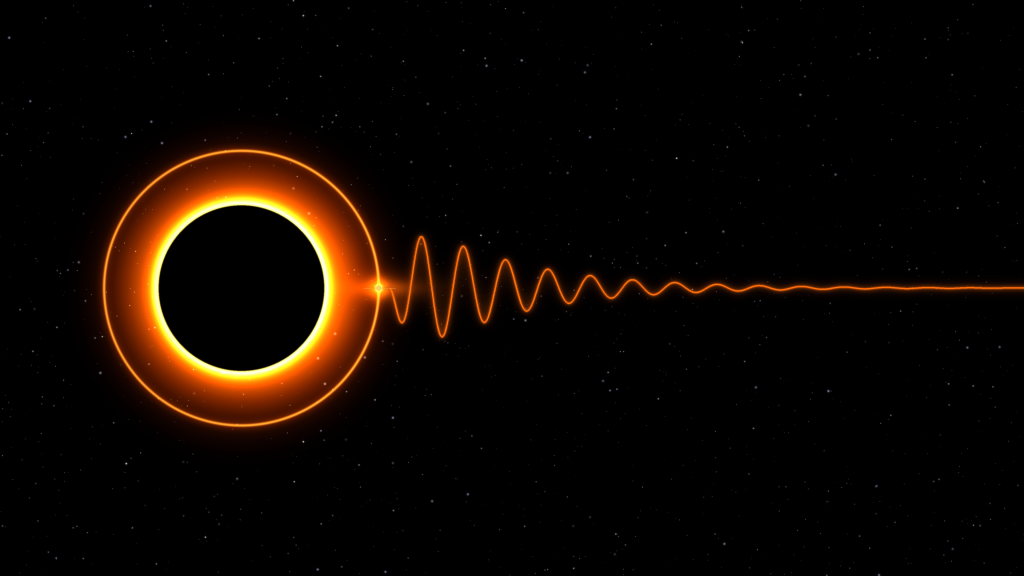
After two black holes merge, the resulting object settles toward a stable state. During this stage, it produces fading gravitational waves. Scientists call this pattern ringdown.
A ringing bell offers a useful comparison. Its note has a particular pitch, while its vibrations gradually weaken. A black hole’s ringdown likewise carries information through its oscillation frequency and fading rate.
Frequency Reveals the Rhythm
Frequency describes how rapidly the wave oscillates. On a graph, it determines the spacing between successive peaks. Extra surrounding matter can alter that spacing by changing the gravitational environment.
However, frequency alone does not describe the entire signal. Researchers also need to examine how the peaks shrink over time.
Fading Speed Adds Another Clue
The team found that hidden matter need not change frequency and fading speed by matching amounts. Their different responses could help researchers investigate the source of a departure from standard predictions.
The calculations also connect these changes with the surrounding matter’s pressure. That creates a possibility beyond simply noticing something unusual. Scientists might eventually learn about the properties of whatever produces the extra structure.
How Researchers Calculated the Changes
The researchers began with mathematical black hole models and introduced small contributions from additional matter. They then calculated how those contributions would alter the expected ringdown.
Their framework represents the extra source as an effective fluid. Its pressure can differ between directions. This mathematical description lets the team explore several possibilities without claiming that any particular substance exists nearby.
Light Orbits Provide a Mathematical Shortcut
The method uses an established approximate connection between unstable light orbits and black hole vibrations. Studying how those orbits change helps researchers estimate changes in the wave signal.
This approach simplifies a difficult calculation. Instead of starting again for every possible model, researchers gain a common framework for comparing predicted effects.
The team examined several theoretical examples and extended its analysis to rotating black holes. These examples test the method’s behavior; they do not represent newly observed objects.
Why Rotation Makes the Pattern More Complex
A spinning black hole introduces another distinction. Light traveling with its rotation behaves differently from light traveling against it.
The researchers explored how additional structure changes those behaviors. Their results suggest that the corresponding ringdown changes also depend on the direction relative to the spin.
Consequently, there is no single universal shift that would identify every possible form of hair. Different arrangements can produce different combinations of frequency changes and fading rates.
For observers, that complexity could offer useful information. Comparing several features may help narrow the range of explanations for an unusual signal.
However, the pattern would still require careful interpretation. A theoretical match could guide further investigation without immediately establishing the identity of hidden matter.
What the Black Hole Hair Study Does Not Prove
The work provides predictions, rather than a confirmed detection. It does not establish that an observed black hole carries hidden hair. Nor does it identify a new particle or demonstrate that Einstein’s theory has failed.
In fact, the researchers use Einstein’s equations in their calculations. Additional matter can change a black hole’s surroundings while remaining compatible with general relativity.
That distinction shapes the central question. Finding a departure from an isolated black hole model would open an investigation into its cause. Scientists would then need to determine whether surrounding matter explains the difference, or whether another physical explanation deserves closer attention.
Predictions Still Need Observational Tests
The method also has limits. It treats the extra structure as a small contribution and relies on an approximate mathematical relationship. Those assumptions define where its predictions apply.
An actual measurement would therefore need more than a suggestive difference. Researchers would have to compare the data with appropriate models and assess how confidently the signal supports an interpretation.
The study offers no guaranteed timetable for that step. Its immediate value lies in making the search more specific. Scientists now have clearer predictions to examine when suitable observations become available.
A New Direction for the Search
Black hole hair remains a possibility that researchers must test. This study advances that effort by connecting hidden structure with measurable features of ringdown.
The key is the relationship between a wave’s rhythm and its fading speed. Together, those features could reveal details that either measurement alone might miss.
For now, the achievement is a better guide to interpretation. Future observations may show whether black holes carry additional structure, and whether their final vibrations can tell us what surrounds them.
Main sources:
- Nagoya University: Official research announcement
- Research paper: Ringdown waves from hairy black holes
- Journal publication: Journal of Cosmology and Astroparticle Physics
- EarthSky: Original story