
BY:SpaceEyeNews.
Black hole jets may influence a galaxy’s future far beyond its visible stars. Astronomers have detected a faint hydrogen glow that follows these jets into surrounding gas. That gas supplies material for future stars, making its condition crucial to a galaxy’s growth.
The discovery connects activity near a central black hole with changes hundreds of thousands of light-years away. It also reveals why this particular signal can escape detection: averaging observations across every direction weakens the pattern. To uncover it, researchers needed to follow the jets.
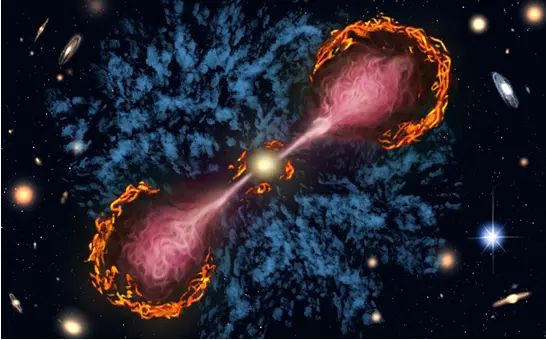
Artist’s illustration of a supermassive black hole at the center of a radio galaxy launching powerful jets (shown in pink) all the way into the galaxy’s CGM.
A galaxy’s future depends on its outer gas
Beyond a galaxy’s bright disk lies the circumgalactic medium, or CGM. This extensive gas reservoir reaches roughly 10–20 times the size of the visible galaxy, according to Arizona State University.
Some of that gas can cool, move inward, and eventually provide material for new stars. However, having a large reservoir does not guarantee a steady supply of usable fuel.
Astronomers want to understand what interrupts that process. Energy from an active central black hole offers one possible explanation. Jets can carry that energy outward and alter gas far from the galaxy’s center.
The key challenge involves tracing where that influence reaches and how the surrounding material responds.
How astronomers traced black hole jets
Sanchayeeta Borthakur of Arizona State University and Namrata Roy of the Raman Research Institute led the research. Their findings appear in The Astrophysical Journal Letters.
The team combined optical observations from the Dark Energy Spectroscopic Instrument, or DESI, with radio measurements from LOFAR’s Two-meter Sky Survey. These datasets provided complementary information about the gas and jet directions.
Combining hundreds of faint signals
The hydrogen emission surrounding an individual galaxy was too faint to reveal the pattern clearly. Researchers therefore combined measurements from hundreds of galaxies with active jets.
This approach, often called stacking, brings out a shared signal that individual observations struggle to show. However, the team also preserved a crucial piece of information: each measurement’s direction relative to the jets.
When researchers averaged observations around the galaxies in all directions, the hydrogen signal remained weak. Along the radio jet axes, it became much stronger.
This is a statistical view of many galaxies, rather than a continuous image of gas flowing through one system.
That difference turned direction into an essential part of the discovery. Combining more data helped, but combining it in the right way revealed the pattern.
Hydrogen reveals where the jets leave their mark
The researchers searched for H-alpha, a characteristic emission line from hydrogen. It traces glowing gas associated with ionization and provides a way to investigate the jets’ surroundings.
The stronger emission along the jets indicates that the gas responds differently depending on direction. Its glow does not spread evenly around the galaxies.
This pattern supports the interpretation that jets transfer energy into the surrounding reservoir. They can change the gas along their paths even far beyond the visible stellar population.
Two regions stand out
The team reported enhanced hydrogen brightness in two regions. One lies closer to the galaxy, where the jet encounters the surrounding reservoir. The other sits farther out, near the CGM’s outer edge.
The researchers interpret the outer enhancement as a region where jets release substantial energy into their environment.
These findings map a relationship between jet direction and gas emission. They do not provide a direct measurement of how many future stars a galaxy will form. That distinction matters when connecting the observed glow with long-term evolution.
Why cooler gas tells a different story
As a check, the researchers examined magnesium absorption, which traces cooler gas.
Unlike the hydrogen emission, this tracer showed no comparable connection with jet direction. The cooler component appeared more evenly distributed around the galaxies.
That contrast helps explain why comparing different tracers matters. One reveals a directional glow, while the other offers information about the broader gas reservoir.
The result supports a picture in which jets change the condition of gas along their paths. It does not establish that every individual galaxy has a perfectly uniform halo.
Instead, the combined observations reveal different patterns in the cooler gas and the hydrogen emission.
What black hole jets could mean for star formation
A galaxy needs gas that can cool and gather before it can produce new stars. Energy entering its outer reservoir can interfere with that supply.
By heating and disturbing surrounding material, jets may delay cooling or reduce the inward flow of fresh gas. Over time, that could slow star formation within the galaxy.
Astronomers describe this connection as black-hole feedback: activity near the central object changes the environment that supports galactic growth.
The new findings offer observational evidence relevant to that process. Their significance lies in connecting the jets with distant gas, where future stellar fuel resides.
Consequently, understanding a galaxy requires looking beyond its visible stars. Conditions in its outer reservoir may help explain why abundant gas does not always lead to abundant new stars.
What remains open
The study reveals an average pattern across many systems. Individual galaxies may differ, and the measurements do not track their evolution over time.
Further investigation must establish how much gas the jets affect and how long those changes persist. Another question concerns how strongly the observed interaction alters the eventual supply of star-forming material.
The directional signal gives researchers a useful feature to test against models. It strengthens the connection between central activity and distant gas without resolving every step between energy transfer and reduced star formation.
A clearer view of galactic growth
Black hole jets offer a powerful connection between a galaxy’s center and its outer gas supply. By following their direction, astronomers uncovered a faint pattern that broader averages obscured.
The discovery sharpens our view of how galaxies evolve. Their futures depend partly on what happens beyond the starlight, where gas waits to become the next generation of stars.
Main sources:
Arizona State University — official research announcement, September 24, 2026:
https://www.eurekalert.org/news-releases/1145208
The Astrophysical Journal Letters — research paper DOI:
https://doi.org/10.3847/2041-8213/ae9cbd
Phys.org — original coverage credited to Arizona State University:
https://phys.org/news/2026-09-black-hole-jets-galaxies-visible.html