
BY:SpaceEyeNews.
Two black holes merge, but the gravitational-wave signal does not end at that moment. The new remnant continues to vibrate while settling into a stable state. Researchers at the University of Cambridge have developed a black hole ringdown method that maps those fading vibrations in far greater detail. Their Bayesian framework separates supported signals from unnecessary additions. It could give scientists a clearer guide for testing gravity with current and future observatories.
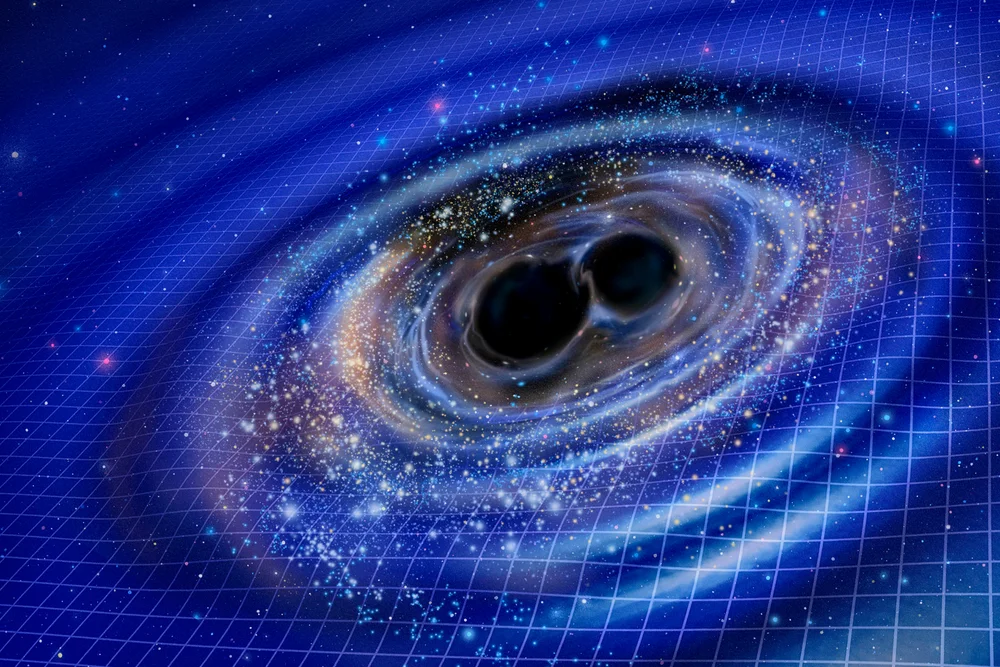
Artist’s impression of two black holes merging, which can be detected on Earth through the gravitational waves the collision creates.Lynette Cook/Science Source.
Black Hole Ringdown Method Targets Fainter Signals
The final black hole releases a sequence of damped gravitational-wave oscillations. Scientists call these signals quasinormal modes. Each mode carries a frequency and a decay rate linked to the remnant’s mass and spin.
The dominant mode usually provides the clearest measurement. Yet quieter components may contain extra information. Several modes can provide independent estimates of the remnant’s mass and spin. General relativity predicts that those answers should agree for a Kerr black hole. Together, the frequencies turn ringdown analysis into black hole spectroscopy.
Why the Quietest Modes Are Difficult to Separate
Weaker modes overlap, decay quickly, and can hide beneath stronger parts of the waveform. The chosen starting time also changes the result. Begin too early, and complex merger behavior may enter the analysis. Start too late, and short-lived signals may disappear.
A model can also include so many frequencies that it fits numerical imperfections instead of genuine physics. Such overfitting may create a close match without proving that every proposed mode exists.
Richard Dyer and Christopher J. Moore designed their framework to address both problems. It examines the signal at many starting times and asks how much evidence supports each possible mode.
Bayesian Evidence Builds the Best Ringdown Model
The black hole ringdown method uses Bayesian inference to compare competing explanations for a waveform. In simple terms, it tests whether adding another mode improves the model enough to justify the extra complexity.
Bayes factors provide that comparison. A strongly supported mode remains in the model. A weak or unnecessary component faces a statistical penalty. This process helps the framework avoid adding frequencies simply because they improve a mathematical fit.
The researchers used predictive checks to assess model quality. A companion study also introduced a Gaussian-process model for numerical uncertainty. Even highly accurate simulations contain small errors.
Rather than forcing one fixed ringdown beginning, the team repeated the analysis across many start times. This approach shows when each mode becomes detectable and how long the evidence for it lasts.
Thirteen Simulations Create a Detailed Mode Map
The team applied the framework to 13 public, high-precision simulations of binary black hole mergers. These systems covered different mass ratios and spin configurations. Their Cauchy–Characteristic Evolution waveforms track radiation to the theoretical boundary where scientists define outgoing waves cleanly.
For every simulated system, the researchers tested possible mode combinations at a wide range of start times. They then recorded which components received strong statistical support. The result is a systematic reference map of ringdown content.
That map may help future observing teams choose the most promising modes for an individual merger. The best target can depend on the original black holes’ masses, spins, and orientation.
Overtones Appear Close to the Merger
The analysis identified more than the fundamental frequencies. It found multiple high-order overtones near the merger. These modes decay faster than the fundamental signal, so researchers must examine the waveform early enough to find them.
Their presence supports a physical role for overtones in early ringdown models. However, detector noise can obscure similar components in real observations.
Retrograde Modes Add Another Layer
The framework also identified retrograde modes. These oscillations move opposite to the remnant’s rotation. Their strength depends on the properties and geometry of the original binary. Including them creates a more complete picture of the final signal.
Nonlinear Modes Reveal Interacting Frequencies
Some frequencies came from interactions among simpler modes. The team identified nonlinear contributions through cubic order, including combinations of two or three underlying oscillations.
The researchers compared the effect to an electric guitar producing extra tones through distortion. The analogy describes interacting frequencies, not sound in space. These components reveal a richer early ringdown.
How the Black Hole Ringdown Method Could Test Einstein
General relativity links a Kerr black hole’s modes to only two main properties: its mass and spin. Measuring several frequencies would let scientists check that relationship from different angles.
If each mode points to the same remnant, Einstein’s description passes another demanding test. Any disagreement would first require checks for noise, modeling errors, and hidden astrophysical effects.
LIGO, Virgo, and KAGRA already observe black hole mergers. Yet many secondary modes remain too faint for confident measurement. More sensitive instruments should capture cleaner examples.
The new mode map offers guidance for those searches. It tells analysts which components simulations predict and when they are most likely to appear.
What This Study Did Not Discover
The researchers did not announce a new gravitational-wave detection. They tested their method on simulated merger waveforms rather than fresh observational data. The results also do not show a failure of general relativity.
Instead, the achievement is methodological. The framework selects supported modes, tracks them through time, and accounts for numerical uncertainty. Real data will add instrumental noise and limited signal strength. The study therefore provides groundwork for future observations and more precise black hole spectroscopy.
Conclusion: A Clearer Map of Black Hole Ringing
The black hole ringdown method turns a complicated set of fading vibrations into a structured mode map. Bayesian evidence helps separate genuine components from overly complex explanations. High-quality simulations then show which signals researchers should expect after different mergers. As gravitational-wave detectors improve, this framework could help scientists measure black hole mass and spin more precisely. It may also support some of the strongest future tests of general relativity under extreme gravity.
Main Sources:
University of Cambridge: https://www.cam.ac.uk/research/news/new-technique-could-uncover-the-secrets-of-ringing-black-holes
Physical Review Letters: https://journals.aps.org/prl/abstract/10.1103/ptmd-rz1t
Original study on arXiv: https://arxiv.org/html/2510.13954v2
Companion methodology study: https://journals.aps.org/prd/abstract/10.1103/pb4k-ng6l