BY:SpaceEyeNews.
Astronomers have caught a black hole doing something that challenges its familiar image as a perfect cosmic sink. During the 2023 outburst of Swift J1727.8−1613, researchers saw material flowing inward through an accretion disc while other material escaped through jets and winds.
The surprise came later. Even after the system faded to around one hundredth of its peak activity, dense gas was still leaving it. These black hole winds suggest that some black holes may be less efficient at keeping material supplied by companion stars than simplified pictures imply.
Swift J1727.8−1613 Offered a Rare View
Swift J1727.8−1613 is a transient low-mass X-ray binary containing a stellar-mass black hole and a companion star. Astronomers detected it in August 2023 when its X-ray output rose rapidly. It soon became one of the brightest X-ray sources in the sky.
The system gave astronomers an unusually valuable opportunity. Instead of seeing only isolated moments, they followed the eruption through several changes in activity.
Researchers used the European Southern Observatory’s Very Large Telescope in Chile and its X-Shooter spectrograph. This allowed them to track changes in the optical spectrum as the system evolved.
The new study describes the black hole as having a mass of roughly 10 Suns. Gas pulled from the companion forms a hot, rotating disc before some of it moves farther inward. Yet the observations show that this inward journey is only part of the story.
Black Hole Winds Emerged as the System Faded
The strongest result appeared during the late, dim phase of the outburst. By then, Swift J1727.8−1613 had become far fainter than at its peak.
University of Warwick researchers report that its activity had dropped to around one hundredth of the maximum level. Despite that decline, the team still found evidence for a dense disc wind.
The optical spectrum showed broad hydrogen absorption features and an asymmetric helium emission line. Their velocities aligned in a way that pointed to a shared origin in an outflow.
The researchers estimated a characteristic wind velocity of about 750 kilometers per second. They also inferred a relatively cool temperature below roughly 10,000 kelvin. The result revealed a substantial outflow even when the system was no longer in its brightest stage.
This matters because astronomers often focus on the dramatic rise of black hole eruptions. The new observations show that the fading phase can still move large amounts of material.
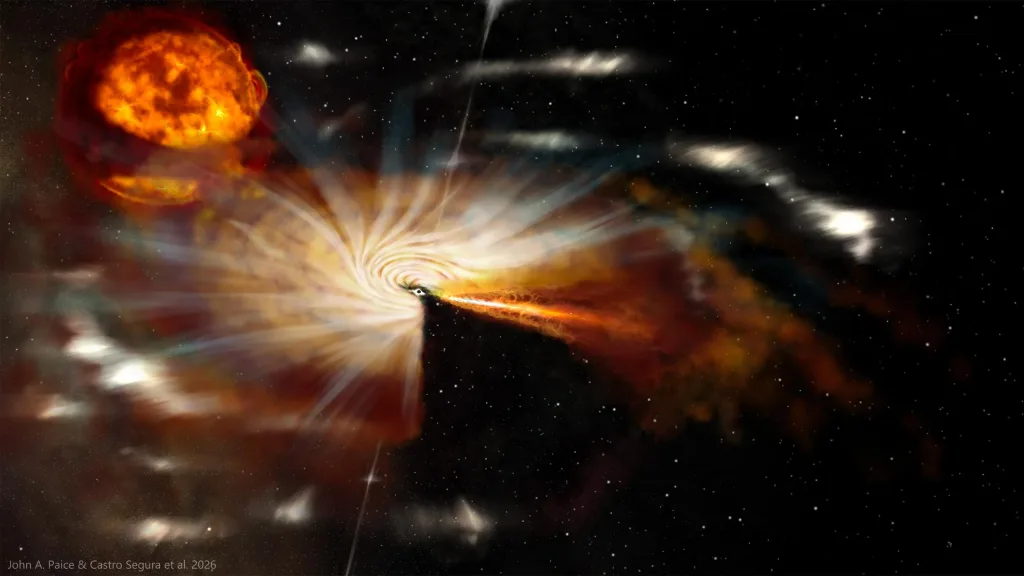
Black Holes May Not Be the Bottomless Pits We Imagined.
How Much Matter Was Leaving?
The study estimated a wind mass-loss rate of at least 10⁻⁹ solar masses per year. More importantly, that rate was comparable to the instantaneous accretion rate.
That means material leaving through the disc wind could rival the amount moving inward toward the black hole at that stage. A significant share of the gas supplied by the companion may therefore leave the system before reaching the event horizon.
That does not mean the black hole returned material after swallowing it. Anything that crosses the event horizon remains hidden from outside observers.
The evidence instead concerns gas in the surrounding accretion system. Some of that material can be redirected before it falls in.
This distinction is essential. The result does not overturn event-horizon physics. It changes the picture of how efficiently matter reaches the black hole.
Jets and the Disc Changed Together
Researchers also saw notable disc changes during periods linked with jet activity.
Around the onset of the brightest radio flare, helium emission strengthened and its profile changed. The team interpreted those shifts as evidence that stronger irradiation altered where part of the optical emission formed in the disc.
The observations do not establish one simple mechanism for every jet and wind feature. However, they offer a detailed view of how inward-moving and outward-moving material can evolve together.
Black hole binaries change state during an outburst. Their discs, X-ray spectra, jets, and winds can all respond as the accretion flow reorganizes.
Following one system across several stages gives astronomers a better way to study those connections.
Why Black Hole Winds Matter for Binary Evolution
If strong black hole winds persist into very faint states, the consequences could extend beyond one eruption.
The companion star may transfer gas for long periods, yet a significant fraction might never reach the black hole. Lost material also carries momentum and angular momentum. Over time, those losses can influence how the binary evolves and how mass transfer proceeds.
The researchers therefore argue that persistent low-luminosity winds could affect the system’s long-term evolution. Their paper notes that the outflow could have a strong impact if it continues at luminosities approaching the system’s quiescent state.
The key uncertainty is how long such winds remain active.
Swift J1727.8−1613 provides strong evidence from one eruption. However, astronomers need similar observations of other systems to determine how common this behavior is.
A Better Picture Than a “Bottomless Pit”
The popular image of a black hole as a bottomless pit is useful, but incomplete.
The event horizon still acts as a one-way boundary. Yet the environment outside it is highly dynamic.
Gas can circulate through the disc, heat up, interact with radiation, become associated with jets, or escape in winds. As a result, the black hole may receive only part of the material initially supplied by its companion.
Swift J1727.8−1613 makes that process unusually visible. By following both brighter and fainter stages, astronomers captured how the balance between inflow and outflow changed with time.
The findings therefore refine how we think about black hole feeding. The central object may be extremely effective at trapping anything that actually crosses its horizon, but getting material to that boundary is another matter.
Conclusion: Black Hole Winds Change the Feeding Picture
The observations of Swift J1727.8−1613 show that black hole feeding is not simply a one-way flow toward the event horizon.
Even after the 2023 eruption faded dramatically, black hole winds continued carrying dense gas away from the system.
With a mass-loss rate comparable to the accretion rate at that stage, the wind may have removed a substantial share of the available material.
If similar behavior occurs elsewhere, astronomers may need to revise how efficiently black hole binaries retain matter and how they evolve over long periods.
The key lesson is simple: what happens around a black hole can be just as important as what finally falls in.
Main Sources:
University of Warwick — “Black hole feeding frenzy ends in cosmic indigestion”
University of Warwick source
Monthly Notices of the Royal Astronomical Society — Castro Segura et al., “Optical outburst evolution of the transient black hole X-ray binary Swift J1727.8−1613”
MNRAS research paper via DOI
Research preprint — arXiv:2603.17023
Original research preprint
MNRAS — Supporting study of Swift J1727.8−1613’s 2023–2024 outburst
Oxford Academic supporting study
The SEO setup keeps “black hole winds” in the title, introduction, multiple subheadings, body, meta description, and conclusion while avoiding the misleading implication that material is escaping from inside the event horizon.