
BY:SpaceEyeNews.
The CERN Little Big Bang experiment has pushed early-Universe research into a surprisingly small arena. An international team created signs of quark–gluon plasma using oxygen-16 and neon-20 nuclei.
The team did not recreate the Big Bang itself. Instead, it reproduced some extreme material conditions that existed during the Universe’s first millionths of a second. Particle motion also carried an imprint of the nuclei’s hidden shapes.
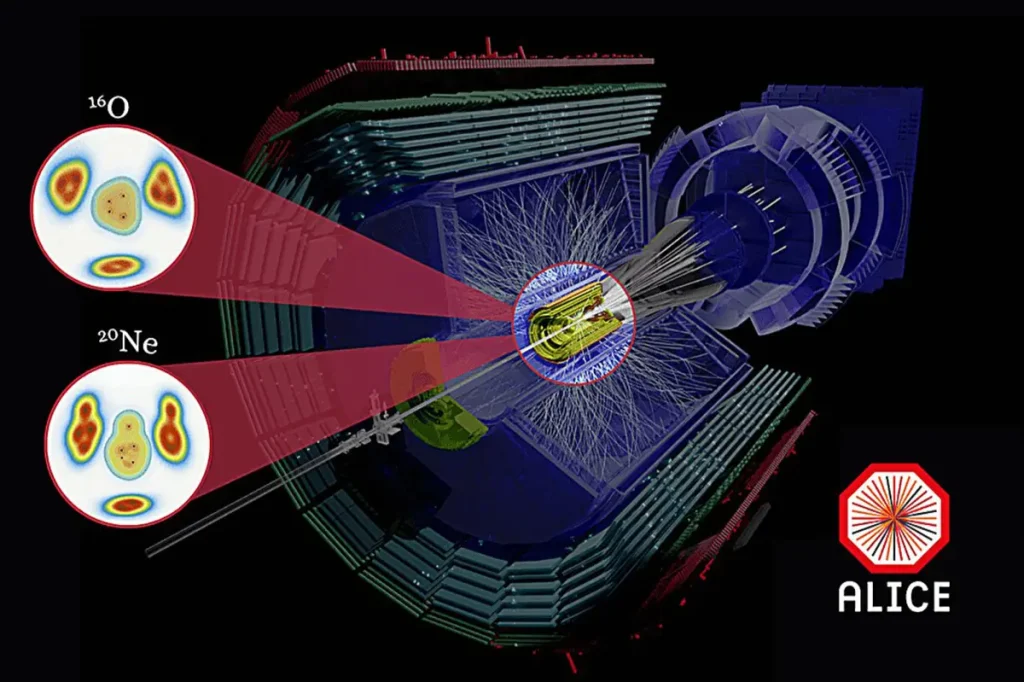
An event display shows collisions between Neon-20 and Oxygen-16.–University of Copenhagen.
How the CERN Little Big Bang Experiment Worked
The Large Hadron Collider conducted its first oxygen–oxygen and neon–neon run in July 2025. It accelerated the nuclei to almost the speed of light. Each collision reached 5.36 TeV per nucleon pair.
The ALICE detector then recorded the particles produced as each microscopic system expanded and cooled. Researchers from the Niels Bohr Institute at the University of Copenhagen in Denmark played central roles.
Physical Review Letters published the peer-reviewed results on August 17, 2026. The study presents the first ALICE measurements of elliptic and triangular particle flow in these light-ion systems.
Physicists have traditionally studied quark–gluon plasma with large nuclei, especially lead. Oxygen and neon offer a harder test. They let researchers examine how small a system can become while still showing collective behavior.
Reading a Plasma Through Particle Flow
The plasma exists for only a tiny fraction of a second. No detector photographs it directly. Scientists reconstruct its behavior from the particles that reach ALICE after the system cools.
The new study focused on anisotropic flow. This term describes differences in how particles spread around the collision point. Researchers summarize those patterns with measurements called elliptic flow, or v2, and triangular flow, or v3.
These patterns contain information about the collision’s starting shape. Pressure inside the short-lived material pushes particles outward. An uneven starting region therefore produces an uneven final distribution.
Hydrodynamic models reproduced the measured patterns well. Those models treat the expanding system like a fluid. The agreement supports geometry-driven hydrodynamic flow in oxygen and neon collisions. It does not provide a direct picture of the plasma. Instead, it offers a measurable fingerprint of collective motion.
Neon’s Bowling-Pin Shape Leaves a Signature
Oxygen-16 and neon-20 do not have identical internal structures. Models describe oxygen-16 as more rounded. They predict a more elongated, bowling-pin-like form for neon-20.
ALICE found stronger elliptic flow in central neon–neon collisions than in comparable oxygen–oxygen events. Models that included the different nuclear shapes predicted this increase. The result therefore supports the deformed structure expected for neon-20.
The effect works somewhat like a shadow. Researchers cannot watch the original nucleus during the collision. However, its geometry influences the expanding matter. That matter then guides the directions of the outgoing particles.
This does not mean the detector displayed a visible bowling pin. Instead, scientists extracted the shape statistically from many collision events. The finding gives nuclear physicists a new way to study how protons and neutrons organize inside nuclei.
Nuclear geometry also matters for plasma research. Scientists must understand the starting conditions before they can measure how the new material evolves. Better nuclear models reduce uncertainty in estimates of the plasma’s size, pressure, and fluid properties.
Is It Really Quark–Gluon Plasma?
Collective flow provides an important clue, but physicists rarely rely on one signal. Other mechanisms can sometimes create particle correlations that resemble fluid behavior.
Evidence from all four major LHC experiments now strengthens the plasma interpretation. ALICE, ATLAS, CMS, and LHCb have reported several signs of quark–gluon plasma in oxygen and neon collisions.
The Evidence Beyond Particle Flow
One major signature involves parton energy loss. Quarks and gluons can lose energy while moving through hot, dense matter. Detectors observe that change through altered particle jets and suppressed particle production.
ATLAS reported jet quenching in oxygen–oxygen and neon–neon collisions. It described them as the smallest collision systems where researchers have observed this effect. ALICE also found strong evidence of parton energy loss in oxygen collisions. CMS and LHCb reported complementary suppression patterns.
Together, these measurements make a stronger case than flow alone. However, researchers still study the precise boundary where quark–gluon plasma behavior first appears. Careful wording therefore matters. The experiments reveal multiple signs of plasma formation, not a miniature universe.
Why Smaller Collisions Matter
Light ions fill a useful gap between proton collisions and heavy-ion experiments. They give scientists a controlled way to change the system’s size and starting geometry.
That comparison may reveal which conditions allow thousands of particles to move collectively. It could also show when familiar individual particle interactions begin acting like a fluid.
The method serves nuclear physics as well. Traditional studies examine nuclear rotation, vibration, and other low-energy behavior. High-energy collisions now provide another route. Particle flow can expose structural information that remains difficult to obtain through other methods.
Testing the Strong Force
The strong force controls that structure. It binds quarks inside protons and neutrons, while related effects hold atomic nuclei together. More accurate shapes can therefore improve tests of nuclear theory.
Researchers have not yet found the minimum size needed for plasma-like behavior. The Copenhagen team has identified helium-4 as a possible future target. Such collisions could push the boundary even further.
CERN Little Big Bang Experiment Opens a New Window
The CERN Little Big Bang experiment did not reproduce the birth of space, time, or the Universe. It recreated microscopic droplets of matter that behave like material from the early cosmos.
Its importance reaches beyond that comparison. Oxygen and neon showed that collective behavior can emerge in unexpectedly small systems. Neon also carried its nuclear shape into the final particle pattern.
Future experiments may determine how small these droplets can become. They may also turn early-Universe physics into a sharper tool for mapping the hidden structure of matter.
Main Sources:
CERN:
https://home.cern/oxygen-collisions-at-the-lhc-show-new-indications-of-extreme-state-of-matter/
Niels Bohr Institute, University of Copenhagen:
https://nbi.ku.dk/english/news/news26/researchers-create-a-little-big-bang-bowling-pin-shaped-nuclei-shed-new-light-on-the-universes-first-moments/
Physical Review Letters:
https://journals.aps.org/prl/abstract/10.1103/gymp-vp87
ALICE Collaboration:
https://alice-collaboration.web.cern.ch/2025-ALICE-shape-shifting-collisions
ATLAS Collaboration:
https://atlas.cern/Updates/Briefing/OO-NeNe-Jet-Quenching