BY:SpaceEyeNews.
Rocks retrieved from the Moon’s far side have revealed an impact record that stretches across more than three billion years. The findings suggest that asteroid activity declined over a long period. It may not have centered on one brief and dramatic event, as some earlier models proposed.
This new Chang’e-6 lunar impact history comes from the first samples ever returned from the Moon’s far side. Researchers dated small pieces of rock that melted during ancient impacts. Their results provide a fresh view of how the Moon and the wider solar system changed after the planets formed.
The discovery does not settle every debate about early impacts. However, it adds evidence from a region that scientists had never sampled directly before.
Chang’e-6 Opened a New Lunar Archive
China’s Chang’e-6 mission landed in the Apollo Basin on June 2, 2024. This basin lies within the vast South Pole–Aitken Basin on the Moon’s far side.
The spacecraft collected material from the surface and below it. Its return capsule reached Earth on June 25, carrying the first lunar samples retrieved from that hemisphere. China’s National Space Administration later reported a total sample mass of 1,935.3 grams.
Location made these rocks especially valuable.
Apollo astronauts, Soviet Luna missions and China’s Chang’e-5 mission all returned samples linked to the Moon’s near side. Scientists therefore built much of the lunar timeline from material collected across only one hemisphere.
Chang’e-6 changed that situation. Its samples provide a physical record from a region with a different crust, chemical composition and geological history.
Researchers can now compare impact evidence from both sides of the Moon. That comparison may reveal whether earlier timelines reflected global events or regional conditions.
Reading Ancient Impacts Inside Lunar Rocks
The research team studied tiny fragments known as impact-melt rocks. These materials form when an asteroid or other object hits the lunar surface and produces intense heat. Part of the surrounding rock melts, then cools and solidifies.
That process can reset radioactive clocks inside the minerals.
Scientists used argon-40/argon-39 dating to determine when the fragments experienced major heating events. The method measures the relationship between different forms of argon released from a sample during controlled laboratory heating.
In practical terms, each reliable fragment can preserve the approximate date of an ancient impact.
The team reported 28 single-fragment ages. Together, they recorded events from around 4.33 billion years ago to approximately 1.13 billion years ago. This range covers much of the Moon’s geological history.
Importantly, the researchers were not dating the formation of the Moon itself. They were identifying later events that melted or strongly reheated lunar material.
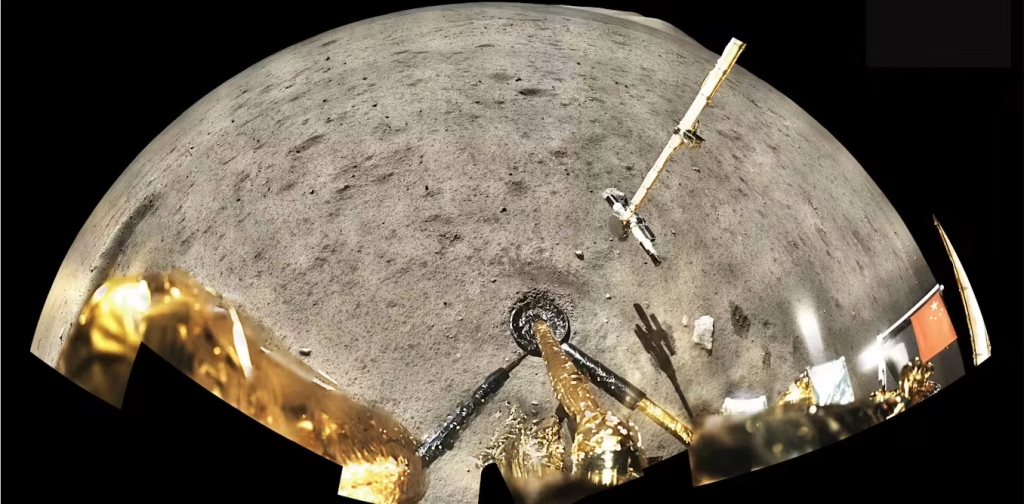
We shaved a billion years off the age of the youngest known Moon rocks, and rewrote lunar geological history
Chang’e-6 Lunar Impact History Shows a Long Decline
The distribution of dates supports a gradual reduction in impact activity as the solar system matured.
Some older models placed strong emphasis on the Late Heavy Bombardment. Under a common version of that idea, the inner solar system experienced a sharp rise in major impacts roughly four billion years ago.
Evidence for that scenario partly came from clusters of ages found in Apollo samples. Yet those samples came from a limited region on the near side. Large impacts may also have spread material over wide areas, causing several samples to record the same events.
The far-side rocks offer an independent test.
According to the new study, their ages fit a longer decline in impacts rather than one isolated surge. Early collisions happened more often. They then became less frequent as the remaining population of asteroids and planetary debris decreased.
This result challenges a simple, short-lived bombardment model. It does not prove that no temporary increase ever occurred.
Researchers still debate the timing, scale and causes of early solar system impacts. Different versions of the Late Heavy Bombardment hypothesis also make different predictions. The new evidence therefore refines the debate rather than ending it.
Why the Far Side Provides Different Evidence
The Moon’s two hemispheres do not share the same geological character.
Large dark volcanic plains cover much of the near side. These plains, known as maria, formed when lava resurfaced major regions. The far side has a thicker crust and far fewer broad volcanic plains.
Later volcanic activity can bury or alter older material. As a result, some far-side locations may preserve ancient events more clearly than heavily resurfaced near-side regions.
However, the far side is not a perfectly untouched archive. It has experienced impacts, volcanic activity, radiation exposure and constant surface mixing. Material can also move across the surface after major collisions.
Its true scientific value comes from independence. Chang’e-6 sampled a different geological environment, not an entirely unchanged one.
That distinction matters. Scientists can now test whether major conclusions drawn from near-side samples apply across the whole Moon.
The mission’s material has already supported research into lunar volcanism, magnetism, mantle composition and differences between the two hemispheres. Official reports describe the South Pole–Aitken Basin as the Moon’s largest, deepest and oldest known impact basin.
What the New Timeline Means for Earth
The findings also carry implications for our planet.
Earth and the Moon formed in the same region of the young solar system. Both experienced collisions from many of the same populations of asteroids and leftover planetary material.
Yet Earth preserves little direct evidence from that period. Plate tectonics continually recycles the crust. Weather, oceans, volcanic activity and erosion also remove or transform ancient surface features.
The Moon lacks those large-scale recycling systems. Its surface therefore retains a much older record.
By improving the Chang’e-6 lunar impact history, scientists can better estimate the environment surrounding early Earth. A more accurate impact timeline may help researchers study changes in the crust, atmosphere and oceans.
Impacts could have delivered some volatile materials while removing others. Large events may also have altered surface temperatures and affected early habitats.
Still, the new study does not explain how life began. It provides a clearer timeline for examining the conditions in which early life may have emerged.
The Moon acts as a partial archive of Earth’s missing past. Each dated lunar impact adds another reference point.
One Mission Cannot Complete the Story
Chang’e-6 delivered a major new dataset, but it sampled only one landing region.
Impact fragments can travel far from their original source. Later events may also disturb their radioactive clocks. Researchers must therefore separate reliable ages from incomplete or altered results.
Future missions could collect material from other far-side locations and major basins. Those samples would show whether the same long decline appears across the Moon.
Scientists must also compare laboratory dates with crater counts, asteroid models and lunar meteorites. No single method can reconstruct the full history alone.
Even so, Chang’e-6 has filled a major gap. For the first time, researchers can test lunar impact models using returned material from both hemispheres.
Chang’e-6 Lunar Impact History Changes the Bigger Picture
The Chang’e-6 lunar impact history suggests that early asteroid activity faded over an extended period. This pattern differs from the simplest model of one short, concentrated bombardment.
Far-side samples now provide an independent record that scientists lacked for decades. They also show why lunar history cannot rely on rocks from one hemisphere alone.
More samples will refine the timeline. Yet the central lesson is already clear. The Moon still contains geological records that can reshape our view of the solar system and reveal chapters of Earth’s history that our own planet erased.
Main Sources:
Science Advances — “40Ar/39Ar geochronology of Chang’e-6 impact melt rocks”
https://www.science.org/doi/10.1126/sciadv.aee8718
Curtin University — “Rocks from unexplored far side of the Moon help rewrite lunar history”
https://www.curtin.edu.au/news/media-release/rocks-from-unexplored-far-side-of-the-moon-help-rewrite-lunar-history/
China National Space Administration — Chang’e-6 collected 1,935.3 grams of far-side samples
https://www.cnsa.gov.cn/english/n6465652/n6465653/c10573149/content.html
China National Space Administration — Chang’e-6 sample research and landing-region information
https://www.cnsa.gov.cn/english/n6465652/n6465653/c10650772/content.html