
BY:SpaceEyeNews.
The Moon may have preserved one of the biggest missing chapters in Earth’s history. Scientists studying samples from the Chang’e 6 mission recently uncovered evidence that could reshape theories about asteroid impacts, Earth’s early environment, and the origins of water-rich materials in the inner solar system.
The new Chang’e-6 lunar soil discovery suggests carbon-rich asteroids reached the Earth-Moon system much later than scientists previously believed. That finding challenges long-standing ideas about how Earth became habitable billions of years ago.
Researchers analyzed tiny metallic fragments hidden inside lunar soil collected from the Moon’s far side. Their results revealed a dramatic shift in asteroid composition across billions of years. The study now raises important questions about the timeline of Earth’s early evolution and the delivery of water and organic materials to our planet.
For planetary scientists, this is far more than another lunar experiment. The Chang’e-6 lunar soil discovery may help explain how the early solar system evolved and why Earth developed into a habitable world.
Why the Moon Preserves Ancient Solar System History
Earth constantly changes. Oceans reshape coastlines. Volcanoes cover older surfaces. Wind and rain erase ancient geological evidence. Tectonic activity also recycles large parts of Earth’s crust deep beneath the planet.
As a result, scientists have very little direct evidence from the earliest period of Earth’s history.
The Moon is completely different.
Its surface has remained relatively stable for billions of years. Ancient impact marks still cover enormous regions of lunar terrain. Dust and rocks on the Moon preserve records of collisions that disappeared long ago from Earth.
That makes lunar soil one of the most valuable scientific archives in the solar system.
The Chang’e-6 lunar soil discovery became especially important because the mission collected samples from the Moon’s far side. Scientists know far less about this region compared to the side visible from Earth.
The Importance of the South Pole–Aitken Basin
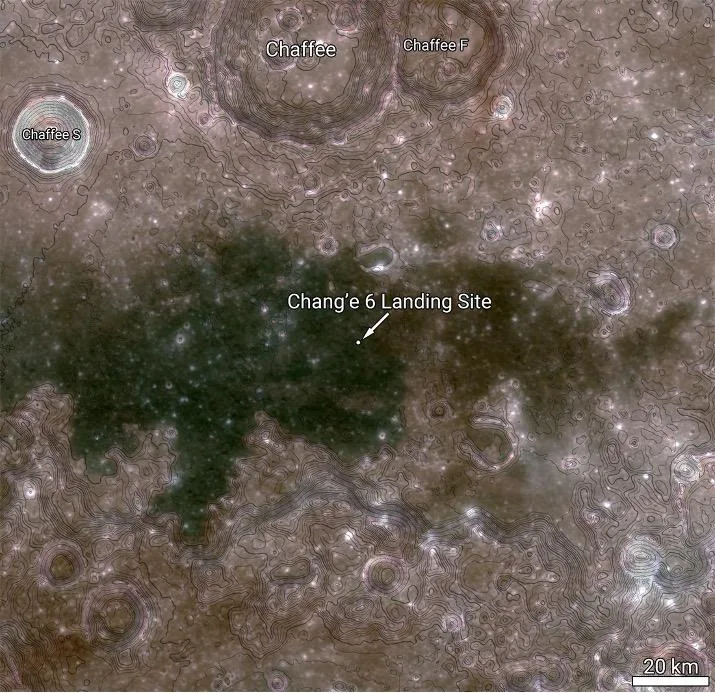
The landing site lies inside the South Pole–Aitken Basin. This massive structure stretches across a huge portion of the lunar far side. Researchers consider it one of the oldest and largest impact basins in the solar system.
Many scientists believe the region preserves extremely ancient material from deep beneath the Moon’s surface.
That gives researchers a rare opportunity to study conditions from the early solar system.
Unlike newer lunar regions, the South Pole–Aitken Basin may contain information dating back more than four billion years.
Because of that, the Chang’e-6 lunar soil discovery immediately attracted global scientific attention.
How Scientists Identified Ancient Asteroid Impacts
Researchers from the Institute of Geology and Geophysics at the Chinese Academy of Sciences focused on microscopic metallic particles trapped inside lunar fragments.
These particles act like chemical fingerprints.
By examining iron-nickel metallic grains, scientists can identify the types of asteroids that struck the Moon during different time periods.
The team identified 40 impact-related fragments containing metallic particles. Scientists then divided the material into two separate groups based on age.
One group came from lunar basalt formed around 2.8 billion years ago. The second originated from much older lunar highland material dating back roughly 4.3 billion years.
That comparison became the key to the entire discovery.
A Major Shift Appeared in the Data
The older material showed very few signs linked to carbonaceous asteroids. However, the younger samples contained a much larger proportion of those same signatures.
That means the asteroid population impacting the Earth-Moon system changed significantly over time.
Scientists now believe carbon-rich asteroids became more common later in solar system history instead of dominating the earliest periods.
This finding surprised many researchers because earlier theories suggested these asteroids played a major role during Earth’s first stages of formation.
The Chang’e-6 lunar soil discovery now points toward a more complicated timeline.
Why Carbonaceous Asteroids Matter
Carbonaceous asteroids contain water-bearing minerals and carbon-rich compounds. Scientists often connect these materials to the ingredients needed for habitable environments.
For years, many planetary models proposed that these asteroids delivered large amounts of water and organic materials to early Earth.
That idea became one of the leading explanations for how Earth’s oceans and chemistry developed.
The new study introduces a different possibility.
Earth May Have Received Less Material Than Expected
If carbonaceous asteroids arrived later than scientists thought, then Earth may not have received as much water-rich material during its earliest history.
That does not mean asteroids played no role. Instead, it suggests the process may have been more gradual and complex.
Researchers may now need to reconsider other contributing sources for Earth’s water.
Possible explanations include:
- volcanic outgassing
- icy objects from outer regions
- multiple delivery mechanisms over time
The Chang’e-6 lunar soil discovery does not erase previous theories. Instead, it expands the discussion and adds new layers to the story.
That is why this finding has become so important within planetary science.
What Could Have Changed the Asteroid Population?
Scientists also explored why the asteroid composition shifted between 4.3 billion and 2.8 billion years ago.
Several possibilities could explain the transition.
Giant Planet Migration
One leading theory involves the movement of giant planets like Jupiter and Saturn.
As these planets slowly shifted positions early in solar system history, their gravity may have altered asteroid orbits across enormous distances.
That process could have redirected more carbon-rich asteroids toward the inner solar system.
Asteroid Breakups
Another possibility involves the fragmentation of large carbonaceous asteroids.
When large asteroids break apart, they create streams of smaller debris. Over time, some of those fragments can drift toward planets and moons.
Scientists believe this mechanism may have increased the number of carbon-rich impacts later in solar system history.
Gradual Orbital Drift
Long-term orbital drift may also explain part of the change.
Tiny thermal effects and gravitational interactions slowly alter asteroid trajectories over billions of years. Even small adjustments can eventually reshape impact patterns across the solar system.
The Chang’e-6 lunar soil discovery may therefore reveal evidence of large-scale solar system evolution that occurred billions of years ago.
Why the Discovery Matters Beyond the Moon
This discovery is not only about lunar geology.
It also connects directly to one of science’s biggest questions:
How did Earth become habitable?
Researchers have spent decades trying to understand the origin of Earth’s oceans and the development of organic chemistry on the young planet.
The Chang’e-6 lunar soil discovery now suggests the timeline may be more complicated than scientists expected.
A New Era of Lunar Science
The findings also show how valuable lunar exploration has become again.
Modern missions are returning samples from regions humans never studied before. Each new mission adds another piece to the solar system’s hidden history.
Future lunar programs may reveal:
- additional asteroid records
- ancient volcanic activity
- deep lunar interior materials
- evidence of solar system instability
Scientists increasingly view the Moon as a giant scientific archive rather than a simple neighboring world.
That perspective is transforming modern planetary research.
The Moon Still Holds Many Secrets
Researchers have only begun studying the samples returned by Chang’e 6.
More discoveries could emerge as laboratories continue analyzing the material in greater detail.
Tiny particles inside lunar soil may still contain clues about:
- asteroid evolution
- early planetary movement
- ancient solar system conditions
- Earth’s missing geological history
The Chang’e-6 lunar soil discovery may ultimately become one of the most influential lunar findings in decades.
Conclusion
The Chang’e-6 lunar soil discovery is changing how scientists view the history of asteroid impacts in the Earth-Moon system. By analyzing ancient lunar material from the Moon’s far side, researchers uncovered evidence that carbon-rich asteroids became more common later than previously believed.
That finding challenges older theories about the origins of Earth’s water and early habitable conditions.
More importantly, it proves the Moon still preserves ancient records that Earth lost billions of years ago. As scientists continue studying the samples, the Chang’e-6 lunar soil discovery could unlock even more hidden chapters from the early solar system and reshape our understanding of Earth’s distant past.
Main Sources:
Chinese Academy of Sciences:
https://english.cas.cn/