
BY:SpaceEyeNews.
The CHIME hydrogen signal offers a fresh way to investigate why the universe’s expansion is accelerating. A Canadian radio telescope has detected the collective glow of distant hydrogen using its own observations. That achievement brings scientists closer to mapping cosmic history through an abundant element with an exceptionally faint voice.
Researchers have not identified dark energy or solved its mystery. Instead, they have demonstrated a technique that could help test competing explanations. Their result shows how ancient radio waves can reveal the arrangement of matter across enormous distances.
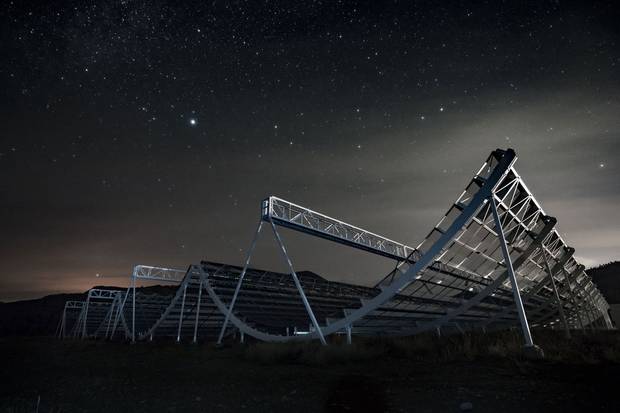
A view of CHIME at night, with the Milky Way in the background. Photo credit: CHIME collaboration.
What the CHIME Hydrogen Signal Reveals
CHIME stands for the Canadian Hydrogen Intensity Mapping Experiment. Located near Penticton, British Columbia, it surveys the northern sky and gathers radio signals from space.
Hydrogen provides a useful target because it is the universe’s most abundant element. It also supplies the raw material from which stars form. Its distribution therefore offers clues about the cosmic structures that host galaxies.
The latest result detects the combined emission of distant neutral hydrogen. Astronomers call this approach intensity mapping. Rather than cataloguing every galaxy individually, they measure changes in radio brightness across broad regions.
An Ancient Signal With a Familiar Origin
Neutral hydrogen can emit radio waves with a wavelength of approximately 21 centimetres. As those waves travel through expanding space, their wavelength stretches.
This stretching shifts the signal to lower frequencies. Astronomers use that shift, called redshift, to distinguish different periods in cosmic history.
The observed emission comes from when the universe was roughly five billion years old. That means the waves have travelled for approximately eight to nine billion years. This is a look into a much younger cosmos, long before our solar system formed. UBC Science
Why an Independent Hydrogen Detection Matters
Earlier CHIME studies compared radio observations with galaxy surveys from other telescopes. Matching patterns between those datasets helped researchers establish that the hydrogen signal was real.
Now, the team has measured the signal’s statistical structure from CHIME observations alone. The research describes this achievement as an autocorrelation detection. arxiv.org
That independence opens an important opportunity. Future measurements need not depend on matching external surveys to establish the same kind of signal. Consequently, CHIME can develop its own route toward studying cosmic structure.
Independent methods also offer a useful cross-check. If radio maps and galaxy surveys produce compatible results, they strengthen the overall picture. If they disagree, researchers can investigate whether calibration, modelling or other assumptions explain the difference.
Mapping the Collective Glow
Imagine observing a distant city whose individual buildings appear too small to distinguish. Differences in its overall brightness can still reveal busy districts and quieter neighbourhoods.
Hydrogen intensity mapping follows a similar principle. Researchers study the combined emission across regions instead of resolving every source separately.
The result is a statistical view of how hydrogen clusters. With further development, this approach could survey large cosmic volumes efficiently. It also complements detailed galaxy surveys, giving scientists another way to investigate the same universe.
How Hydrogen Mapping Could Probe Dark Energy
Dark energy is the name scientists give to the unknown explanation for the universe’s accelerating expansion. Understanding its behaviour requires measurements across different stages of cosmic history.
Hydrogen helps trace where matter lies. Meanwhile, its redshift identifies the expansion since the emission began its journey. Together, those clues support three-dimensional mapping across cosmic time.
However, detecting hydrogen alone does not immediately reveal the expansion rate. Scientists must extract useful patterns and compare observations with physical models.
Using Cosmic Patterns as a Ruler
One valuable pattern comes from ancient pressure waves in the early universe. These left a characteristic spacing in the distribution of matter, known as baryon acoustic oscillations.
Astronomers can use that spacing as a cosmic ruler. Comparing its appearance at different epochs helps them reconstruct the universe’s expansion history. NASA Science
CHIME’s new detection represents progress toward this broader goal. It does not yet provide a definitive dark energy measurement. The next challenge involves extending reliable measurements to the scales needed for such tests.
Finding a Faint Signal Beneath the Noise
The hydrogen glow must compete with much brighter radio emissions. Human technology, foreground sources and the telescope itself can all complicate the observations.
Researchers therefore improved their processing methods to isolate the distant signal. They also spent more than a year checking whether unwanted effects could explain the result.
This careful validation matters because a convincing pattern must survive changes in how scientists analyse the data. A signal that disappears under reasonable checks would offer much weaker evidence.
What the Observations Established
The study used 94 nights of observations collected in 2019. Its preprint reports a detection significance of 12.5 sigma, indicating strong statistical evidence for the measured hydrogen signal.
That number describes confidence in the detection. It does not measure confidence in any particular explanation for dark energy. arxiv.org
An accompanying analysis also examined the hydrogen’s abundance. The researchers estimated that roughly two percent of cosmic hydrogen occupied neutral atomic form at the observed epoch. This estimate broadly agrees with other measurements and offers another test of galaxy evolution models. UBC Science
What Comes Next for the CHIME Hydrogen Signal?
The current measurement uses only a small portion of CHIME’s observations. Researchers now have nearly seven years of data available for further analysis.
Their plans include reaching earlier periods, when the universe was around three billion years old. Expanding that view could help scientists follow hydrogen’s distribution across more of cosmic history. UBC Science
However, additional observations also demand careful calibration and reliable control of unwanted signals. Collecting more data and extracting trustworthy measurements must advance together.
The CHIME hydrogen signal establishes a promising foundation for that work. Ancient hydrogen can now help researchers study distant cosmic structure through an independent observational approach. As the technique develops, it could sharpen our understanding of expansion and bring dark energy’s behaviour into clearer focus.
Main sources:
- CHIME Collaboration — Research paper: Detection of the Cosmological 21 cm Signal
- University of British Columbia — Research announcement, September 28, 2026
- NASA — Baryon Acoustic Oscillations
- Tech Explorist — Hydrogen’s ancient glow could offer a new way to probe dark energy