BY:SpaceEyeNews.
When two Chinese satellites quietly separated high above Earth after months of flying as one, they may have marked a historic first.
According to independent tracking firms, the experimental pair Shijian-21 and Shijian-25 appear to have completed China’s Shijian spacecraft refueling test in geosynchronous orbit, roughly 35,786 kilometers above the equator. Space Launch Schedule+1
There was no big announcement.
No press conference.
Yet the satellites’ behavior tells a powerful story: a long docked phase, fuel-intensive orbit changes, and a clean separation. Put together, they strongly suggest a successful refueling and mission-extension demo at an altitude where some of the world’s most important satellites operate.
This low-profile experiment could reshape how we think about satellite lifetimes, orbital sustainability, and the future of large-scale infrastructure in space. And it places China’s Shijian spacecraft refueling right at the center of that shift.
How China’s Shijian spacecraft refueling mission unfolded
The two spacecraft: Shijian-21 and Shijian-25
The story starts with two very different but complementary satellites.
Shijian-21 launched in October 2021. Officially, it is an “experimental” spacecraft in geosynchronous orbit. In early 2022 it carried out a striking demonstration: it approached a defunct BeiDou navigation satellite, docked with it, and towed it into a higher “graveyard” orbit above the operational belt.
That mission proved Shijian-21 could do more than drift and station-keep. It could rendezvous, dock, and physically move another satellite. In other words, it was an ideal candidate to receive fuel or servicing later in its life.
Shijian-25 launched in January 2025 on a Long March 3B rocket. Official descriptions from Chinese sources and orbital registries say its primary purpose is to test on-orbit refueling and satellite life-extension services in GEO.
From day one, this satellite was built to be a refueling and servicing platform.
Putting these two spacecraft in the same orbital neighborhood was not an accident. It was a deliberate setup for China’s Shijian spacecraft refueling experiment.
Docking 36,000 km above Earth
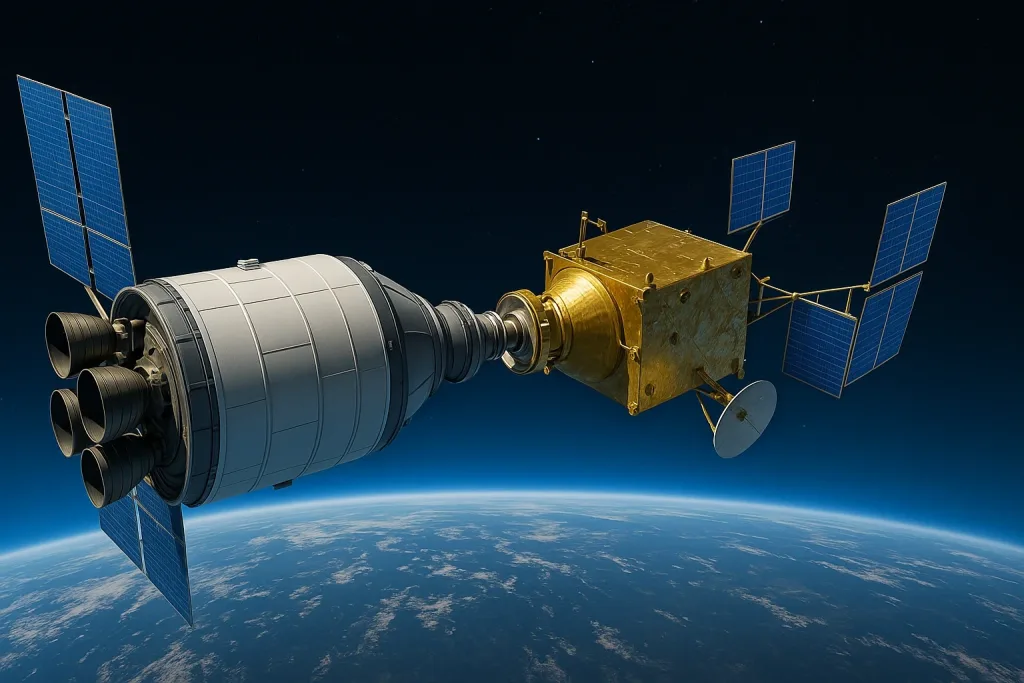
In mid-2025, tracking data from firms such as COMSPOC and S2a showed the first clear signs that the two satellites were doing something special. They performed a series of rendezvous and proximity operations in geosynchronous orbit, repeatedly closing the distance between them. South China Morning Post+1
Analysts observed a close approach on June 13, when Shijian-25 drifted steadily toward Shijian-21 until the separation was on the order of one kilometer. About 90 minutes later, the pair separated slightly, then began a new sequence of careful maneuvers. South China Morning Post+1
By early July, something even more striking happened. Optical sensors could no longer resolve Shijian-21 and Shijian-25 as two distinct points of light. Instead, they appeared visually merged in telescope images, a strong indicator that the spacecraft had docked and were flying as a single combined object. South China Morning Post
From that point onward, Shijian-21 and Shijian-25 behaved like a single satellite.
The tell-tale orbital maneuvers
Docking alone would already be impressive at GEO, but the next phase is what really attracted attention.
While docked, the combined spacecraft executed orbital plane-change maneuvers that reduced their inclination relative to the equator. These maneuvers are extremely fuel-intensive at geosynchronous altitude. They consume a significant fraction of a satellite’s propellant and are not done lightly. Space Launch Schedule+1
For an older satellite like Shijian-21, which had already used fuel during its earlier graveyard-orbit towing mission, this would have been very difficult to achieve alone. With Shijian-25 attached, however, the pair likely had access to additional propellant and more powerful or more efficient thrusters.
That combination—docking, long attachment, and fuel-heavy maneuvers—is exactly what experts expect to see from China’s Shijian spacecraft refueling test.
A quiet separation
Finally, in late November, optical observations from S2a and other trackers showed that Shijian-21 and Shijian-25 had once again become two distinct objects in geosynchronous orbit. They separated near the geostationary belt at about 35,786 kilometers altitude, with their orbits still closely aligned. Space Launch Schedule+1
SpaceNews and other outlets summarized the event as Shijian spacecraft separating after pioneering geosynchronous orbit refueling tests, reflecting the growing consensus among analysts that the mission’s core objectives had been met. Space Launch Schedule
China has not yet provided a detailed public explanation. Still, when you follow the orbital breadcrumbs, the picture is hard to ignore.
Why a refueling test in GEO is such a big deal
From single-use to serviceable satellites
For decades, most satellites have followed a simple life cycle:
- Launch with a fixed amount of propellant.
- Spend fuel on orbit raising, station-keeping, and minor maneuvers.
- End the mission when that fuel is almost gone.
The hardware might still work. The instruments might still be healthy. But once the fuel runs out, the satellite’s useful life ends. That is especially true in geosynchronous orbit, where precise positioning over a specific longitude is essential.
China’s Shijian spacecraft refueling challenges that model.
If you can dock with a satellite in GEO and transfer propellant, you breathe new life into an existing asset. Operators can extend missions by years, adjust orbits more aggressively, or repurpose aging spacecraft for new roles without launching replacements.
GEO is the most valuable “real estate” in orbit
Geosynchronous orbit is prime orbital real estate. It hosts:
- Major communications satellites
- Weather and environmental monitoring platforms
- Navigation and timing relay systems
- High-value technology demonstration spacecraft
Satellites here are expensive to build and launch. They are also crucial for everyday services, from television broadcasts to data links and disaster monitoring.
Deploying a servicing mission like Shijian-25 to GEO, and pairing it with Shijian-21, shows a clear intent to treat this orbit as maintainable infrastructure, not just a one-way destination. Space+1
Technical leap: docking and refueling at 35,786 km
Docking in low Earth orbit is already complex. Docking in GEO is even more demanding.
At 36,000 kilometers, the timing of every thruster pulse matters. Orbital velocity, inclination, and relative motion must be aligned with extreme precision. Even small errors can accumulate into large positional offsets over time.
Shijian-21 and Shijian-25:
- Performed multiple close approaches and proximity operations.
- Managed a stable docked configuration for months.
- Executed fuel-intensive inclination changes while attached.
- Then separated cleanly, with both satellites remaining intact and trackable. South China Morning Post+1
That combination indicates mastery of guidance, navigation, control, and fluid transfer systems in a demanding environment. It is not just a minor upgrade. It is a leap toward a future where satellites in GEO can be serviced much like infrastructure on the ground.
Sustainability and cost savings
There is also a sustainability angle. Extending satellite lifetimes means:
- Fewer replacement launches.
- Less hardware being retired to graveyard orbits.
- More value extracted from each kilogram launched from Earth.
On-orbit servicing and refueling are seen by many industry analysts as essential to a more sustainable, “circular” space economy, especially at higher orbits. China’s demonstration places it among the leading players in this emerging field. Inspenet+1
What China’s Shijian spacecraft refueling means for the future of space operations
New capabilities in geosynchronous orbit
With this test, China has shown that it can perform complex servicing operations around some of the most important orbits in use today. Shijian-21 and Shijian-25 now share a similar inclination with other Chinese spacecraft in GEO, including technology demonstration satellites such as TJS-11, TJS-19, Yaogan-41, and Shijian-23. Space Launch Schedule+1
Those satellites could become future candidates for inspection, orbit adjustments, or mission-extension services. Instead of launching new spacecraft, operators could send a servicing vehicle to refuel or reposition existing ones.
In practical terms, this might mean:
- Extending the life of a communications satellite that still works well.
- Shifting older spacecraft to support backup roles.
- Deploying new technologies on servicing platforms rather than replacing entire fleets.
A more active and closely watched GEO
During earlier phases of the Shijian mission, two U.S. satellites were reportedly positioned near the Chinese pair, watching the operation from both sides. South China Morning Post
This detail highlights another shift: geosynchronous orbit is no longer just a “park and forget” zone. It is becoming a dynamic environment where satellites watch, measure, and sometimes approach each other.
As more missions like China’s Shijian spacecraft refueling appear, we can expect:
- Increased tracking by commercial and governmental space-situational awareness networks.
- Greater calls for clear norms of behavior in GEO, especially for close approaches.
- More transparency discussions around servicing missions, to build trust and avoid misunderstandings.
Independent tracking companies now play a crucial role in this ecosystem. Without COMSPOC, S2a, and others, much of what happened between Shijian-21 and Shijian-25 might have remained invisible to the public. South China Morning Post+1
Stepping stone to deeper-space logistics
Refueling and servicing in GEO also have implications beyond Earth orbit.
If engineers can reliably dock and transfer propellant 36,000 kilometers from Earth, the same technologies can be adapted for future infrastructure:
- Fuel depots in high Earth orbit.
- Servicing hubs that prepare spacecraft for lunar or Martian missions.
- Orbital platforms that recycle or repurpose older satellites.
In that sense, China’s Shijian spacecraft refueling is more than a one-off demonstration. It is a proof of concept for a future where space logistics resemble a network of refueling stations, repair yards, and long-term infrastructure nodes.
Conclusion: A quiet milestone with long-term impact
The separation of Shijian-21 and Shijian-25 after months of docked operations may not have come with dramatic visuals or official fanfare. Yet the data suggest a quiet milestone: China’s Shijian spacecraft refueling test in geosynchronous orbit.
By docking, likely transferring propellant, and then executing major orbital maneuvers before separating, the two satellites have shown what the next era of space infrastructure could look like. Longer-lived satellites. Fewer replacements. More flexible orbits. And a GEO environment that behaves less like a graveyard and more like a living, serviceable network. Space Launch Schedule+1
As tracking firms and analysts continue to watch Shijian-21 and Shijian-25, one thing already seems clear: this mission will be remembered as a turning point, where high-orbit satellites started to move from “use and retire” to “service, refuel, and evolve.”