
BY:SpaceEyeNews.
The closest objects to the Sun travel far inside Mercury’s orbit, where sunlight intensifies and fragile material can rapidly disappear. Some are rocky asteroids making repeated visits. Others are comets whose encounters leave little behind. Meanwhile, NASA’s Parker Solar Probe enters this environment with carefully designed protection.
These journeys raise a more interesting question than who holds a distance record. What determines whether an object emerges intact, briefly survives, or gradually falls apart?
Asteroids That Venture Inside Mercury’s Orbit
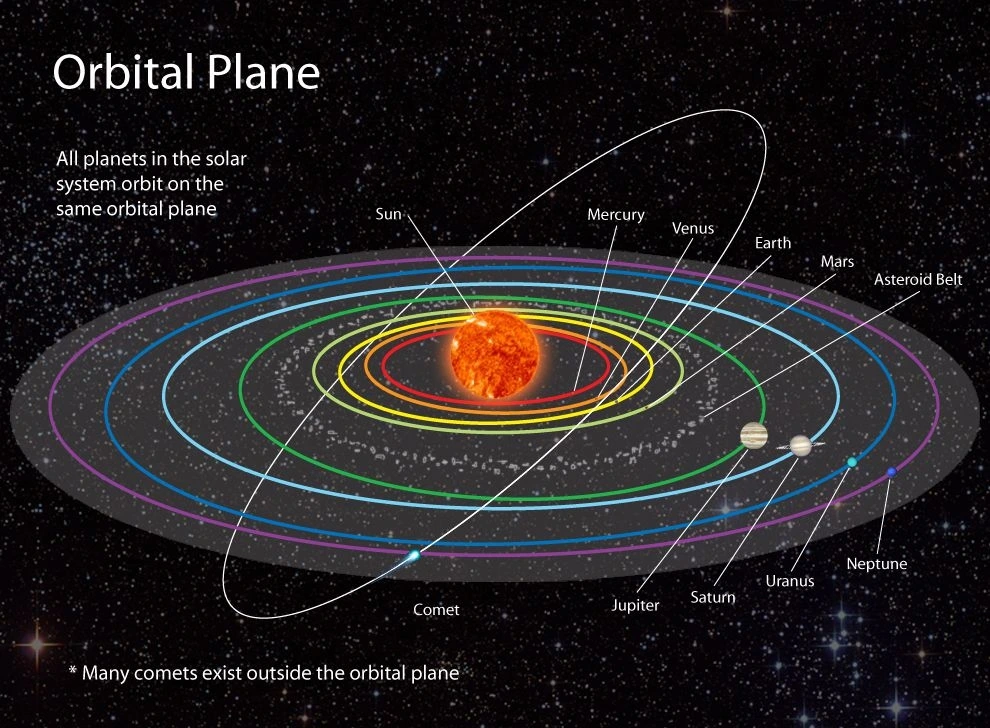
Mercury approaches roughly 47 million kilometers from the Sun at its nearest point. However, an asteroid’s elongated orbit can carry it much farther inward.
One well-documented example is 2021 PH27. Its path takes it approximately 20 million kilometers from the Sun. At discovery, astronomers estimated its diameter at around one kilometer.
Researchers found the asteroid in August 2021 using the Dark Energy Camera in Chile. Twilight observations revealed an object that ordinary nighttime searches could easily miss.
Why These Asteroids Are Difficult to Find
From Earth, objects moving near the Sun’s direction appear against bright skies. Observers therefore have limited opportunities to distinguish faint asteroids from the surrounding glare.
Twilight surveys help fill that gap. Follow-up observations then establish how these objects move and how closely their paths approach the Sun.
However, different orbital records require different comparisons. The shortest orbital period does not necessarily identify the asteroid with the closest individual approach. Likewise, spending part of an orbit inside Mercury’s path differs from remaining entirely within it.
Vulcanoids: A Population Still Missing
Another possibility lies deeper inside Mercury’s orbit: hypothetical rocky bodies called vulcanoids.
Unlike asteroids that briefly sweep inward, these proposed objects would occupy orbits between Mercury and the Sun. Their existence would add another population to the inner Solar System.
NASA’s MESSENGER mission searched for them, but those searches produced no confirmed discoveries. Researchers have also examined images from the STEREO spacecraft.
For now, vulcanoids belong in the category of possibilities. Astronomers cannot assign them a confirmed proximity record or describe them as an observed asteroid belt.
Parker Among the Closest Objects to the Sun
For human-made objects, Parker Solar Probe provides the clearest benchmark. Its closest passes bring it approximately 6.2 million kilometers above the solar surface.
That corresponds to roughly 6.9 million kilometers from the Sun’s center. Keeping those two measurements separate matters when comparing spacecraft with asteroids and comets.
Parker first reached this record distance in December 2024. NASA confirmed that its September 4, 2026 encounter again matched the record.
The spacecraft travels through the corona, the Sun’s outer atmosphere. Its instruments investigate how energy heats this region and accelerates the solar wind.
How Parker Handles Extreme Temperatures
Parker’s carbon-composite shield keeps sensitive equipment in its protective shadow. Yet the surrounding plasma’s temperature does not tell the whole story.
The corona contains extremely energetic particles, but relatively few occupy any given volume. Consequently, particle collisions transfer less heat than the enormous temperature figure might suggest.
Intense sunlight still presents a major engineering challenge. Parker’s protection manages that exposure while its instruments collect measurements.
This distinction explains why the spacecraft does not reach the corona’s million-degree temperatures. Temperature describes particle energy; the spacecraft’s heating depends on how much energy actually reaches and leaves it.
Sungrazing Comets Travel Closer Still
Comets can approach far closer than Parker. However, their mixtures of ice, dust, and rocky material face several overlapping stresses.
Solar heating turns exposed ice directly into gas. Escaping material changes the comet’s activity, while uneven heating can create internal stresses.
Meanwhile, differences in the Sun’s gravitational pull across a nucleus can encourage fragmentation. Size matters, but composition, structure, rotation, and trajectory also influence the outcome.
Many sungrazers belong to the Kreutz family. Scientists link these objects to fragments of a much larger comet that broke apart long ago. Their related paths help researchers reconstruct that shared history. However, belonging to the same family does not give every fragment the same size, strength, or survival prospects.
There is no simple rule that assigns one failure mechanism to small comets and another to large ones.
The Complicated Case of the 1887 Comet
The Great Southern Comet of 1887 often appears in discussions of exceptionally close solar encounters. However, calling it an intact survivor oversimplifies its history.
Researchers describe it as a “headless” comet and discuss its behavior alongside comet disintegration. Its visible tail does not establish that a substantial nucleus remained intact.
That distinction matters when identifying the closest objects to the Sun. A visible aftermath and a surviving solid body represent different kinds of evidence.
Lovejoy’s Survival Came With a Limit
Comet Lovejoy offered a clearer modern example in December 2011. Solar spacecraft observed it emerge after its close passage around the Sun.
Nevertheless, its story continued after that dramatic moment. Subsequent research concluded that its nucleus disintegrated following perihelion, with the process culminating about 1.6 days afterward.
Lovejoy therefore illustrates an essential distinction: passing the closest point successfully does not guarantee lasting survival.
What Solar Observatories Reveal
These encounters also create scientific opportunities. Solar observatories can follow objects that would otherwise vanish into the Sun’s glare.
On March 25, 2024, a volunteer identified SOHO’s 5,000th comet discovery in spacecraft images. The milestone demonstrated how public participation can expand a mission’s scientific reach.
Such observations document changes in brightness, tails, and fragmentation. They help researchers investigate how comet material responds to an extreme environment.
Importantly, a comet does not need to reach the visible solar surface to disappear. Comet ISON, for example, completed its disintegration before its closest approach.
Closest Objects to the Sun: More Than a Record
The closest objects to the Sun reveal different limits of natural material and spacecraft design. Asteroids make deep visits, Parker gathers measurements, and comets sometimes leave only scattered material behind.
Distance alone cannot explain those outcomes. Structure, composition, heating, and trajectory all matter.
Each encounter offers another opportunity to understand our star’s surroundings—and the demanding conditions that shape everything passing through them.
Main sources:
- AURA/NOIRLab: Discovery of asteroid 2021 PH27
- NASA: Searching for Vulcanoids
- NASA: Parker Solar Probe’s September 2026 encounter
- NASA: Why Won’t Parker Solar Probe Melt?
- NASA Technical Reports Server: Disappearance and Disintegration of Comets
- Sekanina and Chodas: Comet Lovejoy’s Nucleus Disintegration
- NASA: SOHO Discovers Its 5,000th Comet