
BY:SpaceEyeNews.
Complex carbon on Mars has just become one of the most exciting clues in the search for ancient life beyond Earth. NASA’s Perseverance rover has detected complex organic carbon inside two mudstone rocks in Jezero Crater. These rocks sit in the Bright Angel formation, near an ancient river valley called Neretva Vallis.
This is not proof of life on Mars. That point matters.
Yet the discovery is still powerful. Perseverance found hundreds of organic carbon detections in rocks that formed in a water-shaped environment. On Earth, similar ancient mudstones can preserve chemical traces for huge spans of time. That makes this Martian site especially important.
The new finding also connects with the famous Cheyava Falls rock. That rock gained attention because of its unusual “leopard spots.” Scientists describe those features as a potential biosignature candidate. In simple terms, they might have a biological origin, but scientists still need more evidence.
Now, with complex carbon on Mars found in the same wider region, the mystery has become even stronger.
What Did Perseverance Actually Find?
Perseverance examined two mudstone rocks in the Bright Angel formation. This area lies near Neretva Vallis, an ancient river channel that once carried water and sediment into Jezero Crater.
The rover used SHERLOC, one of its key science instruments. SHERLOC stands for Scanning Habitable Environments with Raman and Luminescence for Organics and Chemicals. It uses laser-based spectroscopy to study minerals and organic compounds in rock.
In these mudstones, SHERLOC detected macromolecular carbon. That means large, complex carbon-rich material. Scientists often find this kind of carbon in old rocks on Earth and in some meteorites.
The result stands out because of its strength. The measurements showed hundreds of organic detections. Researchers described it as the most robust organic detection so far in Jezero Crater.
That does not mean Perseverance found fossils. It does not mean NASA confirmed microbes. Instead, it means the rover found complex organic chemistry in a place where ancient life could have had a chance to exist.
For the search for life on Mars, that is a serious clue.
Why Complex Carbon on Mars Matters
Carbon sits at the center of life as we know it. On Earth, living things use complex carbon chemistry to build cells, store information, and run biological processes. So when scientists find organic carbon in ancient rocks, they pay close attention.
Still, organic carbon does not automatically mean biology.
Complex carbon on Mars could have formed in several ways. Some pathways involve life. Others do not. Meteorites could have delivered organic material to the Martian surface. Rock-water reactions could also create or alter organic compounds. Hydrothermal processes may play a role too.
This is why the discovery is exciting, but not final.
The key point is location. Perseverance found this carbon in mudstones from an ancient river-lake environment. That is exactly the kind of setting where scientists would expect good preservation.
Ancient Mars once had flowing water in many places. Jezero Crater was one of the best targets because it once held a lake and a river delta. Sediments could have settled there slowly. Over time, those sediments hardened into rock.
If ancient microbes ever lived in that environment, mudstone might preserve their chemical traces.
Why Mudstone Is So Important
Mudstone may not sound dramatic. Yet it can act like a natural archive.
It forms from fine particles that settle in calm water. These particles can trap minerals, organic compounds, and chemical signals. On Earth, mudstones can preserve signs of ancient environments with impressive detail.
That is why the Bright Angel rocks matter.
They are not random stones on the Martian surface. They formed in a place shaped by water. They also contain fine-grained sediment. This gives scientists a better chance of finding preserved organic material.
Perseverance did not just detect carbon on the surface of an ordinary rock. It found complex carbon linked to ancient sedimentary material. That detail changes the story.
It tells us that Jezero Crater may have preserved organic chemistry in a way that scientists can still detect today.
Even more interesting, the carbon appears in different mineral settings. One mudstone showed carbon mainly with silicate minerals. Another showed carbon with carbonate and sulfate minerals. This suggests a more complex history.
Water may have moved through these rocks at different times. Minerals may have formed or changed during later chemical events. Organic material may have arrived or survived across more than one stage of Martian history.
That makes the Bright Angel formation a layered mystery.
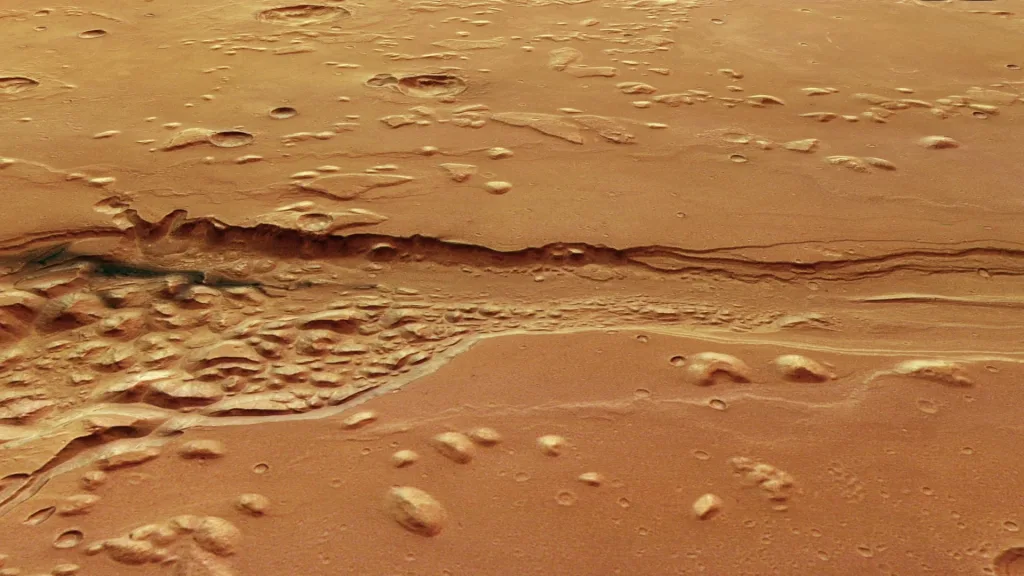
Perseverance rover spots complex carbon in Red Planet rocks.
The Bright Angel Formation Is Becoming a Scientific Hotspot.
Bright Angel has quickly become one of the most important locations in Perseverance’s mission.
The region sits near Neretva Vallis. This ancient valley once carried water into Jezero Crater. That means the area offers a direct connection to Mars’ watery past.
Perseverance had already found Cheyava Falls there. This arrowhead-shaped rock became famous because of its “leopard spots.” These small markings include chemical and mineral patterns that could relate to ancient reactions inside the rock.
On Earth, some similar features appear in rocks linked to microbial activity. But Mars is not Earth. Scientists must stay careful. Heat, fluid chemistry, and non-biological reactions can also create surprising patterns.
That is why the new carbon discovery matters.
It does not prove that Cheyava Falls came from life. Yet it places more organic chemistry in the same scientific neighborhood. Bright Angel now has ancient mudstones, organic carbon, water-related minerals, and possible biosignature candidates.
One clue alone may not solve the mystery. A cluster of clues makes the site harder to ignore.
How SHERLOC Found the Organic Carbon
SHERLOC gives Perseverance a close-up chemical view of Martian rocks. It uses laser light to detect minerals and organic compounds. It can also map where those signals appear.
That mapping matters.
Scientists do not only want to know whether carbon exists. They want to know where it sits inside the rock. They also want to know which minerals surround it. The mineral context can reveal how the carbon may have formed, moved, or survived.
In the Bright Angel mudstones, SHERLOC detected organic carbon in a natural rock surface on Mars. That makes the finding especially important.
Still, SHERLOC has limits.
The instrument can identify compelling targets. It can show scientists where organic chemistry appears. It can reveal links between carbon and minerals. But it cannot fully prove whether the carbon came from life or non-life chemistry.
That final answer requires deeper laboratory tests.
Earth labs can study samples with far more powerful tools. Scientists can examine carbon structure, isotopes, microscopic textures, and mineral relationships at much higher sensitivity.
Perseverance can find the best clues. Earth laboratories may be needed to solve them.
The Cheyava Falls Connection
The new discovery also brings Cheyava Falls back into focus.
Cheyava Falls is one of the most intriguing rocks ever studied by Perseverance. It contains organic compounds, calcium sulfate veins, and unusual spots. These spots have drawn attention because they may record chemical reactions that could have supported microbial life.
Again, the word “could” is essential.
Scientists have not confirmed a biological origin. They continue to test other explanations. Some minerals in the rock may point to complex fluid activity. Other details raise questions about temperature and timing.
Yet Cheyava Falls remains special because it contains several important ingredients in one place. It has organic material. It formed in a water-shaped setting. It includes chemical patterns that deserve deeper study.
Now, the wider Bright Angel region also shows complex carbon on Mars in nearby mudstones. That strengthens the case for this area as a prime target.
The story is no longer about one strange rock. It is about an entire environment that may have preserved valuable clues.
Could This Be Evidence of Ancient Martian Microbes?
This is the question everyone wants answered.
Could complex carbon on Mars point to ancient microbial life?
Yes, it could. But it could also point to non-biological chemistry.
On Earth, macromolecular carbon can appear in ancient rocks as a remnant of past life. In some cases, it may be the only surviving organic trace of organisms that lived long ago.
That makes the Martian detection exciting.
Early Mars may have had rivers, lakes, sediments, and chemical energy sources. Those are ingredients that matter for habitability. Jezero Crater had several of them.
But habitability is not the same as life.
A planet can have water and organic chemistry without biology. A rock can contain carbon without fossils. A chemical signal can look promising but still have a geological explanation.
This is why scientists use cautious language. They speak about potential biosignatures, organic detections, and possible ancient-life clues. They do not call it confirmed life.
That caution makes the discovery stronger, not weaker. It protects the science from hype. It also keeps attention on the real question.
What process made this carbon?
Why Scientists Need the Samples Back on Earth
Perseverance was designed to explore, analyze, and collect promising samples. It was not designed to answer every question from the Martian surface.
That matters here.
The rover has done its job well. It found rocks with strong scientific value. It studied them with advanced instruments. It identified organic carbon in an ancient water-rich setting.
But the final verdict needs more.
Earth laboratories can test samples in ways a rover cannot. Scientists can slice rocks into ultra-thin sections. They can examine microscopic textures. They can measure carbon isotopes. They can compare organic structures with minerals around them.
These tests could help separate biological and non-biological origins.
A sample from Bright Angel or Cheyava Falls would be incredibly valuable. It could help scientists understand whether the carbon formed on Mars, arrived from space, or came from chemical reactions linked to water.
It could also show whether any pattern truly points toward ancient microbial activity.
Until scientists can study these rocks with Earth-based tools, the mystery remains open.
What This Discovery Changes About Mars
The discovery does not rewrite Mars history overnight. But it sharpens the picture.
For years, Mars has looked like a planet that once had habitable environments. Rovers and orbiters have found dry river valleys, lake beds, clay minerals, sulfates, and carbonates. Perseverance has now added another key piece.
Complex carbon on Mars appears inside ancient mudstones from Jezero Crater.
That suggests organic material may have survived in places where water once shaped the landscape. It also supports the idea that ancient Mars had more than one ingredient needed for life.
This does not mean Mars was alive. But it does mean Mars continues to look chemically interesting.
The strongest story is not one headline. It is the pattern.
Water shaped Jezero. Sediments settled there. Mudstones formed. Organic carbon survived. Cheyava Falls showed possible biosignature features. Now, Bright Angel has produced another major clue.
Each step makes the ancient-life question more serious.
Why This Story Needs Careful Language
Space discoveries often attract dramatic headlines. This one deserves excitement. It also needs accuracy.
NASA has not announced life on Mars. Perseverance has not photographed microbes. No fossil has been confirmed. No single instrument result can settle the case.
What Perseverance has found is more subtle and more scientifically valuable.
It found complex organic carbon in ancient Martian mudstones. It found that carbon in a region tied to flowing water. It found it near a rock already known for possible biosignature features.
That makes the discovery important without exaggeration.
For a general audience, the best way to understand the story is simple. Mars has not given us the answer yet. But it has given us one of the most interesting clues so far.
Conclusion: Complex Carbon on Mars Keeps the Mystery Alive
Complex carbon on Mars is not proof of ancient life. But it is one of the strongest clues Perseverance has found in Jezero Crater.
The rover detected complex organic material inside ancient mudstones from the Bright Angel formation. These rocks formed in a water-shaped environment near Neretva Vallis. They also sit close to Cheyava Falls, the famous rock with possible biosignature features.
That combination matters.
Mars once had the right places to preserve ancient chemistry. Perseverance has now shown that some of that chemistry still exists. The next challenge is to understand its origin.
Did geology create it? Did meteorites deliver it? Or did ancient Martian microbes leave behind a chemical trace?
For now, the answer remains unknown. But the trail is becoming harder to ignore.
Main sources :
NASA/JPL — NASA’s Perseverance Rover Scientists Find Intriguing Mars Rock
https://www.jpl.nasa.gov/news/nasas-perseverance-rover-scientists-find-intriguing-mars-rock/
NASA/JPL — NASA Says Mars Rover Discovered Potential Biosignature Last Year
https://www.jpl.nasa.gov/news/nasa-says-mars-rover-discovered-potential-biosignature-last-year/
Planetary Science Institute — What new analyses reveal about the Bright Angel formation on Mars
https://www.psi.edu/blog/what-new-analyses-reveal-about-the-bright-angel-formation-on-mars/
NASA Science — Mars 2020 Perseverance Rover Mission
https://science.nasa.gov/mission/mars-2020-perseverance/
Original article you shared — Space.com
https://www.space.com/astronomy/mars/did-nasa-just-find-evidence-of-ancient-life-on-mars-perseverance-rover-spots-complex-carbon-in-red-planet-rocks