
BY:SpaceEyeNews.
Cosmic inflation may have lasted only a tiny fraction of a second, yet its possible fingerprints still shape the sky. Researchers have now sharpened their search for those fingerprints using distant quasars. Their approach improves a key measurement by approximately 25% compared with an earlier analysis of the same catalog.
The advance comes from studying more than where quasars gather. Astronomers also examine how their redshifts vary across different directions. Together, these clues offer a more precise way to investigate the physics behind the Universe’s earliest expansion.
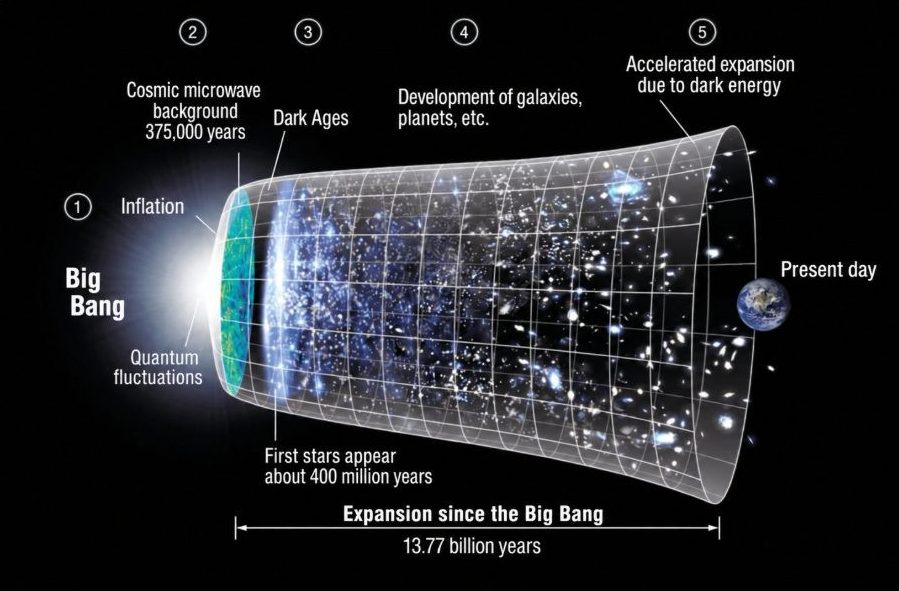
Why Cosmic Inflation Still Holds a Mystery
Inflation offers an explanation for how tiny early fluctuations grew into the seeds of cosmic structure. However, identifying the mechanism behind that expansion remains a major challenge.
Different models can produce broadly similar universes. Scientists therefore need measurements sensitive enough to reveal subtle differences between their predictions.
One promising clue concerns the statistical pattern of the earliest fluctuations. Researchers investigate whether that pattern departed from a Gaussian distribution, a particular statistical form. They call these departures primordial non-Gaussianity.
The distinction matters because competing inflation scenarios can predict different amounts and types of non-Gaussianity. Measuring those differences could help narrow the possibilities. Today’s galaxy and quasar maps offer a way to investigate those ancient conditions through the structures that developed afterward.
Why Quasars Make Such Useful Cosmic Markers
The team used Quaia, a catalog containing approximately 1.3 million quasars. Kate Storey-Fisher and her collaborators built it by combining Gaia observations with unWISE infrared data. arxiv.org
Gaia primarily mapped the Milky Way, but its observations also captured vast numbers of objects far beyond our galaxy. Quaia turns that information into a resource for studying the wider Universe.
Its strength lies in the enormous volume it covers. Nearby maps reveal only a limited portion of the cosmic landscape. Distant quasars extend that view across much larger regions, giving researchers access to patterns on immense scales.
These objects did not exist during inflation. Instead, their distribution traces later structures that developed from earlier fluctuations. That connection lets astronomers investigate the distant past without observing inflation directly.
Looking Beyond the Number of Quasars
Conventional analyses examine how object counts change across the sky. Some regions contain more quasars than average; others contain fewer. Those contrasts help researchers study the distribution of matter.
The new analysis adds another layer: angular redshift fluctuations.
Redshift measures how much cosmic expansion stretches light toward longer wavelengths. It helps astronomers estimate an object’s distance. Across a selected sample, variations in redshift therefore provide information that object counts alone cannot capture.
Two sky regions can contain similar numbers of quasars while showing different redshift patterns. Counting objects would overlook that distinction. Including redshift variations gives researchers another way to examine the same cosmic landscape.
Adding Planck’s View of Matter
The researchers also combined the quasar measurements with Planck maps of gravitational lensing of the cosmic microwave background.
Matter bends this ancient light as it travels across the Universe. Lensing maps therefore provide another view of intervening structure. Comparing these maps with quasar observations strengthens the combined analysis. arxiv.org
The achievement shows why better analysis can matter alongside larger telescopes. Existing observations can contain useful information that earlier approaches did not fully exploit.
What the 25% Improvement Actually Means
The study focuses on the local primordial non-Gaussianity parameter, written as fNL. Under its baseline modeling assumption, the team obtained fNL = −3 ± 14 at 68% confidence.
The uncertainty matters more than the slightly negative central value. Zero sits comfortably within that range, so the result does not establish a detection of primordial non-Gaussianity.
Instead, the analysis tightens the range of possibilities. Its uncertainty improves by up to approximately 25% compared with the previous Quaia measurement. arxiv.org
That comparison has a specific meaning. It does not mean scientists now understand inflation 25% better. Nor does it mean this technique outperforms every other measurement of the early Universe.
The findings appear in Astronomy & Astrophysics. José Bermejo-Climent of Hungary’s Konkoly Observatory led the study, with collaborators including researchers at the Instituto de Astrofísica de Canarias.
Why Cosmic Inflation Still Needs Stronger Tests
Planck’s measurements of the cosmic microwave background provide an important benchmark, with uncertainty of roughly five units for this parameter. The quasar result has not surpassed that precision.
Researchers want to approach uncertainty of around one unit to distinguish important classes of inflation scenarios more effectively. Reaching that level requires further progress.
A result consistent with zero does not rule out inflation. Some scenarios predict signals too small for current measurements to distinguish. As uncertainties shrink, researchers can test more of those predictions. The goal is to separate plausible explanations through increasingly demanding observations.
Precision Must Come With Reliability
A narrower uncertainty range only helps if the analysis also handles observational limitations correctly. Distance estimates, uneven sky coverage, and assumptions about how quasars trace matter can influence the interpretation.
For that reason, the new result represents a methodological advance rather than a final verdict. It strengthens one route toward testing inflation while leaving the underlying physical mechanism unresolved.
What the Next Sky Surveys Could Reveal
The researchers plan to apply the approach to major surveys, including DESI, Euclid, SPHEREx, and Rubin Observatory’s Legacy Survey of Space and Time. iac.es
These projects offer opportunities to combine larger cosmic maps with more informative analysis. Their value will depend on data quality as well as the number of objects they observe.
The next step is to test how much additional precision redshift fluctuations can provide across those datasets. No single survey guarantees a definitive answer.
Reading the Earliest Universe More Clearly
Cosmic inflation remains an open investigation into the physics of our beginnings. Quasar maps now offer a sharper tool for that search. By extracting more information from familiar observations, astronomers can tighten their tests and move closer to understanding what shaped the Universe’s first moments.
Main sources:
- Instituto de Astrofísica de Canarias — Official research announcement
- Research paper — Improving constraints on primordial non-Gaussianity from Quaia
- Quaia: The Gaia-unWISE Quasar Catalog — Original catalog research
- Universe Magazine — Quasars are helping researchers track the traces of cosmic inflation following the Big Bang with greater precision.