
BY:SpaceEyeNews.
The cosmic treble clef looks like a musical symbol drawn across space. Yet its looping radio filaments may preserve a much older story. Astronomers think a supermassive black hole supplied the original material. Later, a merger between two galaxy clusters helped that fading material shine again.
NASA’s Chandra X-ray Observatory provided crucial clues to this sequence. Together with radio and infrared observations, its measurements connect the unusual structure to its surroundings. The result offers a likely explanation for the glow, while leaving questions about its intricate shape. science.nasa.gov
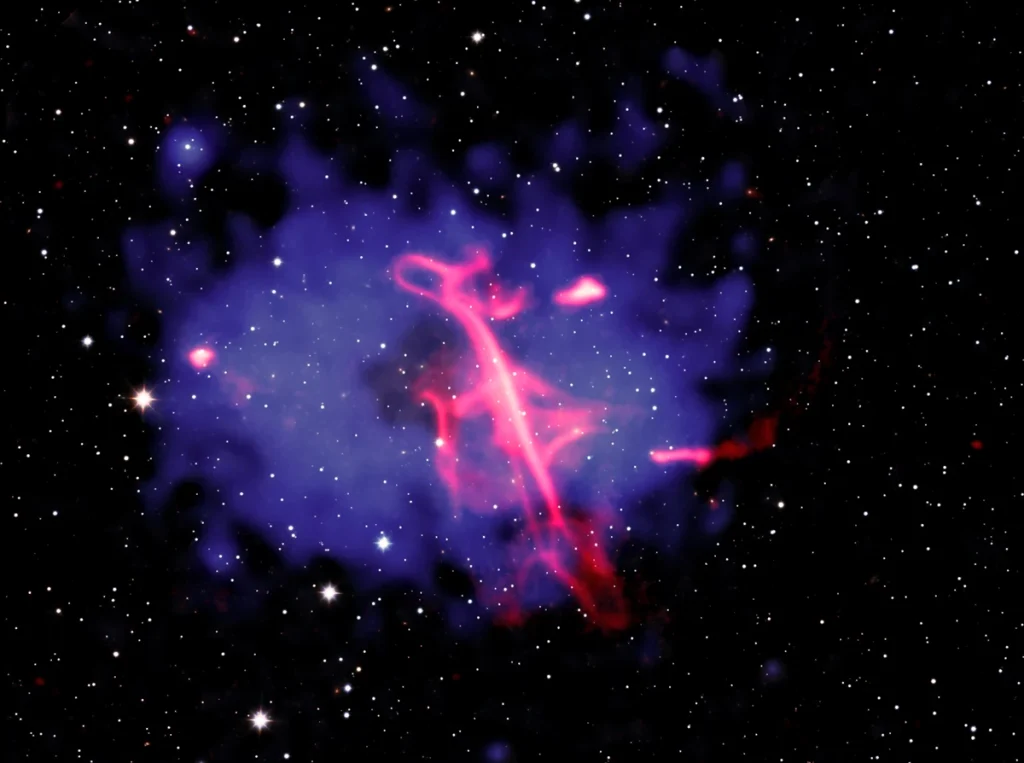
Cosmic Treble Clef: Chandra Reveals a Galaxy Cluster Merger.
Why the Cosmic Treble Clef Stayed Mysterious
The source, formally known as VLSS J0318.9+5755, lies behind the crowded plane of the Milky Way. From Earth, foreground stars, gas, and dust complicate the view. That makes identifying the environment around the radio structure particularly challenging.
Earlier observations even prompted an initial pulsar interpretation. However, later work suggested that the source belonged to a heavily obscured galaxy cluster. Researchers needed additional evidence to establish that setting and understand what had happened there.
Andrea Botteon of Italy’s National Institute for Astrophysics led the new study, published in Astronomy & Astrophysics. His team combined observations across several wavelengths to investigate both the radio filaments and their host cluster. arxiv.org
This approach shifts the focus from the outline alone to the conditions that produced it. The key evidence comes from comparing the radio source with the gas surrounding it, rather than judging its resemblance to a familiar symbol.
Different Telescopes Reveal Different Clues
LOFAR, a European radio telescope network, reveals the striking outline that inspired the nickname. Meanwhile, Chandra and eROSITA detect the surrounding hot gas through its X-ray emission. Together, those observations link the radio source to a cluster undergoing a merger.
The published composite brings these different measurements into one image. Red traces the radio emission, while blue represents gas at temperatures of millions of degrees. Infrared observations from the United Kingdom Infrared Telescope add mostly white points of light.
These colors help readers separate the components. The narrow radio filaments and the broader X-ray glow trace different physical conditions. Treating everything as one cloud would hide the relationship scientists want to understand.
Just as importantly, the image translates invisible wavelengths into visible colors. It does not show a musical symbol that human eyes could directly see. chandra.harvard.edu
A Black Hole Supplied the Original Material
The proposed history begins with an earlier episode of black hole activity. An outflow carried charged particles and magnetic fields away from the central region. Initially, this material produced bright radio emission.
Over time, the particles lost energy, and the radio glow weakened. The structure therefore retained evidence of past activity even as its brightness declined.
That fading stage matters because today’s emission need not come entirely from a fresh outburst. Instead, the surrounding environment may have changed the condition of material already present.
This distinction gives the discovery its central question. If the original particles were aging, what allowed the radio source to become prominent again? The answer appears to involve the much larger system around it. chandra.harvard.edu
How a Cluster Merger Revived the Radio Glow
As the two galaxy clusters interacted, their gas changed the environment around the old outflow. Compression or renewed energization could then make the faded material brighter in radio waves.
Astronomers describe the Treble Clef as a “radio phoenix.” The name captures the apparent revival of an aging radio source. It also connects the object’s current appearance to an earlier phase of black hole activity.
However, identifying that broad sequence does not settle every physical detail. Shock waves may have contributed to the revival. Researchers also suggest that merger-driven gas motions helped shape the complex filaments.
The distinction is important: evidence supports a relationship with the merger, while the precise shaping process remains uncertain. Scientists have not established that several intersecting shock waves created every loop. arxiv.org
Chandra Reveals Traces of the Merger
To examine the cluster more closely, researchers looked for departures from a smooth gas distribution. Much of its X-ray glow follows an approximately oval pattern.
They subtracted a model of that smooth component from the image. This calculation highlighted uneven features that the broader glow could otherwise obscure.
The remaining emission appeared brighter on opposite sides and fainter near the center. That pattern suggests the encounter proceeded roughly from left to right in the published image.
Researchers estimate that the clusters passed directly through one another a few hundred million years ago. They interpret the present arrangement as a stage when the clusters are moving apart.
Crucially, this method removed a mathematical model from the data. It did not remove a spherical piece of the black hole outflow. chandra.harvard.edu
What the Filaments Still Have to Tell Us
The cosmic treble clef offers more than an unusual outline. Its filaments provide a way to investigate how old radio-emitting material responds to changing conditions between galaxies.
The team combined observations at different radio frequencies to examine those filaments. Their analysis supports the radio-phoenix interpretation and identifies the source as a promising target for further study.
Future observations with LOFAR2.0 could examine it at very low frequencies with finer detail. Such measurements may help researchers test their ideas about the structure’s complicated appearance.
For now, the broad history is clearer than the explanation for each individual feature. That leaves a focused next step: examining the filaments closely enough to distinguish among possible shaping processes. arxiv.org
The Cosmic Treble Clef Preserves a Hidden History
Its familiar shape draws attention, but the cosmic treble clef matters because it connects two stages of cosmic activity. A black hole likely supplied the material, and a later cluster merger altered its radio glow.
By combining complementary observations, astronomers have reconstructed that likely sequence through a difficult foreground. The remaining mystery concerns the details: exactly how moving gas transformed an aging outflow into the intricate structure we see today.
Main sources:
- NASA: Chandra Breaks Down “Treble Clef’s” Galaxy Cluster Collision
- Chandra X-ray Observatory: Treble Clef observations and images
- Research paper: The Treble Clef radio phoenix and its old nonthermal filaments