BY:SpaceEyeNews.
🚀 Introduction
The Cygnus X-1 black hole jets power has finally been measured with striking precision. For decades, this system stood as one of the most studied yet least understood cosmic engines. Now, new observations reveal jets moving at nearly half the speed of light. Their energy output rivals 10,000 Suns. This breakthrough does more than quantify a famous black hole. It confirms a core assumption in astrophysics and reshapes how scientists study the evolution of galaxies.
🔭 Cygnus X-1 Black Hole Jets Power and the Measurement Challenge
Pinning down the Cygnus X-1 black hole jets power has long tested astronomers. The system lies about 7,200 light-years away, placing it far beyond direct measurement. For years, scientists relied on models rather than observations.
Why measuring jet power was so difficult
Black hole jets travel at extreme speeds and interact with complex environments. Their distance adds another layer of uncertainty. As a result, direct measurements remained out of reach. Researchers instead built simulations to estimate their energy.
One assumption became central. About 10% of the energy from infalling matter was believed to power the jets. This “10% rule” shaped decades of research, yet lacked direct proof.
From assumption to precision
That gap has now closed. Using a global network of radio telescopes, scientists effectively created an Earth-sized instrument. This setup captured fine details in the jet structure. For the first time, the Cygnus X-1 black hole jets power could be constrained by real data rather than theoretical estimates.
🌪️ Cygnus X-1 Black Hole Jets Power Revealed by “Dancing Jets”
A simple but powerful idea unlocked the measurement. Scientists turned to the motion of the jets themselves.
A system in constant motion
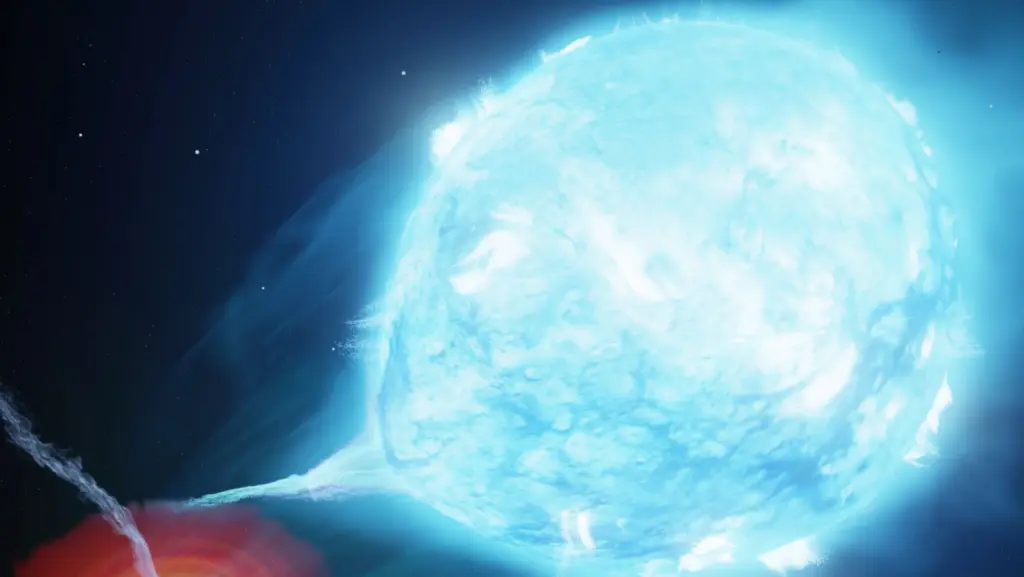
Cygnus X-1 exists in a tight orbit with a massive supergiant star. This companion generates intense stellar winds. These winds interact directly with the black hole’s jets.
As the system moves, the jets shift and bend. Their direction changes in response to the surrounding wind. This motion creates a pattern that can be tracked over time.
Measuring power through deflection
Instead of measuring the jets directly, researchers measured how much they bend. Strong jets resist deflection. Weaker jets bend more easily. This relationship allowed scientists to calculate their true power.
The results were clear:
- Jet speed reaches about 150,000 kilometers per second
- This equals roughly half the speed of light
- The total energy output matches about 10,000 Suns
This method delivers the most reliable measurement yet of the Cygnus X-1 black hole jets power.
A new observational tool
The “dancing jets” technique avoids the limits of direct observation. By focusing on interaction instead of emission alone, it provides a new way to study black hole systems. This approach is expected to apply far beyond Cygnus X-1.
⚡ Cygnus X-1 Black Hole Jets Power Confirms the 10% Rule
One of the most important outcomes lies in what this measurement confirms.
A long-standing assumption tested
The 10% rule has guided astrophysics for decades. It suggests that a fixed portion of energy from falling matter becomes jet power. Until now, this remained an educated estimate.
Evidence from real data
The measured Cygnus X-1 black hole jets power aligns closely with this prediction. The data confirms that the 10% efficiency holds true in this system. This result strengthens confidence in models used across astrophysics.
A universal principle?
Even more compelling, the same physics may apply across all black holes. Whether a system is small or massive, the mechanism appears consistent. This insight simplifies how scientists interpret black hole behavior across the universe.
🌌 Cygnus X-1 Black Hole Jets Power and Galaxy Evolution
The importance of the Cygnus X-1 black hole jets power extends far beyond a single system. It connects directly to how galaxies form and evolve.
Jets as cosmic regulators
Black hole jets inject energy into surrounding gas. This process controls how quickly stars can form. Too much cooling leads to rapid growth. Too much heating slows it down. Jets help maintain that balance.
Shaping galaxies over time
Over billions of years, these interactions influence entire galaxies. They affect gas distribution, star formation rates, and overall structure. Accurate measurements of jet power improve how scientists model these processes.
A benchmark for the universe
Cygnus X-1 now serves as a reference point. Its well-measured properties provide a standard for comparing other systems. The Cygnus X-1 black hole jets power becomes a baseline for understanding cosmic evolution.
📡 Future Observations and the Role of the Square Kilometre Array
The next step in this field will come from more powerful instruments.
Expanding the observational frontier
The Square Kilometre Array will transform radio astronomy. It will detect faint signals across vast distances with unmatched sensitivity.
From one system to millions
With this capability, scientists expect to observe millions of black hole jets. Each system will add to a growing dataset. Patterns and variations will become clearer.
A calibrated cosmic ruler
The Cygnus X-1 black hole jets power measurement provides a crucial reference. It allows researchers to calibrate other observations with greater accuracy. This turns one discovery into a universal measurement tool.
🧾 Conclusion
The Cygnus X-1 black hole jets power measurement marks a defining moment in astrophysics. For the first time, scientists have captured the true energy output of a black hole jet with precision. This result confirms a key theoretical rule and strengthens our understanding of galaxy evolution. It also introduces a new method that will shape future discoveries. One system has provided a universal benchmark. The next challenge is clear: applying this insight across the cosmos to reveal how black holes truly shape the universe.
🔗 Sources:
- https://interestingengineering.com/space/power-of-famous-black-hole
- https://www.icrar.org
- https://www.nature.com/natureastronomy/