
BY:SpaceEyeNews.
The dark energy debate now turns on a surprisingly small detail: whether stellar age subtly changes the brightness of cosmic distance markers. One research team argues that correcting this effect points toward a universe whose expansion has begun slowing. Another finds that established corrections already account for much of it.
Their disagreement reaches beyond a technical adjustment. It affects how astronomers reconstruct cosmic history and predict the universe’s future. However, the competing analyses have not established that expansion is decelerating.
Why the Dark Energy Debate Returned
An age effect with distant consequences
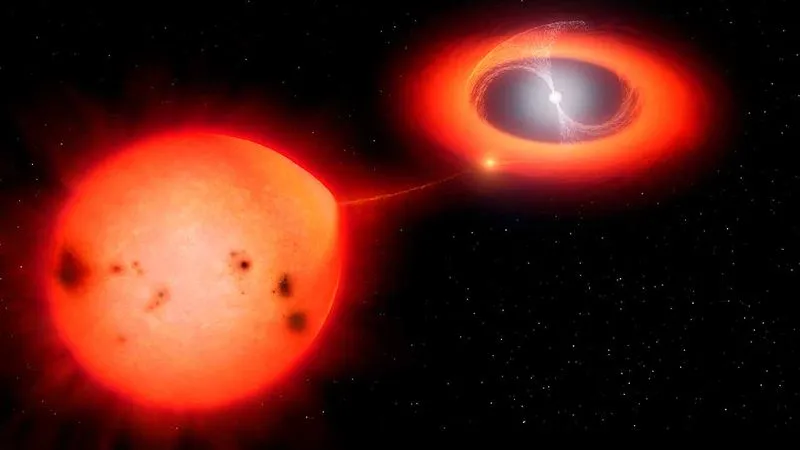
In November 2025, a Yonsei University team drew attention to an apparent bias in Type Ia supernova measurements. These stellar events help astronomers estimate distances through their corrected brightness.
The researchers argued that those corrections leave a meaningful relationship between brightness and the ages of the systems producing supernovae. Because stellar populations change across cosmic time, this relationship could distort comparisons between nearby and distant objects.
Their adopted relationship amounted to roughly 0.030 magnitudes per billion years in size. Although small, such a systematic difference can matter across enormous astronomical samples.
The team applied an additional correction to the Pantheon+ and Dark Energy Survey supernova compilations. They then combined those measurements with galaxy-clustering distances and cosmic microwave background data.
Under their evolving-dark-energy model, the combined results favoured present-day deceleration, with strong statistical tension against the standard cosmological model. Crucially, that conclusion depends on whether the proposed correction accurately represents the underlying stellar populations. Original Yonsei study.
Such a result can look decisive statistically. However, a high significance level cannot establish that the correction itself is physically correct. That is the assumption both teams dispute.
Why Southampton Still Finds Acceleration
Existing corrections change the picture
Phil Wiseman and colleagues at the University of Southampton revisited the analysis. Their June 2026 paper challenged both the brightness correction and the assumed evolution of stellar ages.
Modern supernova analyses already adjust measurements for properties associated with the mass of the host galaxy. Since galaxy mass and stellar age correlate, that adjustment can absorb part of an apparent age effect.
After applying modern corrections, Southampton’s team found a much shallower relationship between age and brightness. Its uncertainty included zero, so this sample did not establish a remaining age trend.
An insignificant residual trend does not prove that age never affects supernova brightness. It means this analysis found no convincing additional effect.
A galaxy’s age is not a star’s age
The researchers also questioned how the earlier analysis connected host galaxies with supernova progenitors, the stellar systems producing these events.
A galaxy contains stars from different generations. Its average age therefore cannot directly identify the age of one particular system.
Southampton’s simulations produced less progenitor-age evolution across cosmic time. Together, these findings reduced the proposed additional correction and preserved the evidence for acceleration in their analysis. Southampton research announcement.
Why Yonsei Disputes the Rebuttal
Could the comparison hide the signal?
Yonsei researchers defended their approach in a counter-response highlighted in August 2026. They argued that Southampton’s methods could weaken the very relationship under investigation.
Their first criticism concerns the range of redshifts, which indicate how much the universe has stretched travelling light. Comparing objects across a wide range also combines populations from different cosmic periods.
According to Yonsei, mixing those populations before measuring the age relationship artificially flattens it. The team says a stronger trend returns within a narrower redshift range.
The researchers also challenged the dust model underlying the host-galaxy correction. They argued that its assumed relationship with galaxy mass conflicts with observed dust behaviour.
Two linked assumptions
Their second objection concerns how researchers calculate the correction. It combines the estimated age change with the brightness change per unit of age.
Yonsei argues that assigning the same brightness difference to a smaller age difference makes the relationship steeper. In their calculations, the two changes largely offset each other.
This response keeps the methodological disagreement open. It does not independently demonstrate that cosmic expansion has started slowing. Yonsei counter-response.
What the Findings Mean for Dark Energy
The dark energy debate involves several questions that headlines sometimes merge. Dark energy could evolve while expansion continues accelerating. Decelerating expansion would also not automatically mean that the universe will eventually contract.
Those possibilities require different evidence and depend on the model describing future evolution.
Meanwhile, the Dark Energy Spectroscopic Instrument, or DESI, provides another way to investigate cosmic expansion through galaxy distributions. Its 2025 results strengthened hints of evolving dark energy when researchers combined them with other observations.
However, DESI’s measurements alone remained consistent with Lambda-CDM, the standard model containing a cosmological constant and cold dark matter. Which datasets researchers combine therefore matters when interpreting the apparent preference for changing dark energy. Berkeley Lab’s DESI explanation.
How Future Observations Could Clarify the Picture
Compare more similar stellar populations
Yonsei proposes testing supernovae in young host galaxies with similar ages across different distances. This approach aims to limit population differences before drawing conclusions about expansion.
Better measurements of host-galaxy ages would strengthen that comparison. Researchers also need clearer dust constraints and consistent treatment of survey selection effects.
Researchers could then check whether different correction methods produce compatible distances for comparable populations. Agreement across independent samples would strengthen confidence that the inferred expansion history reflects cosmology rather than changing stellar environments.
Rubin Observatory’s planned survey should provide millions of supernova discoveries, greatly expanding the available samples. Yet larger numbers alone cannot remove a systematic error. Careful calibration must accompany the new observations. Yonsei’s proposed test, Rubin’s supernova programme.
Dark Energy Debate: What Remains Unresolved
Cosmic deceleration remains an unconfirmed interpretation of disputed corrections. The central challenge is determining whether existing methods adequately capture the relevant stellar-age effects.
The dark energy debate therefore demands better comparisons, alongside more precise observations.
Resolving that question would sharpen one of astronomy’s most consequential measurements. It would help researchers distinguish changes in stellar populations from changes in cosmic expansion, giving future predictions a firmer observational foundation.
Main sources:
Son and colleagues: Original supernova age-bias study.
University of Southampton: Universe expansion still accelerating, say astronomers.
Chung and colleagues: Counter-response on supernova age corrections.
Yonsei University: Research statement outlining its objections and proposed test.
Lawrence Berkeley National Laboratory: DESI results and evolving dark energy.
Rubin Observatory: Supernova observations and cosmic distances.