
BY:SpaceEyeNews.
For years, astronomers treated galaxies without dark matter as little more than scientific curiosities. The idea seemed almost impossible. Modern models suggest that galaxies form inside massive dark matter halos. Remove that invisible framework, and galaxy formation becomes difficult to explain.
That is why the latest Dark Matter Free Galaxy Discovery is attracting so much attention. Researchers have identified a third galaxy whose motions can be explained without dark matter. Known as NGC 1052-DF9, the galaxy joins DF2 and DF4, two unusual systems that challenged conventional thinking when they were first reported.
The discovery is significant for a simple reason. One unusual galaxy might be an anomaly. Two could still be a coincidence. Three galaxies in the same structure begin to look like evidence of a real physical process. Instead of weakening the dark matter model, this finding may actually strengthen it.
Dark Matter Free Galaxy Discovery Adds a Third Example
The newly studied galaxy, NGC 1052-DF9, sits about 67 million light-years from Earth in the region surrounding the massive galaxy NGC 1052.
Astronomers first drew attention to this area after identifying DF2 in 2018. The galaxy appeared to contain far less dark matter than expected. The claim sparked debate across the astronomical community.
Then DF4 appeared.
The second galaxy showed many of the same characteristics. It occupied the same general region of space and displayed similar behavior. Researchers began wondering whether something unusual had occurred in this corner of the universe.
Now DF9 has entered the picture.
Why DF9 Stood Out
DF9 shares several important traits with DF2 and DF4.
The galaxy has a comparable size. Its brightness is similar. It also contains a similar population of star clusters.
These similarities made DF9 an ideal candidate for further study. Researchers measured how stars and clusters move inside the galaxy. Those motions revealed a surprising result.
The visible matter alone could explain the galaxy’s gravity.
Scientists found no strong evidence that a large dark matter halo was present.
From Anomaly to Evidence
Scientific discoveries become more convincing when observations repeat.
That principle makes this Dark Matter Free Galaxy Discovery especially important.
The first galaxy raised questions. The second increased interest. The third strengthens the possibility that astronomers are observing an entirely new category of galaxy formation.
Instead of isolated exceptions, DF2, DF4, and DF9 may represent members of a larger population created by the same process.
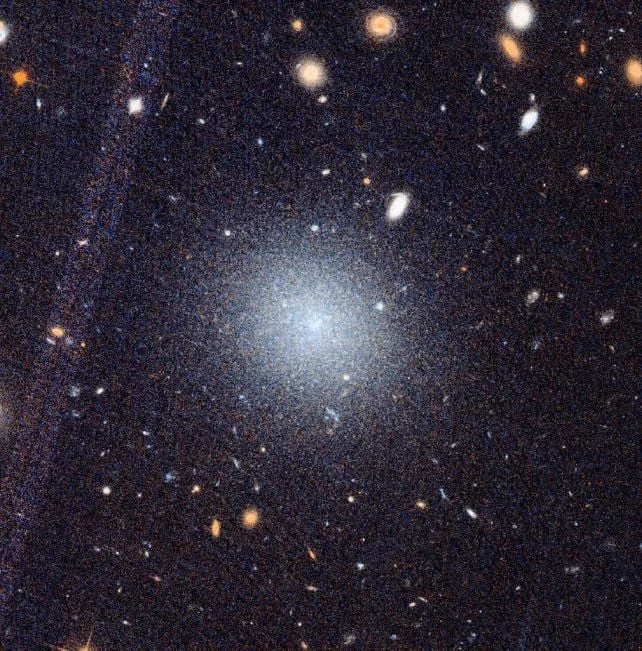
Dark Matter Free Galaxy Discovery and the Mysterious Galactic Trail
The story becomes even more intriguing when researchers examine the broader environment surrounding these galaxies.
Several years ago, astronomers noticed that DF2 and DF4 were not isolated objects.
Both belonged to a narrow chain of faint galaxies extending through space.
A Cosmic String of Galaxies
The structure resembles a trail or string of galaxies arranged in a surprisingly linear formation.
Such arrangements are uncommon.
Researchers identified roughly a dozen galaxies connected to this structure. They appear to share similar locations and movement patterns.
This observation suggested that the galaxies may have formed through a common event rather than independent processes.
Moving Together Through Space
Later studies revealed another important clue.
The galaxies within the trail move through space in a coordinated manner.
That finding strengthened the argument that the objects share a common history.
If the galaxies originated from the same event, then astronomers expected additional members of the chain might also show unusual dark matter properties.
DF9 fulfilled that prediction.
Its discovery provides one of the strongest tests yet of the idea that the entire structure formed through an extraordinary event.
Why This Pattern Matters
Astronomers often rely on predictions to test theories.
When a model predicts an outcome before observations confirm it, confidence in that model grows.
Researchers predicted that another galaxy within the chain would likely lack dark matter.
DF9 appears to match that expectation.
As a result, the discussion has shifted.
Scientists are no longer asking whether DF2 and DF4 were measurement errors. Instead, they are investigating what process created all three galaxies.
Could a Collision Separate Dark Matter From Ordinary Matter?
The leading explanation involves a dramatic event known as a bullet dwarf collision.
While the concept sounds unusual, the basic idea is straightforward.
The Collision Scenario
Imagine two dwarf galaxies traveling toward each other.
Each contains stars, gas, and dark matter.
When the galaxies pass through one another, their stars mostly continue moving. Vast distances separate individual stars, so direct impacts are rare.
Dark matter behaves similarly.
The dark matter halos pass through each other with minimal interaction.
Gas behaves differently.
Gas clouds collide directly. They slow down and become separated from the stars and dark matter.
What Happens Next?
After the collision, a large concentration of gas remains behind.
This region contains ordinary matter but relatively little dark matter.
Over time, gravity causes the gas to collapse.
New stars begin forming.
Eventually, those stars gather into new galaxies.
The result is a galaxy that contains very little dark matter compared with normal galaxies.
Computer simulations suggest this process can create systems remarkably similar to DF2, DF4, and DF9.
Simulations Support the Idea
Researchers have used numerical simulations to test the collision scenario.
The results show that gas-rich dwarf galaxy encounters can produce chains of galaxies with reduced dark matter content.
The simulations also reproduce several characteristics seen in the observed galaxies.
While questions remain, the collision model currently offers one of the most compelling explanations.
What the Dark Matter Free Galaxy Discovery Means for Cosmology
At first glance, galaxies without dark matter might seem like a challenge to the dark matter concept itself.
Ironically, the opposite may be true.
Strengthening the Dark Matter Model
If dark matter can separate from ordinary matter during collisions, then it behaves like a distinct physical substance.
That conclusion supports one of the central assumptions of modern cosmology.
Dark matter is not simply an illusion created by misunderstood gravity.
Instead, it acts as a separate component of the universe.
The observed galaxies may provide rare evidence of that separation occurring naturally.
A New Testing Ground
These galaxies create a unique laboratory for studying dark matter.
Most galaxies contain large dark matter halos. That makes it difficult to isolate specific effects.
DF2, DF4, and DF9 offer a different environment.
Researchers can compare galaxies with unusually low dark matter levels against normal systems.
The comparison may reveal new clues about how dark matter behaves.
Questions Still Remain
Scientists still need answers to several important questions.
How common are these galaxies?
Did all members of the galactic chain form through the same event?
Can additional dark-matter-deficient galaxies be identified nearby?
Future observations will help resolve these uncertainties.
New data from major observatories could reveal whether the structure contains more examples waiting to be studied.
Why This Discovery Could Be a Turning Point
The significance of this Dark Matter Free Galaxy Discovery extends beyond a single galaxy.
Astronomers now have three independent examples within the same structure.
That growing pattern changes the discussion.
The focus has shifted from debating individual measurements to understanding a broader physical phenomenon.
If future observations uncover more galaxies with similar properties, researchers may be witnessing a previously unknown pathway for galaxy formation.
Such a result would influence studies of dark matter, galaxy evolution, and large-scale cosmic structure.
More importantly, it would provide scientists with one of the clearest opportunities yet to examine how dark matter interacts with ordinary matter under extreme conditions.
Conclusion
The latest Dark Matter Free Galaxy Discovery marks an important milestone in the study of galaxies and dark matter. NGC 1052-DF9 joins DF2 and DF4 as the third known galaxy whose motions can be explained without a significant dark matter halo. More importantly, all three belong to the same unusual galactic structure. That pattern suggests a shared origin rather than random coincidence. If future observations confirm additional examples, astronomers may be looking at evidence of a new galaxy formation mechanism. Far from weakening the dark matter model, this discovery may offer one of the strongest opportunities yet to understand how dark matter behaves throughout the universe.
Main Sources:
- ScienceAlert
https://www.sciencealert.com/its-official-third-galaxy-found-with-no-dark-matter-may-solve-an-epic-mystery - The Astrophysical Journal (Research Paper)
https://iopscience.iop.org/journal/0004-637X - arXiv Preprint by Michael Keim and collaborators
https://arxiv.org/abs/2603.15860 - Yale University Astronomy Research Updates
https://astronomy.yale.edu - NASA – Dark Matter Overview
https://science.nasa.gov/universe/dark-matter/