
BY:SpaceEyeNews.
Introduction: Dark Matter Search Enters a Strange New Phase
The dark matter search has reached one of the most important moments in modern physics. Scientists have strong evidence that dark matter exists. They see its pull across galaxies, galaxy clusters, and the early universe. Yet no experiment has confirmed a dark matter particle. That gap is now the real story.
Dark matter may make up about 85% of all matter in the universe. It appears to outweigh stars, planets, gas clouds, and ordinary matter by a huge margin. Still, after decades of deeper and sharper searches, no detector has captured a confirmed particle signal.
That does not mean the idea has failed. It means the mystery has changed shape. The evidence from space remains powerful. But the particle behind that evidence still avoids every test.
Why the Dark Matter Search Still Matters
Dark matter does not shine. It does not reflect light. It does not absorb light. That makes it impossible to see through normal telescopes.
Yet scientists can still track its effects. CERN explains that researchers infer dark matter from gravity. Galaxies rotate so fast that visible matter alone cannot hold them together. Something unseen appears to add the extra gravity they need. CERN also notes that dark matter outweighs visible matter by about six to one and makes up around 27% of the universe.
This is why the dark matter search remains central to physics. It does not start from a weak clue. It starts from many strong clues that all point in the same direction.
Galaxies rotate too quickly. Galaxy clusters bend light too strongly. The cosmic web formed too efficiently. The early universe also carries patterns that fit a cosmos rich in unseen mass.
So the question has shifted. Scientists are not simply asking whether something invisible affects the universe. They are asking what that invisible matter actually is.
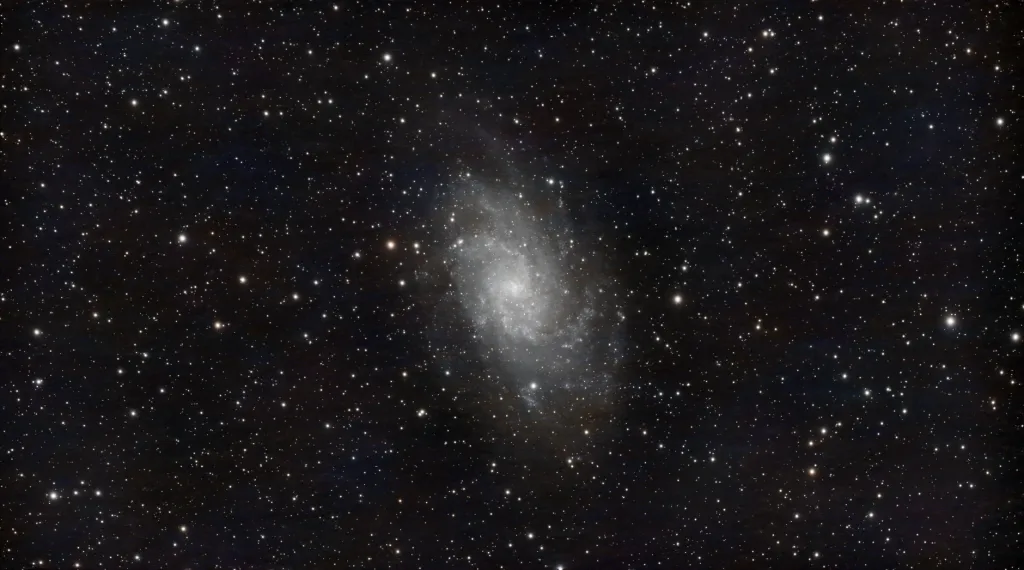
Dark matter is thought to make up roughly 85 percent of all matter in the universe.
The Evidence Is Strong, But It Is Not Direct
The strange part is simple. Every major clue comes from gravity.
Gravity tells scientists that mass exists. It shows where that mass sits. It reveals how that mass shapes galaxies and clusters. But gravity does not reveal the particle itself.
That creates the central gap. Dark matter behaves like real mass. It helps structure the universe. Yet its physical identity remains unknown.
The uploaded article makes this problem clear. The clues show that something with mass exists beyond ordinary matter. But those clues do not tell scientists what it is made of.
This is why direct detection matters. A direct signal would move dark matter from cosmic inference to particle proof. It would change astronomy, particle physics, and cosmology at once.
Until that happens, dark matter remains one of science’s most successful mysteries. It explains a great deal. But it still refuses to show its face.
Dark Matter Search and the WIMP Question
For decades, one candidate led the discussion. Scientists called it the WIMP, or weakly interacting massive particle.
The idea made sense. A WIMP would have mass. It would rarely interact with ordinary matter. That would explain why it shapes galaxies but escapes normal observation.
This is why many experiments focused on WIMPs. If a WIMP passed through Earth, it might sometimes touch the nucleus of an atom. That tiny interaction could leave a faint signal.
The challenge is huge. Earth is full of normal radiation, cosmic-ray effects, and particle noise. So scientists place detectors deep underground. Rock helps block unwanted signals from space.
The strongest searches now use liquid xenon. Xenon is dense, clean, and sensitive. If a dark matter particle nudges a xenon atom, the detector may catch tiny flashes of light and charge.
This is the heart of the modern dark matter search. Scientists build quiet machines in quiet places. Then they wait for a signal that may happen rarely, if it happens at all.
LZ Shows How Powerful the Search Has Become
The LUX-ZEPLIN experiment, known as LZ, now stands near the front of this effort. It operates nearly one mile underground at the Sanford Underground Research Facility in South Dakota. Berkeley Lab leads the experiment.
In 2024, LZ reported a world-leading WIMP search using 280 days of data. The result improved earlier limits by a large margin. But it found no evidence of WIMPs above a mass of 9 GeV/c².
That result matters. It did not confirm dark matter. But it sharply narrowed the places where one leading dark matter candidate could hide.
LZ also plans to collect 1,000 days of data before the experiment ends in 2028. Its team expects future analyses to reach lower energies and test more models.
This makes the silence more meaningful. The detector did not simply “find nothing.” It tested a wider region than previous searches. It also rejected models that once looked possible.
In physics, that counts as progress. A non-detection can still reshape the map.
Why “Nothing” Is Not Empty
When a detector sees no dark matter signal, scientists do not walk away empty-handed. They learn which versions of dark matter do not match the data.
That is what makes the dark matter search so difficult and so valuable. Each new experiment closes part of the mystery. But the mystery does not vanish. It moves.
A stronger detector can test weaker interactions. A deeper detector can avoid more background noise. A longer run can reveal rarer events. If all those improvements still produce silence, then scientists must rethink the best target.
This is now happening with WIMPs. They have not disappeared as a candidate. But their simplest hiding places keep shrinking.
That pressure pushes researchers toward other ideas. Some look harder for axions. Others explore lighter particles. Some test dark sectors that interact with normal matter in very limited ways.
A smaller group also studies whether gravity itself needs revision. Still, particle dark matter remains the leading path for many researchers. It explains more of the full cosmic evidence than galaxy rotation alone.
Beyond WIMPs: The Search Widens
The next era may not center on one favorite candidate. It may become a wider hunt.
Axions offer one path. These particles would be far lighter than WIMPs. They would also interact very weakly with normal matter. That makes them hard to find, but not impossible.
Other ideas go further. Dark matter may belong to a hidden sector. That would mean it has particles and forces of its own. It may barely connect with the matter we know.
Some models also explore primordial black holes. These would not be particles in the normal sense. They would be ancient compact objects from the early universe. Scientists still test whether they could explain part of the dark matter puzzle.
This wider search does not weaken the case for dark matter. It shows how hard the identity problem has become.
The universe keeps pointing to unseen mass. But each detector result tells scientists that nature may have chosen a stranger answer than expected.
The Neutrino Fog Could Make the Hunt Harder
The dark matter search now faces another challenge. Future detectors may become so sensitive that they start seeing signals from neutrinos.
Neutrinos are real particles. They come from the Sun, space, and particle reactions. They pass through matter easily. But in rare cases, they can interact with detector material.
That creates a problem. Some neutrino signals can look like the faint signal expected from dark matter.
The uploaded article describes this obstacle as a “neutrino fog.” It notes that neutrinos from the Sun can mimic dark matter signals and make the hunt harder.
This does not end the search. It changes the strategy.
Scientists will need better analysis tools. They will need new detector designs. They may also need different target materials and stronger ways to separate signal from background.
In a way, this is a sign of success. The detectors have become so sensitive that they are approaching a natural background from the universe itself.
That is an amazing milestone. But it also means the next discovery may demand more than a larger detector.
What This Means for Cosmology
Dark matter is not a small detail in the universe. It acts like cosmic architecture.
Without it, galaxies would be harder to explain. Galaxy clusters would look different. The large-scale structure of the universe would not form in the same way.
This is why the dark matter search affects more than particle physics. It also affects our story of cosmic history.
If scientists find the particle, they can connect the smallest scale to the largest scale. They can link particle interactions to galaxy formation. They can explain how invisible matter helped shape the universe.
If they do not find it soon, that also matters. It may mean dark matter interacts even more weakly than expected. It may mean the best candidate is not a WIMP. It may also mean scientists need a more creative way to test the dark universe.
Either result changes the field.
The silence does not close the story. It opens the next chapter.
Why the Public Should Pay Attention
What is the universe made of?
Ordinary matter makes stars, planets, water, rocks, and people. Yet it appears to form only a small part of the cosmic inventory. The rest remains unseen or poorly understood.
That is why the dark matter search deserves public attention. It shows how much science knows and how much it still does not know.
Modern astronomy can map galaxies across billions of light-years. Particle physics can test nature at tiny scales. Yet one major part of the universe still sits between both fields.
It leaves fingerprints everywhere. But no lab has confirmed its identity.
That tension makes dark matter one of the most important science stories of our time.
Conclusion: Dark Matter Search Faces a Louder Silence
The dark matter search has entered a strange and powerful phase. The evidence for unseen mass remains strong. Galaxies, galaxy clusters, and cosmic structure still point toward something real. But the particle behind that evidence remains missing.
LZ and other experiments have not ended the mystery. They have made it sharper. They have narrowed WIMP models. They have tested weaker interactions. They have shown that the simplest answers may not be enough.
That is why the silence matters. It is not empty. It is data. It tells scientists where dark matter is probably not hiding. It also pushes the search toward new particles, new methods, and deeper questions.
The dark matter search is now more than a hunt for one particle. It is a test of our cosmic picture. If scientists find the signal, physics will change. If they do not, physics may change anyway.
Either way, the universe is telling us something. We just have not learned how to hear it yet.
Main Sources:
Space Daily article provided by the user:
https://spacedaily.com/t-dark-matter-is-thought-to-make-up-roughly-85-percent-of-all-matter-in-the-universe-yet-after-nearly-four-decades-of-increasingly-sensitive-searches-from-deep-underground-detectors-to-space/
CERN — Dark Matter:
https://home.cern/science/physics/dark-matter/
Berkeley Lab — LZ Experiment Sets New Record in Search for Dark Matter:
https://newscenter.lbl.gov/2024/08/26/lz-experiment-sets-new-record-in-search-for-dark-matter/