
BY:SpaceEyeNews.
A faint gravitational-wave hum may carry clues about black holes born near the beginning of cosmic history. Researchers have explored whether hypothetical dark stars could help explain that signal. Their results connect dark stars and gravitational waves through events spanning more than 13 billion years.
The study does not claim that scientists have discovered dark stars. Instead, it tests whether black holes left by these proposed objects could grow, form binary systems, and contribute to the gravitational-wave background detected today.
Dark Stars and Gravitational Waves Meet in a Cosmic Signal
Pulsar timing arrays have found evidence for a background of gravitational waves at nanohertz frequencies. These waves change over years or decades.
NANOGrav produced one of the clearest results after monitoring 68 millisecond pulsars for 15 years. Researchers found correlated timing changes consistent with a gravitational-wave background.
The leading explanation involves a large population of supermassive black-hole binaries. These systems orbit slowly in galaxy centers and produce long-wavelength gravitational waves. Their combined signals can form a persistent cosmic background.
Systems with a total mass above roughly one billion Suns matter most at PTA frequencies. That creates an important question. How did their original black-hole seeds form?
The Puzzle of Early Supermassive Black Holes
Webb and Chandra observations have revealed surprisingly massive black holes during the Universe’s first billion years. Some appear too large for simple growth models that begin with ordinary stellar remnants.
Astronomers have proposed several paths to heavier seeds. Gas clouds might collapse directly without first forming normal stars. Dense stellar clusters could also produce intermediate-mass seeds. Another possibility involves supermassive dark stars.
The new research examines whether descendants of those early seeds could survive and grow with their galaxies. Later galaxy mergers could bring two central black holes together. Those binaries would contribute to the gravitational-wave background billions of years after their seeds formed.
How Dark Stars Could Produce Heavy Black-Hole Seeds
Despite their name, dark stars would not necessarily look dark. They remain theoretical primordial objects whose early energy could come mainly from dark-matter heating instead of standard nuclear fusion.
The study considers the WIMP scenario. In that framework, dark-matter particles could interact inside a forming star and release energy. This heating might keep the object relatively cool and extended while it continues collecting gas.
Some models allow a dark star to grow beyond one million solar masses. Its collapse could create a much heavier black-hole seed than an ordinary massive star would leave behind. That head start could make rapid early growth easier to explain.
However, scientists have not confirmed WIMPs or dark stars. Webb observations have identified possible supermassive dark-star candidates, but those objects have other plausible interpretations. The new work therefore explores a conditional scenario, not an established cosmic history.
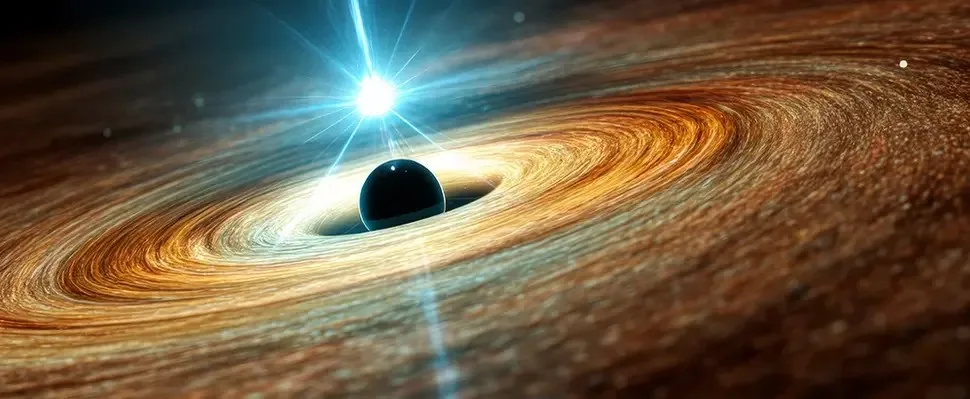
New theory of gravitational waves holds key to the early universe.
Following the Seeds Across Billions of Years
Sohan Ghodla and Cosmin Ilie modeled seeds forming at redshifts between about 10 and 30. Their adopted black-hole seed masses ranged from 10,000 to one million Suns, with an average near 100,000 solar masses.
The researchers placed these seeds in early dark-matter halos. They then followed halo growth, black-hole accretion, galaxy mergers, binary formation, and gravitational-wave production.
This sequence matters when discussing dark stars and gravitational waves. The proposed stars did not directly generate the nanohertz background now under study. Instead, black holes created by their collapse could become the ancestors of much larger binaries. Those later systems would produce the observed waves at lower redshifts.
Could Dark-Star Descendants Dominate the Background?
The model found that dark-star-seeded black holes could provide a major contribution to the PTA signal. That result requires a comoving seed density on the order of 10−3 per cubic megaparsec.
For comparison, the study assigned direct-collapse black holes a characteristic density near 10−6 per cubic megaparsec. That population generated a much weaker background because it was far rarer in the tested scenario.
This does not mean dark-star remnants have displaced other explanations. The comparison depends on seed abundance, halo mass, growth history, and merger assumptions. Different inputs could change the balance.
Using Pulsars to Count Ancient Seeds
The most significant result may be the ability to limit early black-hole populations. If the Universe produced too many heavy seeds, their descendants would create a stronger background than pulsar timing arrays observe.
For the models examined, seed densities around 10−2 to 10−1 per cubic megaparsec begin to exceed the measured signal. The precise limit depends strongly on the original host halos. Seeds placed in more massive halos tend to grow into larger black holes and generate a stronger background.
Merger timing adds another uncertainty. After two galaxies combine, their central black holes may take millions or billions of years to form a close binary. Gas, stars, and dark matter can influence that process. These environmental details affect the predicted signal.
Future PTA observations should improve measurements of the signal’s spectrum and directional structure. Webb and other observatories can refine estimates of early black-hole abundance. Together, these measurements may separate competing seed scenarios.
Dark Stars and Gravitational Waves Open a New Window
The study creates an intriguing bridge between dark-matter physics, early stars, galaxy growth, and gravitational-wave astronomy. It shows that pulsar timing arrays may reveal more than the later evolution of massive galaxies.
Dark stars remain hypothetical, and the current gravitational-wave background does not prove they existed. Yet their modeled black-hole descendants could explain a significant part of the signal under specific conditions.
As the evidence improves, dark stars and gravitational waves may offer a new way to investigate the first supermassive black holes. The faint cosmic hum detected today could constrain objects that formed during cosmic dawn, even if astronomers never observe those original stars directly.
Main Sources:
- Physical Review D — Reconstructing PTA Measurements via Early Seeding of Supermassive Black Holes
- Original study preprint on arXiv
- NANOGrav — Evidence for a Gravitational-Wave Background
- NASA Webb Science — Galaxies Through Time
- Universe Magazine — Dark Stars and Gravitational-Wave Echoes