
BY:SpaceEyeNews.
Introduction: Earth Is Passing Through a Cosmic Debris Field
Earth is currently moving through the remains of a recently destroyed asteroid. This is not speculation. It is a data-driven discovery. Scientists have identified a disintegrating asteroid meteor stream formed near the Sun, made up of hundreds of tiny fragments now intersecting our planet’s orbit.
What makes this discovery remarkable is that the parent asteroid remains unseen. No telescope has directly captured it. Yet its debris reveals its presence with surprising clarity. A cluster of 282 meteors provided the evidence, exposing an object that would otherwise remain hidden.
This finding reshapes how astronomers detect small bodies in the Solar System. It also highlights a powerful force at work: the Sun itself. In the following sections, we explore how this disintegrating asteroid meteor stream formed, why it stands out, and what it means for the future of asteroid detection.
A New Meteor Stream Reveals a Hidden Asteroid
Astronomers often rely on massive datasets to uncover subtle patterns. In this case, they examined millions of meteor detections collected from global observation networks. These systems continuously track meteors entering Earth’s atmosphere, creating a detailed map of their origins.
A Distinct Cluster of 282 Meteors
Within this vast dataset, one cluster stood out. A group of 282 meteors shared nearly identical trajectories. This alignment pointed to a single source, suggesting a recent fragmentation event.
The orbit of these meteors revealed something even more unusual. Their paths traced back to a region extremely close to the Sun. Such orbits are rare, and they immediately raised questions about the conditions that could produce them.
An Invisible Parent Object
Despite the clear signature of a shared origin, the parent asteroid has not been directly observed. This is where the significance of the disintegrating asteroid meteor stream becomes clear. It acts as indirect evidence of an otherwise invisible object.
Meteor streams serve as cosmic clues. By analyzing their paths, scientists can reconstruct the orbit of their source. In this case, the debris tells a story that telescopes alone could not capture.
How Solar Heat Is Tearing the Asteroid Apart
The Sun is not just a source of light and heat. It is also a powerful agent of change for objects that venture too close. The asteroid responsible for this disintegrating asteroid meteor stream appears to have crossed a critical threshold.
Thermal Stress and Surface Breakdown
As the asteroid approached the Sun, it experienced intense heating. Unlike comets, which contain ice that vaporizes, this object is rocky and dry. The heat penetrated its surface, creating internal stress.
Over time, that stress caused fractures. Small cracks formed first, then expanded. Eventually, pieces began to break away from the surface.
Gas Release and Progressive Fragmentation
In addition to cracking, trapped gases within the asteroid may have been released. This added pressure weakened the structure further. As a result, fragments detached more easily.
These fragments became the building blocks of the disintegrating asteroid meteor stream. Initially, they remained clustered together. Gradually, they spread along the asteroid’s orbital path.
A Different Type of Asteroid Activity
This process differs from more familiar asteroid breakups. Many asteroids fragment due to collisions or rapid rotation. In this case, solar heat appears to be the dominant force. That makes this event a clear example of thermally driven disintegration.
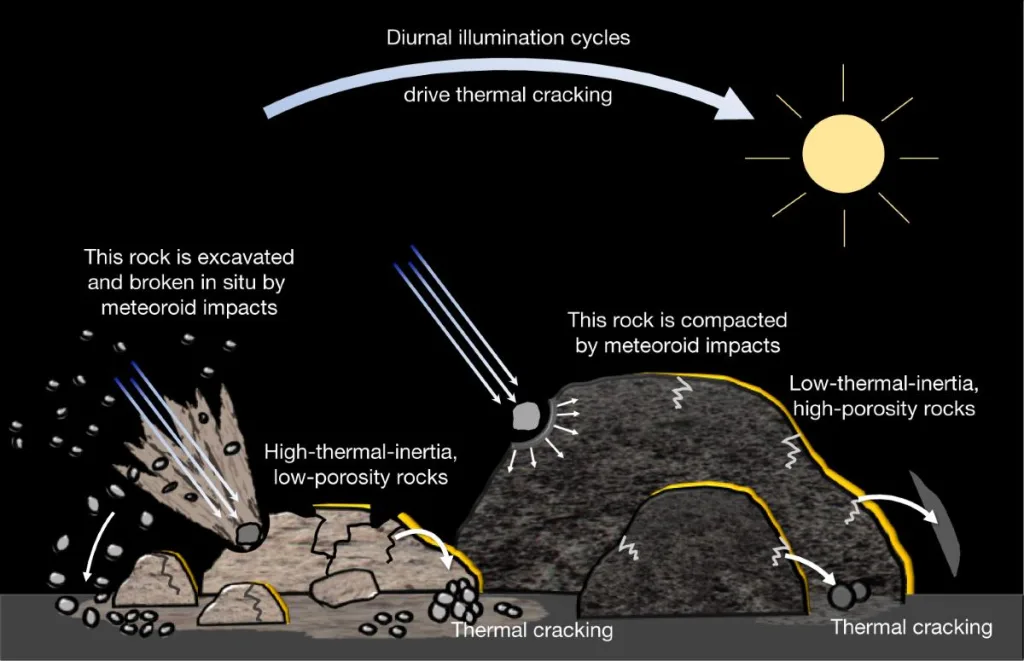
Fine-regolith production on asteroids controlled by rock porosity.
Why This Disintegrating Asteroid Meteor Stream Is Unique
Not all meteor streams offer the same level of insight. This one stands out because of its orbit, composition, and apparent age.
An Orbit Deep Within the Inner Solar System
The trajectory of this stream is extreme. It carries debris to distances nearly five times closer to the Sun than Earth’s orbit. Such proximity exposes the material to intense radiation and temperature swings.
This explains why the asteroid could not remain intact. Few rocky bodies can endure such conditions over long periods.
Clues from Material Properties
The meteors themselves reveal important details. They appear fragile, but not as delicate as cometary dust. This suggests a rocky origin with internal weaknesses, possibly due to cracks or volatile pockets.
These characteristics help scientists understand how the parent asteroid responded to heat. They also provide insight into its composition.
A Connection to Active Asteroids
The behavior observed here resembles that of known active asteroids, such as 3200 Phaethon, which produces the Geminid meteor shower. However, this newly identified stream appears much younger.
Because the debris has not yet fully dispersed, researchers have a rare opportunity. They can study the early stages of asteroid disintegration in real time.
Meteor Streams as a Tool to Detect Hidden Objects
Meteor streams do more than create visual displays in the night sky. They serve as a powerful method for detecting objects that remain otherwise invisible.
Reconstructing the Source from the Debris
When an asteroid cannot be observed directly, its debris can still reveal its path. By tracking meteors as they enter Earth’s atmosphere, scientists can trace their trajectories backward.
This method allows them to reconstruct the orbit of the parent body. In the case of the disintegrating asteroid meteor stream, it provides a clear link to a near-Sun object that has yet to be seen.
How Debris Evolves Over Time
At first, fragments remain tightly grouped. Over time, gravitational interactions with planets begin to separate them. Each piece follows a slightly different path.
This gradual spreading causes the stream to stretch out. Eventually, it becomes diffuse and blends into the background dust of the Solar System.
Implications for Planetary Awareness
The ability to detect hidden objects through their debris has important implications. It expands the range of detectable asteroids, especially those that approach the Sun and are difficult to observe.
This improves our overall understanding of near-Earth space. It also enhances long-term monitoring efforts aimed at identifying potential risks.
What Comes Next for Asteroid Detection
This discovery arrives at a time when new tools are about to expand our view of the Solar System. Future missions will play a key role in identifying objects like the one behind this disintegrating asteroid meteor stream.
The Promise of NEO Surveyor
One of the most anticipated missions is NEO Surveyor. Designed to detect near-Earth objects, it will observe regions close to the Sun that are currently difficult to study.
Its advanced sensors will allow it to identify dark asteroids that reflect little light. This capability makes it ideal for locating the parent body of the newly discovered stream.
Completing the Picture
If the source asteroid is identified, it will confirm the full origin of the disintegrating asteroid meteor stream. This would provide a complete view of the process, from fragmentation to debris dispersion.
Such confirmation would also strengthen the use of meteor observations as a detection method.
A More Dynamic Solar System
Each new discovery reveals a more active Solar System than once imagined. Asteroids are not static relics. They evolve, break apart, and respond to their environment.
This event highlights that reality in a striking way. It shows that even small, unseen objects can leave behind measurable signatures.
Conclusion: A Rare Glimpse Into Ongoing Asteroid Disintegration
The disintegrating asteroid meteor stream offers a rare opportunity to observe an asteroid breaking apart under the influence of solar heat. It demonstrates how invisible objects can still be studied through the trails they leave behind.
This discovery expands the tools available to astronomers. It also reinforces the importance of continuous observation. By tracking even the smallest fragments, scientists can uncover hidden processes shaping our Solar System.
More importantly, it raises a compelling question. How many other unseen asteroids are quietly disintegrating near the Sun right now?
Sources:
- https://universemagazine.com/en/the-sun-tore-the-asteroid-to-pieces-and-earth-is-flying-through-its-debris/
- https://iopscience.iop.org/journal/0004-637X (The Astrophysical Journal)