BY:SpaceEyeNews.
Draconid Meteor Shower 2026 Returns After Historic Storms
The Draconid meteor shower 2026 will return in October, carrying the remarkable legacy of one of the most dramatic meteor displays ever recorded.
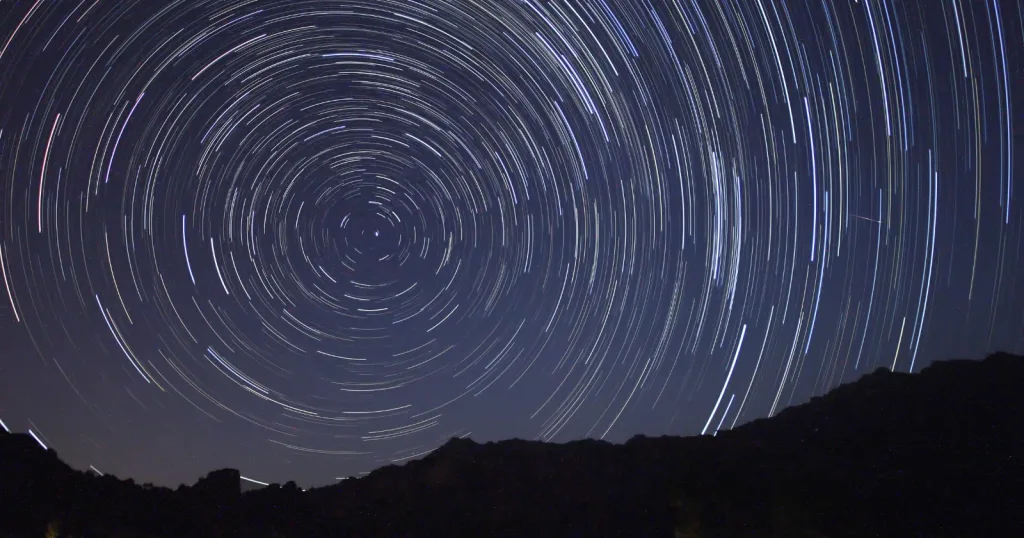
On October 9, 1946, observers across Europe and North America saw the sky fill with Draconid meteors. Estimates vary, but reports suggest that several thousand meteors appeared every hour. Some observers described almost continuous streaks spreading across the sky.
The same shower will reach its annual maximum again in October 2026. However, current forecasts do not predict another historic meteor storm.
Instead, the International Meteor Organization expects a relatively quiet display. Observers may see around five Draconids per hour under ideal conditions. Still, this shower deserves attention because its activity has changed suddenly in the past.
The main question is not whether its parent comet is close to Earth. It is whether Earth will cross a concentrated trail of particles left behind during an earlier comet passage.
The Night the Draconids Filled the Sky
The Draconids usually produce only a small number of visible meteors. Yet the shower has occasionally delivered extraordinary events.
Its most famous twentieth-century displays occurred in 1933 and 1946. During the 1933 event, observers in Europe reported hundreds of meteors every minute. NASA notes that some estimates reached around 500 meteors per minute.
Another exceptional display followed in 1946. Observers in the United States reportedly counted between 50 and 100 Draconids per minute. Other historical estimates placed the overall rate between roughly 2,000 and 10,000 meteors per hour.
Exact figures remain uncertain because observing methods differed across locations. Weather and visibility also affected the reports. Nevertheless, the evidence confirms that the 1946 event reached genuine meteor-storm levels.
British radar measurements provided further support. The detected activity reportedly increased from around ten meteors per minute to nearly 300 per minute during the strongest period.
These events established the Draconids as an unpredictable shower. Most years bring limited activity. Rare encounters with dense particle trails can produce something entirely different.
Why the Draconids Can Suddenly Intensify
Comet 21P/Giacobini-Zinner creates the Draconid meteor shower. NASA describes it as a small periodic comet measuring about two kilometres across. It completes one orbit around the Sun in roughly 6.6 years.
Each time the comet approaches the Sun, heat releases dust and small particles from its surface. Those particles spread along its orbit and form separate trails.
However, the material does not spread evenly. Some parts of the stream remain thin and scattered. Others form narrow and concentrated filaments.
During a typical year, Earth travels through a weak section of the stream. That produces only a handful of meteors. In a storm year, Earth passes through a much denser trail.
The age and position of each trail also matter. A strong display can come from material released decades before Earth finally reaches it.
The Comet’s Distance Is Not the Whole Story
A close comet approach does not guarantee high meteor activity.
Comet 21P passed about 58 million kilometres from Earth in September 2018. It was the comet’s closest approach to our planet in 72 years. Yet the October 2018 Draconids produced only a moderate enhancement rather than a repeat of 1946.
That difference shows why distance alone cannot predict the shower’s strength. Earth must cross the right particle trail at the right moment.
Where Is Comet 21P in 2026?
Some reports may give the impression that Comet 21P is making a major approach to the Sun or Earth in 2026. That interpretation is incorrect.
The comet reached perihelion, its closest point to the Sun, on March 25, 2025. Its closest Earth approach occurred four days earlier, at a distance of about two astronomical units. That placed it far beyond the range of an impressive naked-eye appearance.
By mid-2026, the comet was moving outward again. It was more than four astronomical units from Earth and heading toward the distant section of its orbit. Its next perihelion is expected in 2031.
Therefore, the Draconid meteor shower 2026 does not depend on a fresh close approach by its parent comet. The event comes from older particles already distributed along the comet’s path.
Comet 21P also holds an important place in space exploration. On September 11, 1985, NASA’s International Cometary Explorer passed through its environment. It became the first spacecraft to fly past a comet.
Draconid Meteor Shower 2026 Forecast
The International Meteor Organization lists the 2026 Draconids as active from October 6 to October 10. The expected maximum falls on October 9.
The organization gives the shower a predicted zenithal hourly rate of about five. That figure describes ideal conditions with a dark sky and the radiant placed high overhead. Most observers could see fewer meteors.
Light pollution, cloud cover, haze and nearby buildings can all lower the visible rate. The observer’s latitude also matters because the radiant lies in the northern constellation Draco.
The Draconids enter Earth’s atmosphere at around 20 kilometres per second. This makes them slower than meteors from many other well-known showers. Their slower movement can make individual streaks easier to follow.
Most importantly, the official 2026 calendar does not identify a predicted Draconid outburst. The current forecast supports a normal annual display rather than a storm.
Why Evening Viewing Is Better
Many meteor showers appear strongest after midnight. The Draconids behave differently.
Draco stands relatively high in the Northern Hemisphere during the evening. Therefore, observers can begin watching soon after darkness arrives on October 8.
A thin waning crescent Moon should create little interference near the expected peak. Dark rural skies will still provide the best results.
Could the 2026 Draconids Still Surprise Astronomers?
Meteor forecasting has improved greatly since the historic storms of the twentieth century.
Researchers now model individual particle trails and calculate when Earth might cross them. These techniques have helped predict several later Draconid enhancements.
Even so, the stream contains complex fine structures. Small concentrations of particles can remain difficult to identify. That leaves some room for unexpected activity.
Later increases occurred in 1998, 2011, 2012 and 2018. However, not every increase reached full meteor-storm status.
A shower may rise from five meteors per hour to several hundred without reaching the accepted storm threshold. NASA commonly defines a meteor storm as a display producing at least 1,000 meteors per hour.
An unexpected enhancement in 2026 cannot be completely ruled out. Still, there is currently no strong scientific evidence that another 1933- or 1946-style event will occur.
How to Watch the 2026 Draconids
Begin watching after nightfall on October 8 and continue around the October 9 maximum.
Choose a location away from city lights. Find a wide and unobstructed view of the sky, preferably toward the north. Allow at least 20 minutes for your eyes to adjust.
No telescope is needed. Meteors can appear far from Draco, so watch a broad section of the sky instead of staring directly at the radiant.
Plan to observe for at least one hour. Meteor activity often arrives unevenly, with quiet periods followed by several visible streaks.
Draconid Meteor Shower 2026: A Quiet but Important Return
The Draconid meteor shower 2026 is unlikely to recreate the legendary displays of 1933 or 1946. Current forecasts suggest around five meteors per hour under ideal conditions.
Yet the shower remains one of the most interesting events on the annual meteor calendar. Its history shows how a quiet display can change when Earth meets a concentrated comet trail.
The dragon may not fully awaken in October 2026. However, its unpredictable past gives astronomers and skywatchers a strong reason to keep watching.
Main Sources:
International Meteor Organization — 2026 Meteor Shower Calendar:
https://www.imo.net/files/meteor-shower/cal2026.pdf
NASA — Comet 21P/Giacobini-Zinner:
https://science.nasa.gov/solar-system/comets/21p-giacobini-zinner/
NASA — International Sun-Earth Explorer-3 / International Cometary Explorer:
https://science.nasa.gov/mission/isee-3-ice/
NASA — October Skywatching and the Draconids:
https://science.nasa.gov/solar-system/whats-up-october-2025-skywatching-tips-from-nasa/
TheSkyLive — Comet 21P Tracking and Orbital Data:
https://theskylive.com/21p-info