
BY:SpaceEyeNews.
Astronomers have identified a dual AGN in a Green Pea galaxy, capturing two supermassive black holes as both draw in material within a compact merging system. The galaxy, SDSS J162209.41+352107.5, or J1622+3521, contains two bright nuclei aligned with separate X-ray sources.
It is the first confirmed example reported in the Green Pea population. The result offers a detailed view of black-hole growth in a small, intensely star-forming environment. However, the study remains an arXiv preprint and awaits peer review.
Dual AGN in a Green Pea Galaxy: What Astronomers Found
Deep optical images show that J1622+3521 has a disturbed and irregular shape. Faint filaments and tidal debris extend around its two visible cores. Those features point to an ongoing merger rather than a settled galaxy.
The nuclei appear only 1.9 arcseconds apart. At the system’s redshift, that equals a projected separation of 8.4 kiloparsecs, or about 27,000 light-years. “Projected” matters because astronomers do not yet know their full three-dimensional distance.
Chandra Resolves Two Powerful X-Ray Sources
Two optical cores alone cannot confirm two active supermassive black holes. The researchers therefore combined 42.7 kiloseconds of data from three observations by NASA’s Chandra X-ray Observatory.
Chandra resolved two luminous, hard X-ray point sources. Each one coincides with an optical nucleus. Their absorption-corrected 2–10 keV luminosities reach about 10^43.93 and 10^43.55 ergs per second. Such powerful emission strongly supports active accretion onto two supermassive black holes.
Astronomers measure the energetic environments created as surrounding material moves inward. The positional match between the optical and X-ray sources strengthens the dual-AGN case.
Keck Spectroscopy Confirms Both Active Nuclei
Follow-up observations used the DEIMOS spectrograph on the Keck II telescope. Spectra from both nuclei contain broad hydrogen-alpha emission, with widths near 1,900 and 1,700 kilometers per second. Broad hydrogen-beta emission also appears in each source, although those measurements carry greater uncertainty.
The spectra reveal high-ionization lines from helium, neon and iron. These include He II, [Ne V] and [Fe VII]. Ordinary star formation alone struggles to produce this combination at the measured strength. Standard emission-line diagnostics also place both nuclei securely in the AGN category.
Keck measured nearly identical redshifts of about 0.2667. The calculated velocity difference is only 7 ± 74 kilometers per second. Therefore, seven kilometers per second should not be treated as exact. Within the uncertainty, both cores share the same systemic velocity and belong to one interacting system.
How Quickly Are the Two Black Holes Growing?
Broad hydrogen-alpha measurements produced mass estimates of about 20.4 million solar masses for Source 1 and 19.5 million for Source 2. These are not direct measurements. The method carries a systematic uncertainty of roughly 0.4–0.5 dex, so the true values could differ substantially.
Even so, both black holes appear to be accreting efficiently. Their estimated Eddington ratios are 0.66 and 0.29. Source 1 therefore radiates at about two-thirds of its calculated Eddington limit. Source 2 reaches almost one-third.
Here, “feeding” describes accretion inferred from radiation. The objects should also be called a dual AGN rather than a confirmed binary black hole. Their separation remains far larger than that of a tightly bound pair.
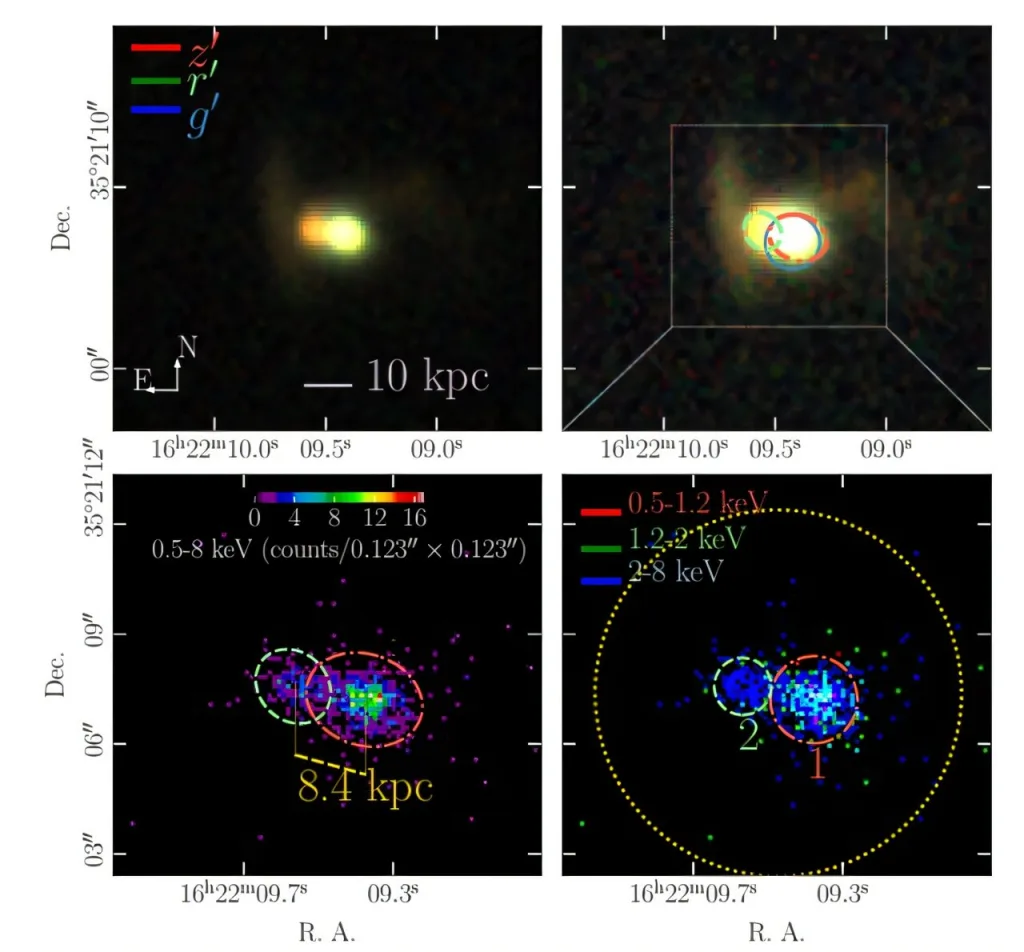
First pair of feeding supermassive black holes found in a Green Pea galaxy.
Why the Green Pea Host Changes the Picture
Green Pea galaxies combine compact structures, low metallicity, intense star formation and unusually strong ionization. Most confirmed dual AGNs, however, occupy larger and more massive gas-rich mergers. A dual AGN in a Green Pea galaxy extends the known population into a different environment.
Green Peas also offer accessible comparisons with compact galaxies from much earlier cosmic periods. They are analogs, not perfect replicas, but they share several conditions linked with rapid galaxy assembly.
J1622+3521 suggests that two supermassive black holes can grow efficiently in a host with relatively modest stellar mass. It also gives astronomers a closer target for examining how accretion, star formation and galaxy interactions develop together.
What Role Is the Merger Playing?
The disturbed morphology suggests that the merger may channel gas toward both nuclei. That material could support intense star formation while also supplying each black hole. Significant nuclear obscuration fits this gas-rich picture.
Still, one object cannot show how often Green Pea mergers produce dual AGNs. Nor does the 8.4-kiloparsec separation imply an imminent combination. The system represents an earlier, pre-coalescence stage whose later evolution remains unknown.
Hidden Activity and the Next Observations
X-ray modeling indicates substantial absorption around both nuclei. The estimated gas columns are about 10^22.9 and 10^23.6 atoms per square centimeter. Source 2 appears more heavily obscured, although both estimates remain below the usual Compton-thick threshold.
Current data cannot completely exclude a more deeply hidden component. Future hard X-ray observations could measure the obscuration and test whether scattered or reflected emission affects existing estimates.
A Window Into Black-Hole Growth in Young Galaxies
J1622+3521 shares several traits with compact active galaxies observed by the James Webb Space Telescope. These include broad emission lines, dense surroundings and rapid accretion. Comparisons with Little Red Dots and Little Blue Dots remain provisional because those distant populations may contain several types of objects.
The lower-redshift Green Pea system offers a major advantage. Astronomers can separate its nuclei and examine them across several wavelengths. It may therefore help test ideas that remain difficult to investigate directly in the early universe.
Conclusion
The dual AGN in a Green Pea galaxy rests on a strong combination of evidence. Chandra detected two matching hard X-ray sources. Meanwhile, Keck found separate AGN signatures at a common redshift. Both black holes appear massive, active and efficiently growing.
The unusual host makes the finding especially important. J1622+3521 shows that simultaneous black-hole growth can occur inside a compact, intensely star-forming merger. Larger surveys must now determine whether this is a rare exception or the first recognized member of a hidden population.
Main Sources:
- Original research paper – arXiv
- First pair of feeding supermassive black holes found in a Green Pea galaxy – Phys.org
- NASA’s Hubble and Chandra Find Supermassive Black Hole Duo
- Keck Observatory Telescopes and Instrumentation