
BY:SpaceEyeNews.
Only 100 million years after the Big Bang, the universe may already have had the materials needed to build rocky worlds. New simulations reveal early rocky planet formation around a young, low-mass star. Its surrounding disk held several Earth masses of solid material and a surprising supply of water. The result moves the possible beginning of planetary history much closer to the cosmic dawn.
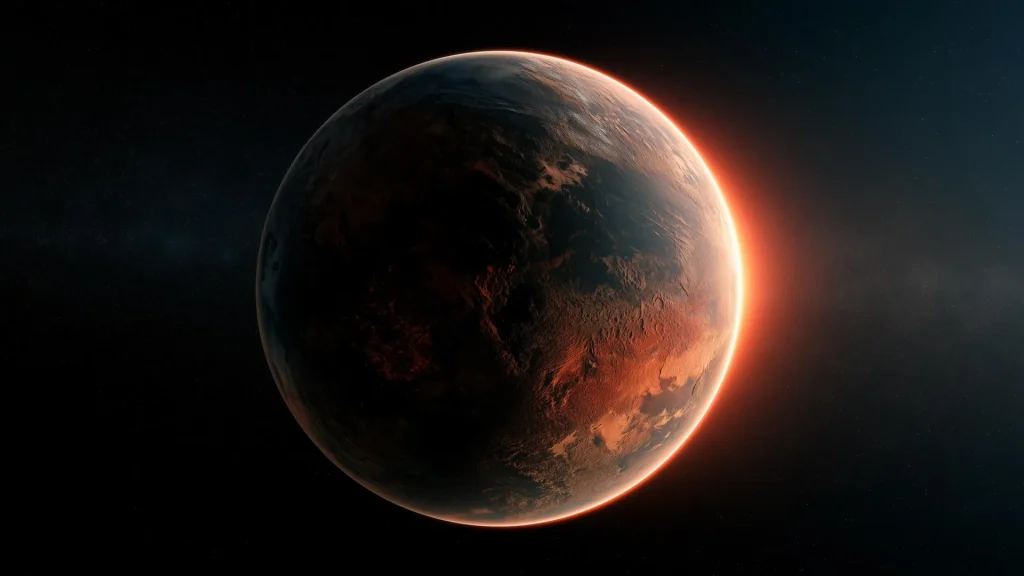
Rocky planets may have had the ingredients they needed to form astonishingly early, just 100 million years after the Big Bang.
The finding does not confirm an ancient Earth or even a completed planet. Instead, it shows that planetesimals could form under exceptional conditions. These small solid bodies can later combine into rocky planets. That distinction is important, but it hardly makes the result less remarkable.
Early Rocky Planet Formation Started With One Rare Event
The research appears in The Astrophysical Journal Letters. Its title is Planet Formation at Cosmic Dawn: Planetesimals in H2O-Rich Disks Around Low-Mass Stars.
Earlier models suggested that planet formation rose gradually. Successive generations of stars had to produce and distribute heavier elements first. The new study identifies a much faster local route.
The route begins with a Population III star. These first-generation stars contained almost only hydrogen and helium. NASA notes that astronomers have not yet directly identified a completely metal-free Population III star. However, their existence follows from the chemical history of the universe.
Some of these stars may have ended as pair-instability supernovae. Such an event could release more than 100 times the Sun’s mass in heavier elements. Carbon, oxygen, iron, and other materials would then enter the surrounding gas.
This enrichment did not need to affect the entire universe. A rare event could transform one nearby cloud. In the researchers’ scenario, local metallicity reached levels as high as the Sun’s. That created an isolated pocket where solid objects could develop far ahead of the cosmic average.
From an Early Supernova Remnant to a New Star
The team used a chain of computer simulations to follow that enriched material. The starting point was a dense core inside the supernova remnant. It held roughly one to two solar masses of material.
Gravity compressed the core and produced a young star with about 70% of the Sun’s mass. A rotating protoplanetary disk developed around it. The model then followed the behavior of gas, dust, heat, and chemical materials inside that disk.
The star’s relatively low mass matters. Very massive stars live briefly, but smaller stars can remain active for billions of years. Therefore, a system like this could offer enough time for planetesimals to grow and for its surroundings to evolve.
The simulation represents one carefully modeled pathway. It does not show that every early supernova created planets. Nor does it establish how common these enriched clouds were. It demonstrates that the required sequence was physically possible under the modeled conditions.
Several Earth Masses Appeared at Familiar Distances
The disk produced several Earth masses of planetesimals between about 0.5 and 1 astronomical unit from the star. One astronomical unit equals the average distance between Earth and the Sun.
That location sounds familiar, but it should not be treated as an exact Earth match. The modeled star had less mass than the Sun and would have delivered energy differently. Orbital distance alone cannot determine a planet’s temperature or climate.
Still, the quantity of solid material stands out. The disk contained enough planetesimals to make the later construction of rocky planets plausible. It did not merely contain traces of dust.
However, the simulation stopped before producing mature planets. Planetesimals must collide, merge, and survive many interactions before they become full-sized worlds. Future models will need to follow that longer process.
Water Strengthens the Case for Early Rocky Planet Formation
Water provided the study’s biggest surprise. The disk’s water mass fraction was only a few times lower than the amount available during the formation of our Solar System.
That water could have entered solid bodies as they developed. Later collisions might then have delivered water to growing rocky planets, broadly resembling one proposed route for Earth’s water.
This result challenges the idea that water-rich planetary material required billions of years of chemical evolution. In rare, highly enriched regions, both solid material and water may have appeared almost as soon as long-lived stars became possible.
Yet water inside a disk does not equal an ocean on a planet. The study did not model a planetary surface, atmosphere, climate, or long-term water cycle. NASA also stresses that even rocky planets at favorable distances are not automatically habitable. Their atmospheres and surface conditions remain essential.
Could Habitable Worlds Have Appeared Before Galaxies Matured?
The findings widen the possible timeline for habitable environments. If rocky planets completed their formation in such systems, some worlds could have started evolving before galaxy formation became widely established.
That possibility remains speculative. A habitable world needs far more than rock and water. It may require a stable orbit, a suitable atmosphere, manageable radiation, and long-term chemical stability. Early space may also have presented conditions unlike those around later stars.
Researchers must now determine how often pair-instability supernovae produced these enriched pockets. They also need to test whether the planetesimals could assemble into stable planets. Searches around extremely old, metal-poor stars may eventually offer observational clues.
What the New Timeline Really Means
This study does not reveal an ancient Earth or evidence of early life. It establishes something more precise: early rocky planet formation was physically possible much sooner than the traditional average timeline suggested.
A rare first-generation supernova could enrich one cloud. That cloud could form a long-lived star, a disk, several Earth masses of solid bodies, and substantial water. All of this may have happened about 100 million years after the Big Bang.
The universe may not have waited billions of years to begin experimenting with rocky worlds. If later research confirms that these planetesimals could become stable planets, the history of potentially habitable environments may reach almost to the first chapter of cosmic time.
Main Sources:
University of Portsmouth — The ingredients for planets formed far earlier than thought
https://www.port.ac.uk/news-events-and-blogs/news/the-ingredients-for-planets-formed-far-earlier-than-thought
The Astrophysical Journal Letters — Planet Formation at Cosmic Dawn
https://doi.org/10.3847/2041-8213/ae907c
University of Portsmouth Research Portal — Publication abstract and details
https://researchportal.port.ac.uk/en/publications/planet-formation-at-cosmic-dawn-planetesimals-in-h2o-rich-disks-a/
NASA Science — What Were the First Stars Like?
https://science.nasa.gov/mission/webb/science-overview/science-explainers/what-were-the-first-stars-like/
NASA Science — Rocky? Habitable? Sizing Up a Galaxy of Planets
https://science.nasa.gov/universe/exoplanets/rocky-habitable-sizing-up-a-galaxy-of-planets/