BY:SpaceEyeNews.
The idea that Earth has only one moon is technically incomplete. Astronomers have discovered that our planet occasionally captures small asteroids that become temporary natural satellites. These objects are known as Earth mini-moons. They can orbit Earth for weeks, months, or even years before escaping back into solar orbit. Recent observations suggest that Earth may host these tiny companions far more often than most people realize.
What Are Earth Mini-Moons?
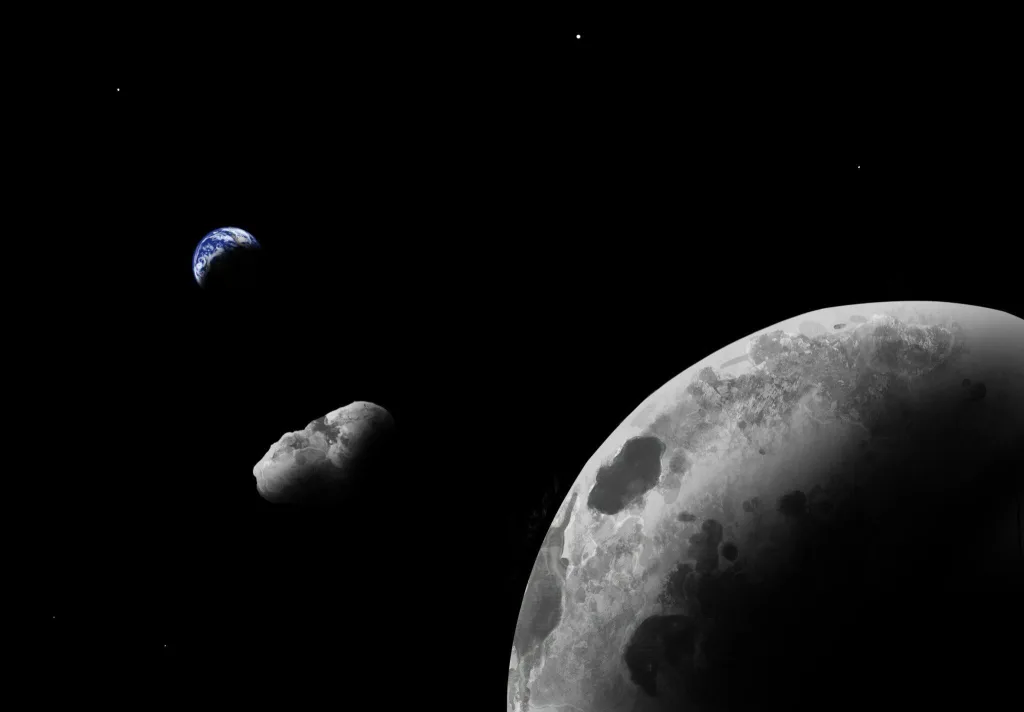
Earth mini-moons are small asteroids that become temporarily trapped by Earth’s gravity. They are not permanent moons. Instead, they follow short-lived paths around our planet before drifting away again.
Scientists usually divide these objects into two categories:
- Temporarily captured orbitersThese objects complete at least one full orbit around Earth.
- Temporarily captured flybysThese objects linger near Earth but do not complete a full orbit.
Both types belong to the broader population of Earth mini-moons. Their existence shows that Earth’s gravitational environment is more dynamic than it appears.
The Confirmed Earth Mini-Moons
A few Earth mini-moons have been confirmed through telescope observations and orbital analysis.
2006 RH120
This asteroid, only a few meters across, became temporarily bound to Earth in 2006. It remained captured for about a year and completed several orbits before escaping.
2020 CD3
Discovered by the Catalina Sky Survey, 2020 CD3 stayed in Earth’s neighborhood for at least two and a half years. Its size has been compared to that of a small car.
2024 PT5
In late 2024, astronomers tracked 2024 PT5 as it lingered near Earth for several weeks. It never completed a full orbit, so it is classified as a temporary flyby rather than a full captured orbiter.
These cases provide direct evidence that Earth mini-moons are real astronomical objects, not just theoretical predictions.
Why Earth Mini-Moons Are Hard to Find
Most Earth mini-moons remain invisible to casual observers. Several factors make them difficult to detect.
Small Size
Many Earth mini-moons measure only a few meters across. They reflect very little sunlight.
Faint Brightness
Because they are tiny and dark, they appear extremely dim against the night sky.
Fast Motion
Earth mini-moons move quickly relative to the stars. This motion makes them harder to track with automated surveys.
Short Lifetimes
Many captures last only weeks or months. By the time astronomers identify an object, it may already be leaving Earth’s vicinity.
For these reasons, the number of confirmed Earth mini-moons is probably much smaller than the true number that exist at any given time.
How Common Are Earth Mini-Moons?
Modeling studies suggest that Earth mini-moons may appear and disappear almost continuously. Astronomer Robert Jedicke has argued that there may be roughly one dishwasher-sized minimoon somewhere within the Earth-Moon system at any given time.
That estimate does not mean a visible second moon hangs in the sky. These objects are tiny. Most would require powerful telescopes to detect.
The important point is that Earth mini-moons may be a regular feature of Earth’s environment rather than rare exceptions. If future surveys confirm the prediction, our planet may almost always have at least one temporary companion.
Not Every Second Moon Is an Earth Mini-Moon
Popular headlines often describe several different phenomena as “second moons.” The distinction matters.
Quasi-Satellites
Objects such as 469219 Kamoʻoalewa are sometimes called Earth’s second moon. However, they are not true Earth mini-moons. They orbit the Sun, not Earth, while remaining in a resonant relationship with our planet.
Space Junk
Some objects initially suspected to be Earth mini-moons turned out to be discarded rocket stages from past missions.
Lunar Fragments
Researchers have suggested that both Kamoʻoalewa and 2024 PT5 may be fragments ejected from the Moon by ancient impacts. If true, some Earth mini-moons may actually be pieces of our existing Moon returning to Earth’s neighborhood.
Why Earth Mini-Moons Matter
Earth mini-moons are more than a curiosity. They could become valuable targets for future space missions.
Easy to Reach
These objects already move slowly relative to Earth. A spacecraft could reach them with less energy than many other asteroids.
Ideal for Robotic Exploration
Small robotic probes could visit Earth mini-moons, study their composition, and possibly return samples.
Useful for Planetary Defense Research
Studying temporarily captured asteroids could improve our understanding of near-Earth object trajectories and impact risks.
Potential Technology Testbeds
Because they are nearby and short-lived, Earth mini-moons could serve as convenient targets for testing spacecraft navigation, autonomous operations, and sampling techniques.
In other words, Earth mini-moons could become stepping stones between Earth orbit and deeper asteroid exploration.
The Vera Rubin Observatory and the Next Wave of Discoveries
The biggest change may come from new sky surveys. The Vera C. Rubin Observatory is designed to scan large areas of the sky repeatedly and detect faint, fast-moving objects.
Astronomers expect Rubin to discover many more Earth mini-moons than previous surveys. If that happens, the field will move from a handful of examples to a large statistical catalog.
Such a catalog would allow researchers to answer important questions:
- How often does Earth capture new mini-moons?
- How long do typical captures last?
- What sizes dominate the population?
- How many of these objects originate from the Moon itself?
The next decade could transform Earth mini-moons from rare curiosities into a well-understood class of near-Earth objects.
The Bigger Picture
For most of human history, Earth seemed to have one obvious moon and nothing else. Modern surveys are revealing a more complicated story. Tiny asteroids regularly pass through Earth’s gravitational sphere of influence. Some become temporary satellites. Others linger briefly before escaping.
The evidence from 2006 RH120, 2020 CD3, and 2024 PT5 shows that these captures are real. Modeling studies suggest they are also common. The main limitation has been our ability to detect them.
As new observatories begin scanning the sky with greater sensitivity, Earth mini-moons may become routine discoveries. If current predictions hold, our planet may almost always host at least one small temporary moon that remains invisible to the naked eye.
That realization changes how we think about Earth’s immediate cosmic neighborhood. The Moon remains our dominant natural satellite, but it may not be our only companion. Instead, Earth appears to be surrounded by a constantly changing population of tiny visitors that come and go on timescales of weeks, months, or years.
In that sense, the question is no longer whether Earth has had more than one moon. The emerging evidence suggests it has had many. We are only beginning to count them.
Main sources: