BY:SpaceEyeNews.
A giant planet has emerged astonishingly early in its system’s history. Elias 2-24 b is less than one million years old, yet astronomers describe its mass as comparable to Jupiter’s. It still sits inside the gas and dust surrounding its young star.
The discovery raises a direct question: how did such a substantial planet grow so quickly, so far from its star? For researchers, the excitement goes beyond an age record. This developing world offers a rare opportunity to compare planet formation theories with a system still taking shape.
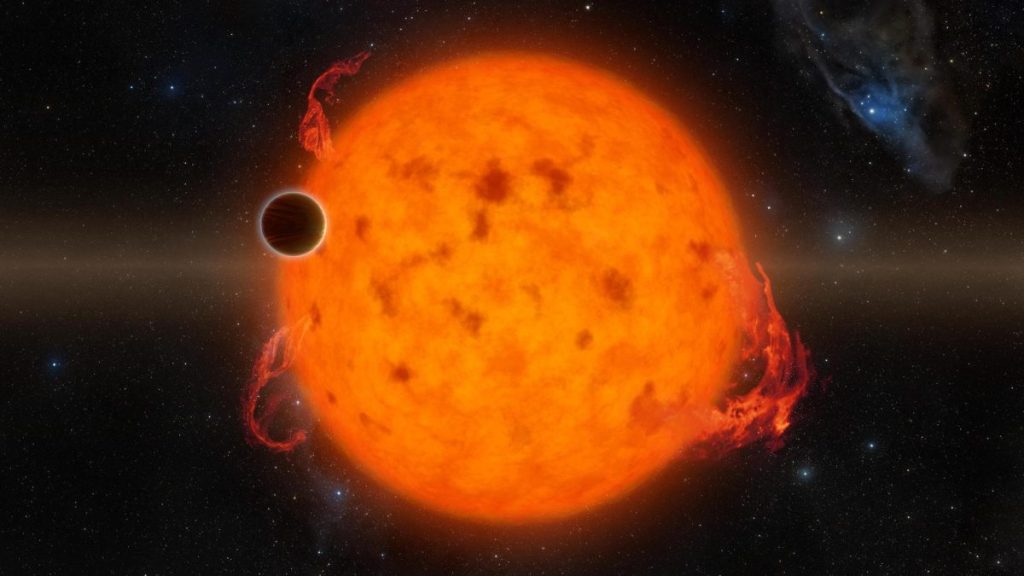
Illustration of a young exoplanet forming around a star. Source: NASA.
Elias 2-24 b: A Giant Still Growing
Located roughly 450 light-years from Earth, the system contains a planet within a prominent gap in its surrounding disk. Its distance from the star is approximately 55 astronomical units. That means about 55 times the Earth–Sun distance, or 8.2 billion kilometers.
For perspective, this places the planet considerably farther from its star than Neptune lies from the Sun. However, distance alone does not make the discovery remarkable. The combination of wide separation, substantial mass, and extreme youth creates the scientific puzzle.
What “Youngest Known” Actually Means
NASA describes Elias 2-24 b as the youngest known planet. That wording matters. Astronomers have identified an exceptionally young object, but they cannot establish that no younger planets exist elsewhere.
Likewise, “less than one million years” describes an age estimate, not a precisely recorded birthday. The story concerns a world caught during its earliest development, rather than a completed planet with a fully understood history.
From a Dusty Gap to a Planet
The investigation began with a clue in the surrounding disk. Around a decade ago, ALMA observations revealed a gap near the young star. Later, the European Southern Observatory’s Very Large Telescope detected a faint point of light in that region.
Together, those observations suggested an intriguing possibility. A developing planet could influence nearby material and help shape the gap. Nevertheless, neither a gap nor a faint source alone settled the object’s identity.
Researchers needed additional evidence to distinguish a planet from a background object or an imaging artifact.
Why Older Observations Mattered
Andrea Bernardi of Universidad Diego Portales in Chile led the team that examined archival Keck Observatory observations. Data from 2018 and 2020 allowed researchers to compare the source’s position over time.
Its motion supported the planetary interpretation, strengthening the case beyond the original detection.
Keck’s coronagraph helped by suppressing the star’s bright light, making the much fainter surroundings easier to examine. The confirmation therefore depended on both suitable instruments and observations across different years. Existing telescope archives supplied a crucial part of the evidence.
Why Elias 2-24 b Challenges Formation Models
The central difficulty involves timing. NASA explains that current models predict roughly five million years to form a Jupiter-size planet at Jupiter’s orbital distance. Farther from the star, formation can take longer.
Yet this planet occupies a much wider location within a system younger than one million years. Researchers must therefore explain how substantial growth happened within that shorter window.
A Timescale, Not a Universal Deadline
The five-million-year figure should not become a fixed rule for every planetary system. Models depend on their starting conditions and the physical processes they include.
Consequently, the discovery does not demonstrate that planet formation theory is entirely wrong. It provides a demanding test of whether existing explanations capture the processes operating in very young disks.
Study co-author Lucas Cieza emphasizes that important processes may still be missing from the models. The next challenge involves identifying which assumptions need improvement and why.
This distinction keeps the result exciting without exaggeration. Astronomers now have an unusually young example that their explanations must accommodate. However, confirming the planet does not automatically reveal the complete sequence that produced it.
What the Discovery Reveals—and Leaves Open
Elias 2-24 b connects evidence from the disk with a directly detected planetary source. That relationship makes it especially useful for investigating how growing planets interact with their surroundings.
The system also offers a comparison point for discussions of our solar system’s beginnings. Still, it should not serve as an exact reconstruction. One young planetary system cannot reveal every detail of another system’s past.
Questions About Its Growth
Several questions remain worth pursuing. How much more material will the planet gather? What will its eventual mass become? How common are similarly young giants at wide separations?
These questions extend beyond confirming that the object exists. Answering them requires further observations and careful comparisons with models.
Researchers also need more examples. A larger sample would help reveal whether this system represents a common formation pathway or an unusual combination of circumstances.
What Astronomers Can Study Next
Further observations could refine the planet’s motion and constrain its properties more closely. Comparing those measurements over time would strengthen the connection between the developing world and its disk.
Better instruments should also expand the range of planets astronomers can investigate. NASA’s Nancy Grace Roman Space Telescope launched on August 30, 2026, and carries an advanced coronagraph.
NASA highlights its potential to detect fainter planets at smaller separations from their stars. These capabilities could broaden comparisons beyond widely separated objects like this one. NASA’s discovery announcement outlines these prospects.
However, potential observations should remain distinct from completed discoveries. The scientific value will come from the measurements astronomers actually obtain.
A New Test of Planetary Origins
Elias 2-24 b matters because astronomers have caught a giant planet during an exceptionally early stage of development. Its youth and location present a concrete challenge for formation models.
The evidence establishes a valuable new target, while its growth history remains an open investigation. By studying this world and finding others like it, researchers can build a clearer picture of how planetary systems begin.
Main sources:
NASA Science — Newfound ‘Baby’ Planet Smashes Record for Youngest Known World. Official discovery announcement and source for the factual checks.
The Astrophysical Journal Letters — Research paper linked by NASA. The full paper was unavailable for direct review.
Universe Magazine — Cosmic baby: Found the youngest planet in the Universe. Original article supplied for this adaptation.