
BY:SpaceEyeNews.
Euclid Ancient Quasars Open a New View of Cosmic Dawn
ESA’s Euclid space telescope has uncovered 31 ancient quasars from the universe’s first billion years. Two of them are now considered the earliest quasars ever observed. This discovery gives astronomers a rare look at a time when the cosmos was still young, galaxies were rapidly changing, and supermassive black holes were already active.
The most distant object is named EUCL J172902.75+641018.1. It has a redshift of 7.77. The second most distant is EUCL J125308.55+705432.3, with a redshift of 7.69. Their light comes from a time when the universe was only about 670 million years old. That is just around 5% of its current age.
This is not only a new distance record. The bigger story is the hidden population Euclid has started to reveal. For years, astronomers knew only a small number of quasars from this early era. Now, Euclid has added 31 more. Twelve of them sit at redshift 7 or higher.
That matters because early quasars help scientists study one of the deepest questions in astronomy. How did supermassive black holes grow so quickly after the Big Bang? Euclid ancient quasars may now give researchers enough data to move from rare discoveries to a more complete cosmic map.
What Euclid Actually Found
Euclid identified 31 previously unknown quasars across the early universe. These objects date from a period less than one billion years after the Big Bang. Their discovery came from Euclid’s wide survey, which combines sharp space imaging with infrared observations.
The two most distant quasars stand out. EUCL J172902.75+641018.1, at redshift 7.77, now marks the most ancient quasar reported by ESA. EUCL J125308.55+705432.3 follows closely at redshift 7.69. Both objects appeared when the universe was only 670 million years old.
This makes them powerful cosmic markers. They show that active supermassive black holes already existed very early. They also suggest that some young galaxies had gathered enough gas and structure to feed these black holes at an impressive rate.
The discovery paper reports quasars in the range of redshift 6.6 to 7.8. That places them firmly in one of the most important periods in cosmic history. Astronomers call this period the Epoch of Reionization. During that era, the universe changed from a darker, more neutral state into a clearer and more ionized cosmos.
Euclid ancient quasars do not only tell scientists where bright objects were. They also show how common these active black holes may have been. That is the key shift. A single record object can be exciting. A larger group can change the science.
A Record From 670 Million Years After the Big Bang
The phrase “oldest quasar” can sound confusing. These objects are not old because they exist near Earth today. They are old because we see them as they were more than 13 billion years ago. Their light needed almost the entire history of the universe to reach us.
That makes EUCL J172902.75+641018.1 a special object. It gives scientists a view of a black-hole-powered galaxy core from a very early chapter of cosmic history. The second record quasar does nearly the same.
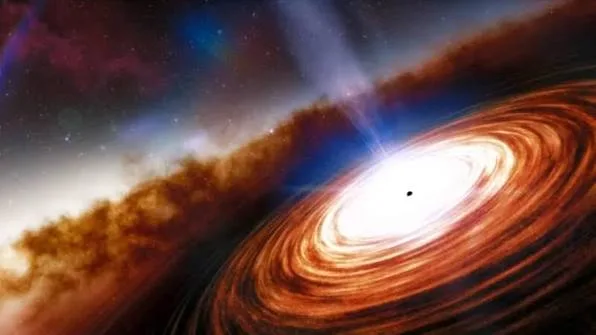
Both objects were shining with extreme power when the universe was still young. Their brightness came from material falling into supermassive black holes. As gas moved inward, it heated up and released enormous energy. That energy turned the galactic center into a beacon visible across cosmic time.
Yet the main mystery remains. Black holes need time to grow. They gain mass by pulling in material or joining with other black holes. In the early universe, time was limited. So the presence of such active systems so soon after the Big Bang raises a serious question.
Did these black holes grow from unusually large seeds? Did they feed faster than many current models allow? Or did early galaxies provide special conditions that helped them grow quickly? Euclid’s new sample gives astronomers more evidence to test these ideas.
Why Euclid Ancient Quasars Matter for Black Hole Growth
Supermassive black holes sit at the centers of many galaxies. Some contain millions or even billions of times the mass of the Sun. In the modern universe, scientists can explain much of their growth over long periods. The early universe creates a harder puzzle.
Euclid ancient quasars show that some black holes became active very soon after the first galaxies formed. That means the growth process must have started early and moved fast.
Researchers now have more targets to compare. They can study brightness, distance, surrounding gas, and host galaxy activity. They can also test whether the most distant quasars share common traits.
This matters because the previous sample was small. When scientists only have a few objects, the most extreme cases can shape the whole story. That can lead to an incomplete picture. A larger sample helps separate rare exceptions from common patterns.
The new Euclid data may help refine models of black hole formation. Some models suggest that the first black holes formed from the collapse of massive early stars. Others suggest that large gas clouds may have collapsed directly into heavier black hole seeds. Euclid cannot answer the full question alone. But it gives researchers more places to look.
Each quasar acts like a time stamp. It tells scientists that a galaxy and its central black hole had already reached a powerful stage at a known time. With enough time stamps, the growth history becomes clearer.
From Rare Discoveries to a Cosmic Census
Before Euclid, finding ancient quasars was slow work. Astronomers used many observatories and years of follow-up to identify a small number of objects above redshift 7. Those discoveries were important. Yet they only showed the brightest and rarest examples.
Euclid changes that approach. Its strength comes from scale. The mission can scan huge areas of the sky while also capturing faint infrared light. That combination helps scientists find distant objects that may have escaped earlier searches.
This is why the new discovery feels different. Euclid did not only add one more object to the record books. It uncovered a group. That group more than doubles the known number of quasars from this ancient category.
A census changes the type of questions scientists can ask. Instead of asking only, “What is the farthest quasar?” researchers can ask, “How many existed at this time?” They can also ask how bright they were, where they formed, and how quickly their black holes grew.
That shift is important for early-universe astronomy. Population studies help reveal the rules behind cosmic growth. They show whether the early universe produced many active black holes or only a few extreme cases.
Euclid ancient quasars could therefore reshape how scientists measure the early quasar population. They may also improve estimates of how much energy these objects released into their surroundings.
The Hidden Population of Fainter Quasars
One of the most important parts of Euclid’s result is not only the record distance. It is the ability to find fainter objects. For a long time, ancient quasar searches favored the brightest sources. That made sense. Bright objects are easier to find across vast distances.
But bright quasars may not represent the full population. They may sit at the extreme end of black hole activity. If astronomers rely too much on them, they may overestimate how unusual early black hole growth was.
Fainter quasars can tell a different story. They may show how more typical black holes grew in young galaxies. They can also help scientists understand how common these systems really were.
Euclid’s survey may become a major step toward that goal. It can search large regions and detect objects that were previously hard to separate from closer stars or galaxies. This matters because distant quasars often appear small and faint in telescope images.
The wider sample also helps scientists refine the quasar luminosity function. This term describes how many quasars exist at different brightness levels. It sounds technical, but the idea is simple. Scientists want to know whether early quasars were mostly rare and brilliant, or whether many dimmer examples filled the young universe.
Euclid’s early results suggest the hidden population is real. As the survey expands, that picture may become much clearer.
What These Quasars Reveal About Early Galaxies
Every ancient quasar also points to a young galaxy. That is why the discovery matters beyond black holes. It helps scientists study the relationship between black hole growth and galaxy growth.
A quasar needs fuel. That fuel comes from gas near the center of a galaxy. If a quasar shines strongly in the early universe, its host galaxy likely had a rich supply of gas. It may also have had intense star formation.
This raises another key question. Did galaxies and their central black holes grow together from the beginning? Or did one process lead the other?
Euclid ancient quasars can help answer that. Follow-up observations can examine the galaxies around these bright cores. Scientists can look for dust, gas, young stars, and structure. They can also measure how the quasar affects its environment.
This is where other observatories become important. Euclid can find strong candidates across wide areas. Then telescopes such as JWST and major ground-based observatories can study selected objects in greater detail.
Together, these missions can build a fuller story. Euclid finds the population. Follow-up instruments examine the details. That combined approach may reveal how early galaxies assembled so quickly.
Clues From the Epoch of Reionization
The 31 Euclid ancient quasars belong to the Epoch of Reionization. This era shaped the universe we see today. During this time, the first generations of stars, galaxies, and active black holes changed the state of cosmic gas.
Quasars help scientists study this period in two ways. First, they show where powerful early systems existed. Second, their light travels through gas on the way to Earth. That light carries clues about the material between the quasar and our telescopes.
In this sense, quasars act like background lamps. They help reveal the condition of the early universe. By studying how their light changes during its journey, astronomers can learn about gas, structure, and radiation during reionization.
This is why the Euclid discovery has wide importance. It is not only about black holes. It is also about the transformation of the universe itself.
A larger quasar sample gives scientists more lines of sight through the early cosmos. Each one adds a new path through ancient space. Together, they can help map how reionization unfolded across different regions.
That could answer a major question. Was reionization smooth and widespread, or did it happen unevenly across cosmic neighborhoods? Euclid’s growing database may help bring that answer closer.
What Comes Next for Euclid’s Search
This discovery is likely only the beginning. Euclid will continue scanning large parts of the sky during its mission. As more data arrives, astronomers expect more ancient quasar candidates to appear.
The next step is confirmation and deeper study. Scientists need spectroscopy to measure distances and properties with greater precision. They also need follow-up observations to estimate black hole masses and study host galaxies.
Future work may focus on how fast these black holes were growing. It may also explore whether the quasars sit in dense early environments. That could show whether large-scale structure had already started to shape galaxy formation.
The full Euclid survey could turn today’s early result into a much larger catalog. That would give scientists a stronger statistical base. It would also help compare early quasars across different distances and brightness levels.
For now, the discovery already changes the field. Euclid found 31 ancient quasars, including two record objects, early in its survey work. That alone shows how powerful the mission has become for studying cosmic dawn.
Conclusion: Euclid Ancient Quasars Turn Records Into a Map
Euclid ancient quasars have opened a new chapter in early-universe astronomy. ESA’s telescope has identified 31 ancient quasars, including two that date back to a time when the universe was only about 670 million years old.
The discovery matters because it goes beyond a single record. It reveals a hidden population of early black-hole-powered galaxy cores. It also gives scientists a better way to study how supermassive black holes grew so fast after the Big Bang.
These quasars can help explain early galaxy growth, the Epoch of Reionization, and the rise of large cosmic structures. As Euclid continues its survey, this first census may grow into one of the most important maps of the young universe.
Main Sources:
European Space Agency — “Euclid discovers the most ancient quasar in the Universe”
https://www.esa.int/Science_Exploration/Space_Science/Euclid/Euclid_discovers_the_most_ancient_quasar_in_the_Universe
Astronomy & Astrophysics — “Euclid: Discovery of 31 new quasars at 6.6 < z < 7.8”
https://www.aanda.org/articles/aa/full_html/2026/07/aa58883-26/aa58883-26.html
Leiden University — “Euclid spots dozens of quasars in the early universe”
https://www.universiteitleiden.nl/en/news/2026/07/euclid-spots-dozens-of-quasars-in-the-early-universe
Max Planck Society — “Probing the host galaxy of one of the most distant quasars”
https://www.mpg.de/26858716/euclid-quasars