
BY:SpaceEyeNews.
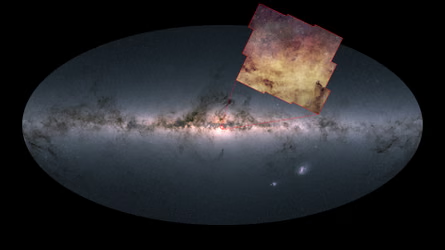
The Euclid Milky Way center image has given astronomers a remarkable new view of one of the most crowded regions in our galaxy. Although the European Space Agency designed Euclid to study dark matter and dark energy by mapping distant galaxies, the mission recently turned its attention much closer to home. The result is one of the most detailed wide-field images ever captured of the Milky Way’s central bulge.
Rather than changing its scientific mission, Euclid demonstrated just how versatile its technology has become. The observation highlights the telescope’s ability to produce sharp images across a vast area of the sky while resolving millions of individual stars hidden behind dense clouds of gas and dust. It also provides valuable data for future studies of our galaxy and helps prepare the mission for its primary survey of the distant Universe.
Why Did Euclid Observe the Milky Way Instead of the Distant Universe?
Euclid’s primary objective has never changed. The spacecraft continues to search for clues about dark matter and dark energy by mapping billions of galaxies across much of the observable Universe. Every observation supports one of the largest cosmology projects ever attempted.
Even so, the mission team occasionally performs observations outside the main survey. These special observations allow engineers and scientists to test the telescope under different conditions while collecting valuable scientific data.
A Difficult Region to Observe
The center of the Milky Way presents one of astronomy’s greatest imaging challenges. Unlike distant galaxies that appear separated across the sky, the Galactic bulge contains an enormous concentration of stars packed into a relatively small region.
Dust clouds make the challenge even greater. Visible light struggles to pass through these thick clouds, hiding many stars from conventional observations. At the same time, overlapping stars make it difficult to distinguish one object from another.
Because of these conditions, astronomers need instruments that combine high resolution, excellent sensitivity, and a wide field of view.
Testing Euclid Under Extreme Conditions
Instead of looking billions of light-years away, Euclid spent roughly 26 hours observing the Milky Way’s central bulge. The telescope combined multiple exposures into a giant mosaic covering an area far larger than typical deep-space observations.
This was not simply an exercise in taking a beautiful picture. Scientists wanted to see how well Euclid could perform in one of the most crowded stellar environments in the sky.
The results exceeded expectations. The telescope successfully separated millions of stars while preserving fine detail across an enormous field.
What Makes the Euclid Milky Way Center Image So Extraordinary?
The new image immediately stands out because of its scale.
Instead of focusing on a tiny patch of sky, Euclid captured an enormous region around the Galactic center while maintaining impressive image quality. That combination remains one of the telescope’s greatest strengths.
Millions of Stars in One Image
The final mosaic contains more than 60 million stars.
Each point of light represents a different object inside our galaxy. Some stars lie relatively close to our Solar System. Others sit much deeper inside the Galactic bulge.
The sheer number of visible stars illustrates how densely populated this region truly is.
Even more impressive, astronomers can distinguish many individual stars instead of seeing them blend into a single bright glow.
A Wide View Without Losing Detail
Many space telescopes specialize in extremely deep observations of relatively small regions.
Euclid follows a different strategy.
Its optics allow it to image huge sections of the sky while preserving high resolution. During this observation, the telescope produced a mosaic measuring roughly six gigapixels after combining nine separate pointings.
This wide-field capability enables scientists to study large-scale stellar structures that smaller images might miss entirely.
Visible and Infrared Instruments Working Together
Euclid carries two complementary scientific instruments.
The Visible Instrument (VIS) records extremely sharp visible-light images. During this observation, VIS resolved vast numbers of individual stars throughout the Galactic bulge.
The Near Infrared Spectrometer and Photometer (NISP) added another important layer of information.
Infrared wavelengths pass through dust much more effectively than visible light. As a result, NISP detected cooler and partially hidden objects that would otherwise remain invisible.
Together, these instruments provide a much more complete picture of the Milky Way’s crowded center than either could achieve alone.
A Different Strength Than Hubble
Comparisons with the Hubble Space Telescope naturally attract attention. However, the two observatories serve different purposes.
Hubble excels at extremely deep observations of relatively small regions. Its detailed images have transformed nearly every field of astronomy.
Euclid focuses on surveying enormous areas efficiently.
For this Galactic observation, Euclid covered an area about 100 times larger than Hubble’s camera field of view while maintaining remarkable image quality. Reaching similar coverage with Hubble would require many individual observations over a much longer period.
That difference does not make one telescope better than the other. Instead, it shows how modern observatories complement each other by solving different scientific problems.
Main Sources :
- European Space Agency (ESA) – Euclid Mission
https://www.esa.int/Science_Exploration/Space_Science/Euclid - ESA – Euclid Captures the Milky Way’s Crowded Heart
https://www.esa.int/Science_Exploration/Space_Science/Euclid/Euclid_captures_the_Milky_Way_s_crowded_heart - NASA – Euclid View of the Milky Way Heart Previews Core Survey by NASA’s Roman Space Telescope
https://www.nasa.gov/missions/roman-space-telescope/euclid-view-of-milky-way-heart-previews-core-survey-by-nasas-roman/ - NASA – Euclid Mission Overview
https://science.nasa.gov/mission/euclid/ - Euclid Consortium / Caltech – ESA’s Euclid Captures the Milky Way’s Crowded Heart
https://euclid.caltech.edu/news/esa-s-euclid-captures-the-milky-way-s-crowded-heart - Universe Magazine – Euclid Reveals the Center of the Milky Way in Incredible Detail
https://universemagazine.com/en/euclid-reveals-the-center-of-the-milky-way-in-incredible-detail/