BY:SpaceEyeNews.
ESA’s Euclid space telescope has uncovered a population of quasars from the earliest chapters of cosmic history. The Euclid quasar discovery includes 31 previously unknown objects, with two now ranked as the most distant quasars observed. Their light began its journey when the Universe was only about 670 million years old.
Each record-setting quasar radiated with the brightness of roughly one trillion Suns. Yet the real importance lies beyond their extraordinary luminosity. Together, these objects offer a new way to investigate how supermassive black holes formed and grew far earlier than many models can easily explain.
Euclid Quasar Discovery Reveals 31 Ancient Objects
The new sample spans redshifts from 6.6 to 7.8. Twelve quasars have redshifts of 7 or higher, placing them within the Universe’s first 770 million years.
The most distant object is EUCL J172902.75+641018.1, with a redshift of 7.77. The second is EUCL J125308.55+705432.3, at redshift 7.69. Astronomers see both as they appeared around 670 million years after the Big Bang.
The team published the results in Astronomy & Astrophysics on July 6, 2026. According to ESA, the sample more than doubled the number of known quasars beyond redshift 7.
That increase matters. Earlier surveys found only a few exceptionally bright examples. Euclid now gives astronomers a broader population to compare. Researchers can move from isolated record holders toward a meaningful census of active black holes at cosmic dawn.
What Produces a Quasar’s Light?
Headlines often describe black holes as shining with the power of a trillion Suns. However, black holes do not emit this light directly.
The glow comes from material falling toward the black hole. Gas and dust gather in a rotating accretion disk. Friction and compression heat that material to extreme temperatures. The disk then releases vast amounts of radiation before some matter crosses the event horizon.
This distinction matters because the luminosity reveals how actively the black hole was feeding. It can also help astronomers estimate its mass and growth rate.
During a quasar phase, the central region can outshine all the stars in its host galaxy by hundreds or even thousands of times.
Why Ancient Quasars Are Difficult to Find
Quasars from this era are rare and faint when viewed from Earth. Their light has traveled for more than 13 billion years. Cosmic expansion also stretched much of that radiation into infrared wavelengths.
Another challenge comes from contamination. Very distant quasars can resemble cooler stars inside the Milky Way. Astronomers must separate a few genuine early objects from vast numbers of closer sources.
Euclid combines sharp imaging, infrared sensitivity, and a wide field of view. It can therefore examine huge sky regions while still detecting faint targets.
Ground-based observatories then help confirm candidates. Spectroscopy measures redshift and identifies the expected quasar signatures. This process turns promising points of light into reliable detections.
The Euclid Quasar Discovery Deepens a Growth Mystery
The main question is not simply why these quasars were bright. It is how their supermassive black holes became so large so quickly.
The first stars likely produced some early black holes. Yet ordinary stellar remnants may not have had enough time to become enormous before the Universe reached an age of 670 million years.
Several explanations remain possible. Early black holes may have started as unusually massive seeds. Dense gas clouds might have collapsed directly into larger black holes. Some objects may have experienced long periods of rapid feeding. Black-hole mergers could also have accelerated growth.
Another possibility involves growth above the conventional Eddington limit. This limit describes when outward radiation pressure restricts the inward flow of material. Under certain conditions, a black hole may exceed that rate temporarily.
No single idea has solved the full problem. Euclid’s larger sample can help researchers test which growth paths best match the observed population.
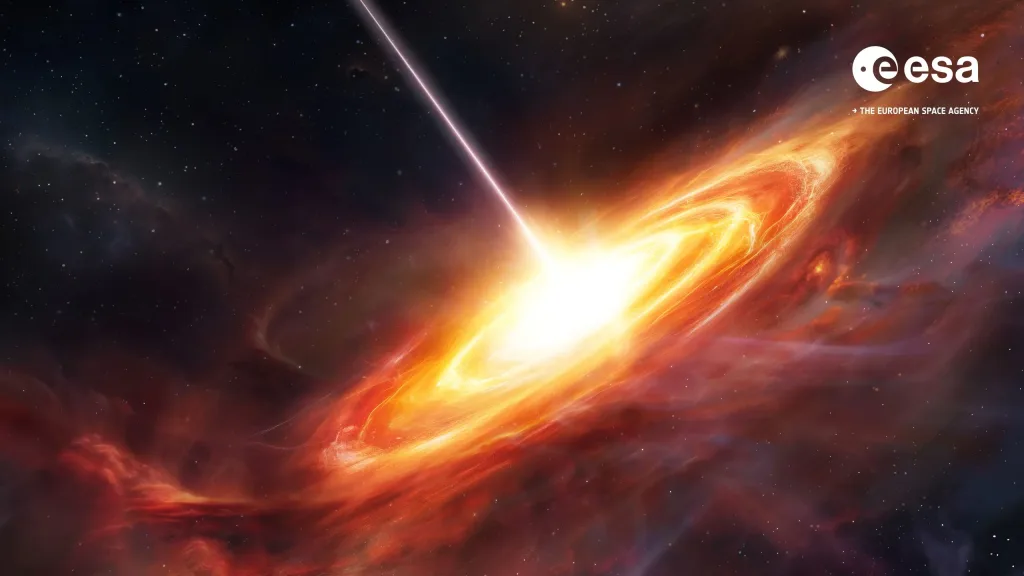
Astronomers Find Ancient Black Holes Shining With the Power of a Trillion Suns
Ancient Quasars Illuminate Cosmic Dawn
These quasars reveal more than black-hole history. They also act as bright background sources for studying the young Universe.
Their radiation passed through gas between early galaxies and Earth. Astronomers can examine how that gas absorbed specific wavelengths. The patterns help trace hydrogen during the epoch of reionization.
Before that transition, much of the Universe contained neutral hydrogen. Energetic radiation from early stars, galaxies, and quasars gradually ionized it. This process helped create the transparent cosmos seen today.
One of Euclid’s oldest quasars appears inside a galaxy rich in gas and dust. The galaxy was also forming stars at an intense rate. This environment suggests that rapid black-hole growth and galaxy growth could occur together.
However, one example cannot represent every early quasar. Future observations will show whether such gas-rich hosts were common.
Why Euclid Changes Quasar Astronomy
Euclid launched in 2023 to study the dark Universe and map cosmic structure. Its survey design also makes it highly effective at finding rare, distant objects.
The mission plans to observe more than one-third of the sky. As it maps billions of galaxies, it should reveal more quasars from the Universe’s first billion years.
This scale changes the search. Astronomers no longer need to rely mainly on narrow surveys for the brightest outliers. Euclid can build a wider and more representative sample.
Other observatories can then examine selected objects in greater detail. Follow-up studies may measure black-hole masses, host galaxies, gas supplies, and star-formation rates. Those results could show how early quasars fit into the wider story of galaxy formation.
Conclusion: Euclid Quasar Discovery Opens a New Era
The Euclid quasar discovery has revealed 31 ancient quasars, including two seen only 670 million years after the Big Bang. Their extreme brightness confirms that rapidly growing supermassive black holes already existed during the Universe’s infancy.
The record holders attract attention, but the complete sample may have greater scientific value. It offers a stronger foundation for testing black-hole growth models, studying early galaxies, and examining reionization. As Euclid surveys more sky, this first census could develop into a much clearer history of how the earliest cosmic giants emerged.
Main Sources:
European Space Agency — Euclid Discovers the Most Ancient Quasar in the Universe
https://www.esa.int/Science_Exploration/Space_Science/Euclid/Euclid_discovers_the_most_ancient_quasar_in_the_Universe
Astronomy & Astrophysics — Euclid: Discovery of 31 New Quasars at 6.6 < z < 7.8
https://www.aanda.org/articles/aa/full_html/2026/07/aa58883-26/aa58883-26.html
Euclid Consortium — Euclid Scientists Discover Most Distant Known Quasars
https://www.euclid-ec.org/most-distant-quasars/
Euclid Consortium Press Release — Two Most Distant Quasars
https://www.euclid-ec.org/public/press-releases/euclid-two-most-distant-quasars/