BY:SpaceEyeNews.
The Eulalia asteroid breakup may have sent a vast stream of rocky fragments toward Earth, the Moon, and Mars about 800 million years ago. According to a new study, debris from this single event could explain a mysterious increase in lunar impacts from that period.
The collision occurred in the main asteroid belt. However, its location made it far more important than an ordinary asteroid breakup. The parent object shattered close to a powerful orbital resonance with Jupiter. As a result, the giant planet’s gravity may have redirected much of the debris toward the inner solar system.
Scientists now think the event could have influenced several worlds. The lunar evidence appears strongest. Possible effects on Earth’s environment and Mars’ geological activity remain less certain.
Scientists Trace an Ancient Impact Shower to Eulalia
Researchers have suspected for years that the Moon experienced an increase in large impacts around 800 million years ago.
Several clues support that idea. Scientists have estimated the ages of major lunar craters, including the 93-kilometre-wide Copernicus crater. They have also studied impact glass collected during the Apollo missions.
Such glass forms when an incoming object releases enough energy to melt surface rock. The material quickly cools and preserves information about when the event occurred.
Many samples appear to record impacts from a similar period. Yet scientists lacked a convincing source for the objects that reached the Moon.
A team led by William Bottke of the Southwest Research Institute examined the Eulalia asteroid family. The researchers used computer models to recreate the family’s original formation and the later movement of its fragments.
Their results suggest that a primitive, carbon-rich parent asteroid broke apart roughly 800 million years ago. That timing aligns with the proposed increase in lunar impacts.
Why the Eulalia Asteroid Breakup Location Mattered
The Eulalia asteroid breakup occurred beside Jupiter’s 3:1 mean-motion resonance.
This orbital region acts like a gravitational route out of the asteroid belt. An object inside the resonance circles the Sun three times during each orbit completed by Jupiter.
Repeated gravitational pulls from Jupiter can gradually stretch an asteroid’s orbit. Eventually, that path may cross the orbits of Mars, Earth, or other inner planets.
The location of the Eulalia parent body was therefore critical. A major collision elsewhere in the asteroid belt might have produced thousands of fragments that remained in stable orbits. Eulalia’s debris formed beside a region that could quickly destabilize it.
According to the simulations, about half of the newly created fragments entered the resonance almost immediately. Jupiter’s influence then pushed many of those objects into planet-crossing orbits.
This process could have created a sharp rise in impacts across the inner solar system. The Moon retained the scars, while Earth’s active geology erased most of its ancient evidence.
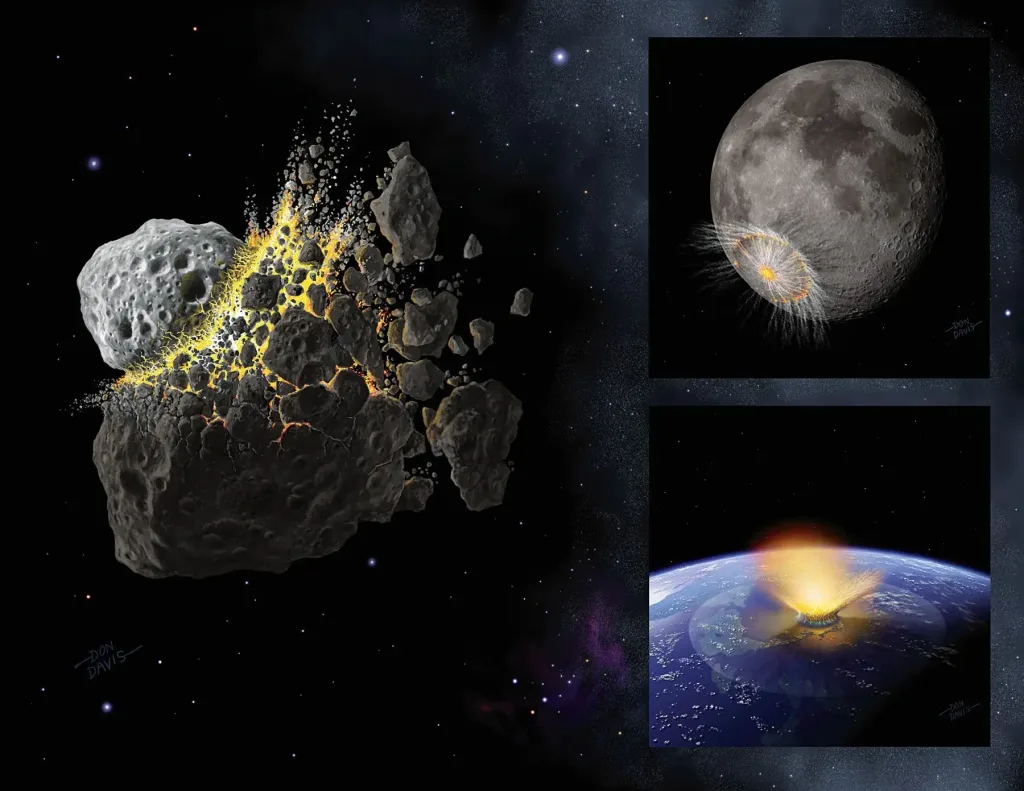
One Asteroid Collision May Have Rocked Earth, Mars, and the Moon.
Sunlight Extended the Impact Episode
The initial release of debris was only part of the story.
Many Eulalia fragments did not enter Jupiter’s resonance immediately. Instead, they slowly moved across the asteroid belt through the Yarkovsky effect.
Small asteroids absorb sunlight and later release that energy as heat. This uneven release produces a very weak push. Although the force is tiny, it can change an asteroid’s orbit over millions of years.
The study found that additional fragments gradually reached the 3:1 resonance during the next 100 to 150 million years. In total, roughly three-quarters of the family’s fragments may have entered the resonance.
Therefore, the event was probably not a brief wave of impacts. It may have produced a prolonged period of increased activity across the inner solar system.
This extended delivery also helps explain why lunar samples may record several impacts across a broad time range rather than one tightly defined moment.
The Moon Preserves the Strongest Evidence
Earth offers a poor record of events from 800 million years ago.
Plate tectonics continuously recycles the crust. Erosion removes old landscapes, while sediment and volcanic activity cover earlier formations. Many ancient impact structures have therefore disappeared or become difficult to identify.
The Moon experiences none of those processes on the same scale. Its surface changes slowly, allowing impact craters to survive for billions of years.
Lunar crater ages and Apollo impact glass provide the strongest evidence for the proposed shower. The researchers’ models also show that the Eulalia family could have supplied enough debris at approximately the correct time.
However, uncertainties remain. Scientists cannot yet connect every crater from this period directly to Eulalia. Some crater ages also have wide error ranges.
The study establishes a plausible source and delivery mechanism. It does not prove that every large lunar impact around 800 million years ago came from the same asteroid family.
Could the Debris Have Changed Earth?
Earth would have received far more impacts than the Moon. Our planet has a larger surface and stronger gravity, which makes encounters with passing objects more likely.
The timing of the proposed impact shower also overlaps with major environmental changes. Earth experienced widespread cooling and important shifts within its biosphere during this broad period.
Repeated impacts could have added dust and gases to the atmosphere. They may also have altered ocean chemistry or delivered carbon-rich material to the surface.
Still, researchers cannot claim a confirmed connection. Timing alone does not show that one event caused another.
Changes in climate and life may have resulted from several factors, including tectonic activity and the changing arrangement of continents. The Eulalia scenario adds another possible influence rather than replacing existing explanations.
Possible Effects Beneath the Martian Surface
Mars may also preserve signs of the ancient impact shower.
Large incoming objects would have generated powerful seismic waves. Those waves could have travelled deep into the Martian crust and disturbed underground magma systems.
The proposed impact period appears to overlap with increased volcanic activity on Mars. This raises the possibility that repeated seismic events helped release magma or changed existing volcanic systems.
Once again, the evidence does not prove cause and effect. Volcanism can develop through internal planetary processes without an external trigger.
Future crater dating and geological modelling may reveal whether the impact shower and volcanic episode were physically connected.
Eulalia Asteroid Breakup Links Three Planetary Histories
The Eulalia asteroid breakup shows how one event in the main belt could influence several worlds.
Its importance came from its location beside Jupiter’s gravitational gateway. That position allowed newly formed fragments to escape the asteroid belt quickly. Sunlight then pushed more debris toward the resonance over millions of years.
The lunar record provides the clearest evidence for the resulting impact shower. Possible links to Earth’s climate, biological changes, and Martian volcanism remain compelling but unconfirmed.
Further lunar sample analysis and improved crater dating could test the idea. Scientists may eventually learn whether one shattered asteroid truly altered the histories of Earth, the Moon, and Mars.
Main Sources:
Southwest Research Institute:
https://www.swri.org/newsroom/press-releases/swri-led-research-connects-asteroid-collision-impact-showers-800-million-years-ago
Original research paper — An 800-Million-Year-Old Impact Shower on the Terrestrial Planets from the Breakup of the Eulalia Parent Body:
https://arxiv.org/abs/2606.05036
Full research paper text:
https://arxiv.org/html/2606.05036v1
The Planetary Science Journal:
https://iopscience.iop.org/journal/2632-3338