
BY:SpaceEyeNews.
For more than two decades, cosmologists have relied on a remarkably successful picture of the universe. In this model, a mysterious component called dark energy drives the accelerating expansion of space. The idea fits observations well and forms a key part of the standard cosmological model. Yet new findings are raising an important question. What if dark energy is not constant after all?
Recent observations from the Dark Energy Spectroscopic Instrument (DESI) suggest that Evolving Dark Energy may be a real possibility. The evidence remains preliminary, but it has captured the attention of astronomers worldwide. If future observations confirm the trend, one of the most important assumptions in modern cosmology may need revision.
Evolving Dark Energy and the Foundation of Modern Cosmology
Why Scientists Accepted a Constant Dark Energy
The current standard model of cosmology is known as Lambda-CDM. The Greek letter Lambda represents Einstein’s cosmological constant. In this framework, dark energy behaves as a fixed property of space itself.
For years, the model delivered impressive results. It successfully explained the large-scale structure of the universe, the distribution of galaxies, and measurements of the cosmic microwave background. It also matched observations of distant supernovae that revealed cosmic acceleration in 1998.
Because of these successes, many researchers viewed the cosmological constant as the simplest explanation for dark energy.
The Long-Standing Vacuum Energy Problem
Despite its success, the cosmological constant has always carried a serious problem.
Quantum physics predicts that empty space should contain energy. However, when physicists calculate this vacuum energy, the result becomes enormously larger than what astronomers observe.
The difference reaches roughly 120 orders of magnitude.
Many scientists describe this mismatch as the worst prediction in theoretical physics. As a result, researchers have spent decades searching for alternatives that could explain the acceleration of the universe more naturally.
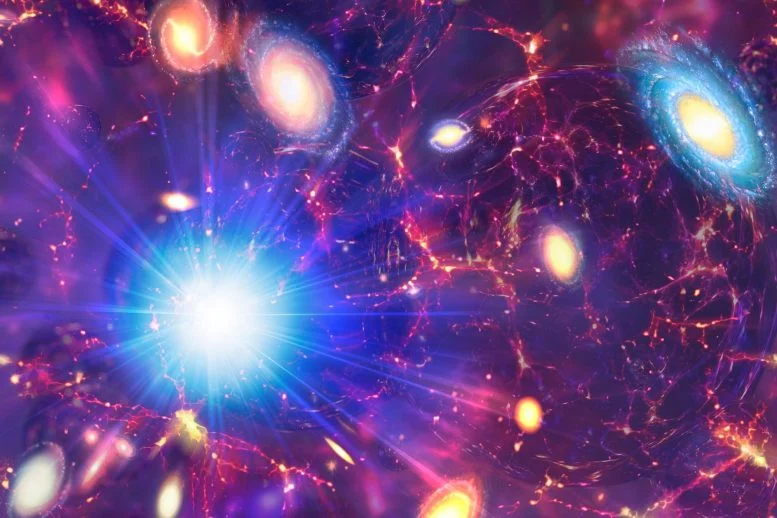
A New Type of Dark Energy: Solving the Mystery of the Expansion of the Universe.
How DESI Is Investigating Evolving Dark Energy
Building the Largest Three-Dimensional Cosmic Map
The Dark Energy Spectroscopic Instrument has become one of the most ambitious astronomy projects ever built.
Located at Kitt Peak National Observatory in Arizona, DESI measures the positions and distances of millions of galaxies and quasars. The project creates a detailed three-dimensional map of the universe across billions of years of cosmic history.
This map allows scientists to study how the expansion rate of the universe changed over time.
Instead of looking only at the present-day cosmos, researchers can reconstruct how expansion behaved throughout much of cosmic history.
What the Latest DESI Results Reveal
Recent DESI analyses combined galaxy maps with several independent datasets.
Researchers compared DESI observations with supernova measurements, the cosmic microwave background, and gravitational lensing studies.
The combined results revealed something unexpected.
The data appears slightly more consistent with a model in which dark energy changes over time rather than remaining perfectly constant.
This does not mean scientists have discovered the true nature of dark energy. However, the possibility of Evolving Dark Energy now appears more plausible than it did only a few years ago.
Why Researchers Remain Cautious
Astronomy has seen many intriguing hints disappear when larger datasets become available.
For this reason, scientists follow strict statistical standards.
Most physics discoveries require a confidence level known as five sigma before researchers consider the result confirmed.
Current DESI findings have not reached that threshold.
The signal remains intriguing, but additional observations will determine whether the trend strengthens or fades away.
That careful approach explains why researchers are excited yet cautious at the same time.
Why Evolving Dark Energy Would Change Cosmology
Einstein’s Cosmological Constant Could Be Incomplete
If future observations confirm Evolving Dark Energy, the implications would be profound.
The standard Lambda-CDM model assumes that dark energy remains unchanged throughout cosmic history.
A changing dark energy component would challenge that assumption directly.
Scientists would need to revise parts of the model that currently describe how the universe evolves.
While many existing observations would remain valid, the theoretical framework connecting them could require major updates.
New Theories Could Gain Attention
Several alternative theories already attempt to explain cosmic acceleration.
One possibility involves a dynamic field that changes strength over time. Researchers often refer to these models as quintessence theories.
Unlike a cosmological constant, a dynamic field evolves as the universe ages.
Other ideas propose entirely new forms of physics that operate on cosmic scales.
At present, none of these explanations has emerged as a clear winner.
That uncertainty makes the DESI findings especially important.
If dark energy evolves, scientists may finally gain clues about which theoretical direction deserves the most attention.
A Larger Mystery Than Expected
Ironically, dark energy was introduced to explain an observational mystery.
Now the explanation itself may be turning into a deeper puzzle.
For decades, researchers hoped the cosmological constant would provide a simple answer. Instead, new data may reveal that reality is more complicated than expected.
That possibility keeps cosmologists focused on every new observation.
Future Observatories Will Test Evolving Dark Energy
Euclid Expands the Investigation
The European Space Agency’s Euclid mission has already begun gathering data.
Its primary goal includes studying dark energy and the large-scale structure of the universe.
Euclid will provide independent measurements that can test DESI’s conclusions.
Vera Rubin Observatory Joins the Search
The Vera C. Rubin Observatory will soon contribute another enormous dataset.
Its long-term sky survey will track billions of celestial objects.
Researchers expect these observations to improve measurements of cosmic expansion significantly.
The observatory may help determine whether the evidence for Evolving Dark Energy becomes stronger.
NASA’s Roman Space Telescope
NASA’s upcoming Nancy Grace Roman Space Telescope will add another powerful tool.
Roman will measure distant galaxies and supernovae with exceptional precision.
Combined with DESI and Euclid, the mission could help answer one of astronomy’s most important questions.
Does dark energy remain constant, or does it evolve over time?
The Future of the Universe May Depend on the Answer
The nature of dark energy influences more than current cosmology.
It may also determine the long-term future of the universe.
If dark energy remains constant, cosmic expansion should continue accelerating indefinitely.
Galaxies would gradually move farther apart, leaving an increasingly isolated universe.
However, if dark energy changes with time, different outcomes become possible.
The expansion rate could evolve in unexpected ways. Future cosmic history might look very different from current predictions.
Scientists cannot yet determine which scenario is correct.
That uncertainty highlights why the search for answers remains so important.
Conclusion
The idea of Evolving Dark Energy has moved from speculation to a serious scientific possibility. Recent DESI observations suggest that dark energy may not remain constant throughout cosmic history. Although the evidence has not reached discovery level, the trend has become difficult to ignore.
For more than twenty-five years, the cosmological constant served as the leading explanation for cosmic acceleration. Now researchers face the possibility that the universe may be more dynamic than previously believed.
Over the next few years, DESI, Euclid, the Vera Rubin Observatory, and NASA’s Roman Space Telescope will provide crucial data. Their observations may confirm the existence of Evolving Dark Energy or reinforce the standard model.
Either outcome would represent a major step forward. Yet if dark energy truly changes over time, cosmology could be approaching one of its most significant discoveries in decades.
Main Sources:
- Space Daily – The universe is not only expanding — its expansion is accelerating
https://spacedaily.com/t-the-universe-is-not-only-expanding-its-expansion-is-accelerating-after-decades-of-searching-physicists-still-do-not-know-what-is-causing-it-the-name-they-gave-the-mystery-dark-energy-is/ - DESI Collaboration / Lawrence Berkeley National Laboratory
https://www.desi.lbl.gov - Lawrence Berkeley National Laboratory – New DESI Results Strengthen Hints That Dark Energy May Evolve
https://newscenter.lbl.gov/2025/03/19/new-desi-results-strengthen-hints-that-dark-energy-may-evolve/ - European Space Agency – Euclid Mission
https://www.esa.int/Science_Exploration/Space_Science/Euclid - NASA – Nancy Grace Roman Space Telescope
https://roman.gsfc.nasa.gov/