BY:SpaceEyeNews.
An exoplanet magnetic field has revealed itself through powerful radio bursts from a giant world about 64 light-years away. Astronomers traced the emission to Beta Pictoris b, separating its position from that of its host star. The signal indicates a magnetic field far stronger than Earth’s.
The team reports the first direct detection of auroral radio emission confidently located at an orbiting exoplanet. However, the findings remain a preprint and await peer review. If confirmed, the result would open a new route into distant planets’ magnetic environments and internal physics.
Pinpointing a planet beside its star
Beta Pictoris b offers an unusually promising target. This young gas giant holds approximately 12 times Jupiter’s mass and circles a relatively magnetically quiet star. NASA also confirms that the system contains at least three giant planets.
Yet locating a radio source there demands exceptional precision. Planet b reaches an apparent separation of only about 0.55 arcseconds from its star. At that scale, detecting emission from the system does not automatically identify its origin.
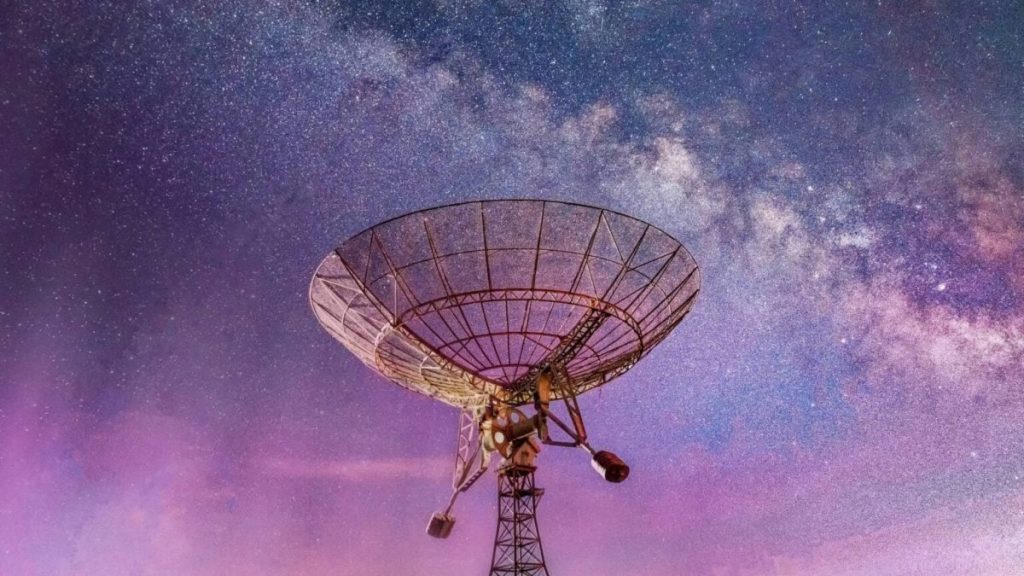
Researchers observed Beta Pictoris four times during 2025 and 2026 with South Africa’s MeerKAT radio telescope array. They then aligned the radio observations with a celestial reference frame using nine quasars and an additional calibration source.
These distant reference points helped establish where the emission originated. After accounting for measured uncertainties, the radio position matched planet b and strongly disagreed with the star’s position.
That distinction drives the discovery. Earlier signals from planet-hosting systems could leave astronomers unsure whether the planet or its star produced the emission.
How radio bursts reveal an exoplanet magnetic field
The observations captured rapid, recurring bursts alongside weaker persistent emission. The bursts showed strong circular polarization, ranging from roughly 40% to 70%. Together, their polarization and rapid changes point toward an auroral process.
Electrons moving along magnetic field lines can produce this radiation through electron cyclotron maser instability. Despite its technical name, the useful connection is straightforward: the emission frequency depends on the magnetic field’s strength.
Earth and Jupiter produce auroral radio emission through the same basic mechanism. At Beta Pictoris b, however, the observed frequencies imply a much stronger field.
Why the measurement is a lower limit
MeerKAT detected a burst extending to 3.5 gigahertz, the upper edge of the observing band. Using the auroral interpretation, researchers calculated a field of at least 1.25 kilogauss, or 1,250 gauss.
Crucially, the instrument reached its frequency limit before the observations revealed where the emission stopped. The actual field could therefore exceed that minimum.
This distinction matters when discussing an exoplanet magnetic field. A local strength measurement answers one question; tracing the field throughout the magnetosphere requires additional evidence.
The value applies at the radio emission site. It does not describe a complete magnetic map or a uniform strength throughout the planet’s surroundings.
Could a nine-hour day power the auroras?
The next question concerns energy. What keeps these powerful auroras operating?
Researchers favor the planet’s rapid rotation. Beta Pictoris b completes a turn in approximately nine hours, based on the Webb measurements cited in the study. Its surrounding magnetosphere contains electrically charged gas, or plasma.
Farther from the planet, that plasma cannot necessarily keep pace with its rotation. The resulting difference drives electrical currents along magnetic field lines. Those currents accelerate electrons and can sustain auroral radio emission.
The plasma’s origin remains uncertain. Possible sources include material from the planet’s atmosphere or gas captured from the system’s debris disk.
Other explanations appear less effective. The team’s calculations suggest that stellar wind supplies too little power under the assessed conditions. Likewise, interaction with a hypothetical moon falls short of the observed emission. These comparisons favor rotational energy, although continued observations must test the proposed picture.
What the magnetic measurement reveals about giant planets
The scientific value extends beyond a detection milestone. Planetary magnetic fields offer clues about processes deep inside worlds that telescopes cannot directly inspect.
Internal motion in electrically conducting material sustains a planetary dynamo. Models connect that activity with a world’s physical properties and energy flow. A measured field gives researchers an observational test of those predictions.
For Beta Pictoris b, the reported strength agrees with dynamo expectations for a young, massive giant. That agreement is encouraging, but one measurement cannot establish how every exoplanet generates magnetism.
Instead, it provides a valuable comparison point. Future measurements across different planets could reveal where existing models succeed and where they need revision. The discovery therefore connects an observable radio signal with questions about otherwise hidden planetary interiors.
An X-ray clue that remains unproven
The researchers also raise a separate possibility: Beta Pictoris b might contribute to weak X-ray emission previously attributed to its star.
Such a contribution could make its radio and X-ray behavior resemble that of some ultracool dwarfs. However, this remains a hypothesis, not another confirmed planetary detection.
Existing Chandra observations cannot separate the proposed planetary contribution from the star. The radio evidence therefore deserves the main emphasis, while the X-ray suggestion remains a question for future investigation. Establishing the source would require evidence beyond the positional radio analysis presented here.
What comes next for exoplanet magnetic field research?
Longer radio monitoring could reveal how the bursts change as Beta Pictoris b rotates. Those patterns may help constrain the tilt of its magnetic axis and the geometry of its field.
The team also identifies seven additional giant planets in five nearby systems as potential targets. Reaching them would require instruments roughly five to seven times more sensitive, according to its estimates.
For now, the reported exoplanet magnetic field measurement offers a promising starting point. Peer review and further observations will test the result and its interpretation. Beyond this single world, the goal is a broader understanding of how distant planets generate and sustain their magnetism.
Main sources:
- Original research preprint — “Discovery of radio emission from the exoplanet β Pictoris b”: https://arxiv.org/abs/2609.16720
- Full research text and methods: https://arxiv.org/html/2609.16720v1
- NASA — official background on the planetary system: NASA’s Webb Discovers Hidden Planet in Famous Star System
- Universe Magazine — Astronomers measure the magnetic field of an exoplanet directly for the first time