
BY:SpaceEyeNews.
Some stars return to the same supermassive black hole again and again. During every close pass, the black hole removes part of the star’s outer material. That gas later produces a bright signal, while the star’s core continues along its orbit. Yet several of these systems show a puzzling pattern. Their flashes become weaker after each return. A new study suggests that fading black hole flares may reveal something hidden about the surviving star: it was already spinning extremely fast before its first observed encounter.
Fading Black Hole Flares Present a Cosmic Puzzle
Astronomers call these systems repeating partial tidal disruption events, or rpTDEs. They differ from complete tidal disruption events because the star retains a surviving core. Its elongated orbit then carries it back toward the black hole months or years later.
Each return removes more stellar material. Some of that debris remains gravitationally bound and flows back toward the black hole. As it loses energy, the surrounding region brightens across wavelengths such as optical light, ultraviolet light and X-rays.
More than 100 tidal disruption events have now been detected. Only a small group has shown recurring activity. Syracuse University reports that astronomers have identified roughly 10 repeating systems. Four have produced progressively dimmer flashes.
At first, the explanation seemed simple. If the star lost less material with each pass, the later flare should naturally become weaker. Hydrodynamical simulations, however, produced a different result.
Why Earlier Simulations Kept the Flares Bright
A star’s response depends strongly on its mass, age and internal structure. Lower-mass stars distribute their material more evenly. They may expand after losing mass and become more sensitive during the next close approach.
Higher-mass stars have more concentrated interiors. They can lose part of their outer layers while their dense cores remain comparatively stable. These stars may therefore surrender less material during later passages.
Previous models still predicted similar peak fallback rates from one encounter to the next. The reason involved rotation. A black hole does more than draw material away. Its tidal forces also apply torque, which can make the star rotate faster.
That extra spin changes how quickly the removed debris returns. Less material may come back, but it arrives within a shorter interval. The concentrated return flow can preserve a similar peak fallback rate. Therefore, the predicted flare remains almost as bright as before.
This effect left researchers unable to explain the observed dimming across several returns.
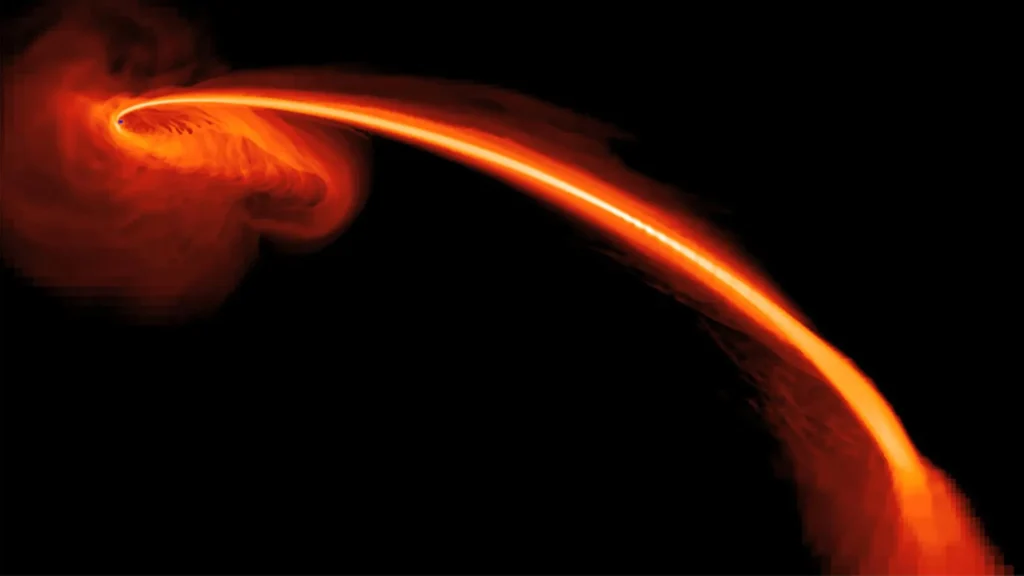
A hydrodynamical simulation of a star being ripped apart by the tidal forces of a supermassive black hole. Credit: NASA/ S. Gezari (JHU)/ J. Guillochon (UCSC).
Rapid Stellar Spin Changes the Result
The new research adds one crucial condition: rapid prograde rotation aligned with the star’s orbit.
An already fast-spinning star cannot gain the same large increase in rotation during each new passage. In some simulations, the tidal interaction even reduced its rotation during the first encounter. Afterward, its spin changed relatively little.
With no major spin increase, the debris fallback timescale stays more consistent. Meanwhile, the star loses progressively smaller amounts of material. The peak fallback rate then declines, producing the expected pattern behind fading black hole flares.
In the published study, the team tested this idea with hydrodynamical simulations of main-sequence stars. The models included stars with one and three times the Sun’s mass at different evolutionary stages. Each approached a simulated black hole with one million solar masses.
Rapid prograde rotation reproduced a declining fallback rate across several passages. In one model, the peak rate fell by about a factor of 1.5 between the first and second returns.
Still, fallback rate is not exactly the same as observed brightness. It measures how quickly debris returns toward the black hole. The way that material forms an accretion flow and releases radiation can also shape the final light curve.
The Hills Mechanism Could Explain the Fast Spin
Why would a star already rotate so quickly before entering such a tight orbit?
The Hills mechanism offers a possible answer. It begins with two stars orbiting closely around each other. When this binary system approaches a supermassive black hole, the strong gravitational field separates the pair. One star can leave the region at high speed, while the other enters a tight orbit around the black hole.
Very close binary stars can also become tidally locked. In that state, each star rotates once during every binary orbit. A compact pair has a short orbital period, so a tidally locked member must also spin rapidly.
One event could therefore explain two unusual features. The binary separation places the surviving star close to the black hole. Its earlier tidal locking supplies the rapid rotation needed to produce weaker flashes.
The researchers describe this connection as strong indirect evidence for Hills capture. It is not direct confirmation. Other processes may also place stars on tight orbits near galactic centers.
What Astronomers Need to Observe Next
The study offers a testable framework, but the known sample remains small. Several rpTDE systems also remain candidates rather than fully confirmed examples. Astronomers need more repeated cycles to establish whether the dimming continues.
Future monitoring should compare each flare’s peak brightness, recurrence time and spectrum. Optical, ultraviolet and X-ray observations can show how the debris flow changes between returns. NASA observations of AT2018fyk already demonstrate the value of this approach. Its renewed activity indicated that the star likely survived and completed another long orbit.
Researchers must also test more stellar masses, spin directions and black hole environments. A star rotating against its orbital motion may behave differently from the prograde examples in the new simulations.
Fading Black Hole Flares Could Reveal a Star’s Past
The new model turns a declining light signal into a record of stellar history. If rapid rotation explains fading black hole flares, astronomers may infer how a star behaved before its first observed passage. They may even uncover evidence of a former binary companion. Continued observations will show whether stellar spin and Hills capture truly explain these rare, repeating events.
Main Sources:
The Astrophysical Journal — The Role of Stellar Spin in Repeating Partial Tidal Disruption Events
https://doi.org/10.3847/1538-4357/ae8f31
Syracuse University — The Spin Behind Fading Black Hole Flares
https://artsandsciences.syracuse.edu/physics/news/the-spin-behind-fading-black-hole-flares/
NASA — NASA Telescopes Work Out Black Hole’s Snack Schedule
https://www.nasa.gov/image-article/nasa-telescopes-work-out-black-holes-snack-schedule/
NASA — NASA’s Swift Learns a New Trick, Spots a Snacking Black Hole
https://www.nasa.gov/universe/nasas-swift-learns-a-new-trick-spots-a-snacking-black-hole/